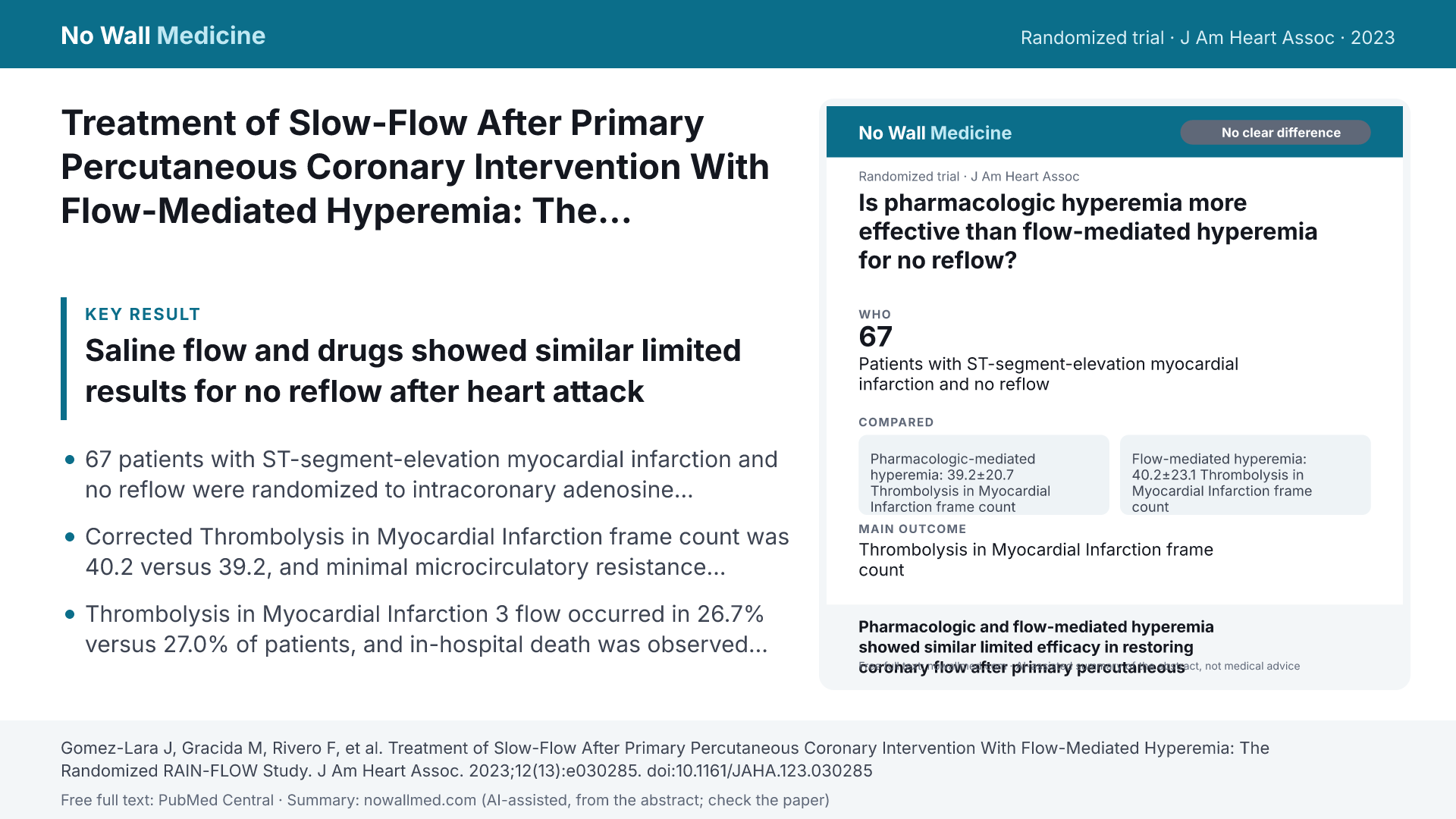
Saline flow and drugs showed similar limited results for no reflow after heart attack
Treatment of Slow-Flow After Primary Percutaneous Coronary Intervention With Flow-Mediated Hyperemia: The Randomized RAIN-FLOW Study
Randomized trialNo clear difference
Is pharmacologic hyperemia more effective than flow-mediated hyperemia for no reflow?
Who
67
Patients with ST-segment-elevation myocardial infarction and no reflow
Compared
Pharmacologic-mediated hyperemia: 39.2±20.7 Thrombolysis in Myocardial Infarction frame count
Flow-mediated hyperemia: 40.2±23.1 Thrombolysis in Myocardial Infarction frame count
Main outcome
Thrombolysis in Myocardial Infarction frame count
Bottom line: Pharmacologic and flow-mediated hyperemia showed similar limited efficacy in restoring coronary flow after primary percutaneous coronary intervention.
Limitation: Further research is warranted to prevent and treat no reflow.
J Am Heart Assoc · 2023-06-22 · Save PNG
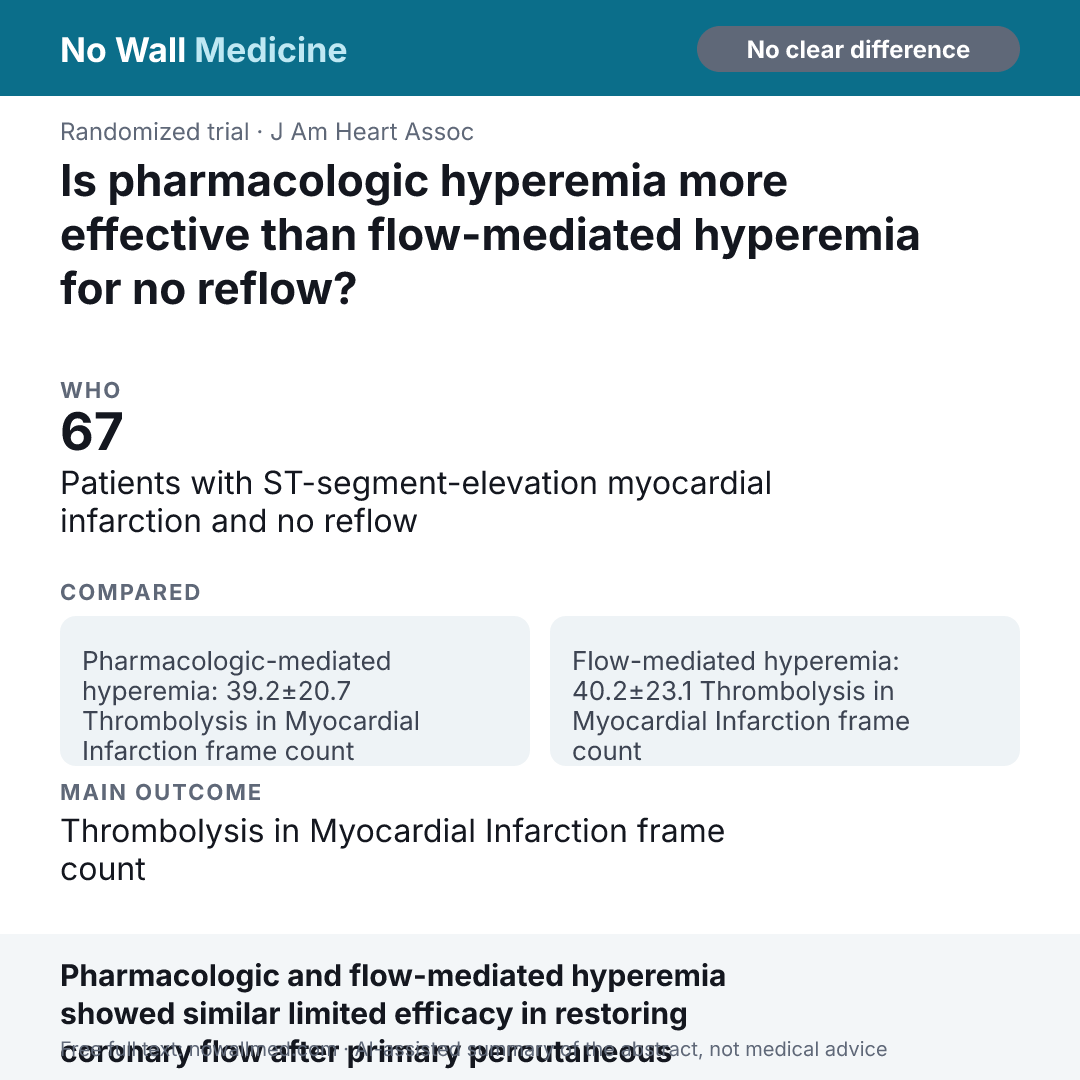
Clinical question: Is pharmacologic hyperemia more effective than flow-mediated hyperemia for no reflow?
Why it matters: Optimal treatment for no reflow after primary percutaneous coronary intervention remains unsettled despite several hyperemic drugs improving flow.
Key points
- 67 patients with ST-segment-elevation myocardial infarction and no reflow were randomized to intracoronary adenosine or nitroprusside versus saline infusion.
- Corrected Thrombolysis in Myocardial Infarction frame count was 40.2 versus 39.2, and minimal microcirculatory resistance was 753.6 versus 993.3 Wood units, with no significant difference.
- Thrombolysis in Myocardial Infarction 3 flow occurred in 26.7% versus 27.0% of patients, and in-hospital death was observed in 10.4%.
Headline and key points written with AI from the paper’s abstract, with every number checked against it. Read the paper before relying on them.
Was this summary helpful?
Subject terms
Headline, design, result, key points, caveat and citation as plain text.
Cite this article
Gomez-Lara J, Gracida M, Rivero F, et al. Treatment of Slow-Flow After Primary Percutaneous Coronary Intervention With Flow-Mediated Hyperemia: The Randomized RAIN-FLOW Study. J Am Heart Assoc. 2023;12(13):e030285. doi:10.1161/JAHA.123.030285
Spotted a mistake? Suggest a correction