High microcirculatory resistance after heart procedure is linked to larger heart damage and scarring
Microcirculatory Resistance After Primary Percutaneous Coronary Intervention Predicts Residual Myocardial Damage and Scar Formation
Post hoc analysis of a randomized trialBenefit found
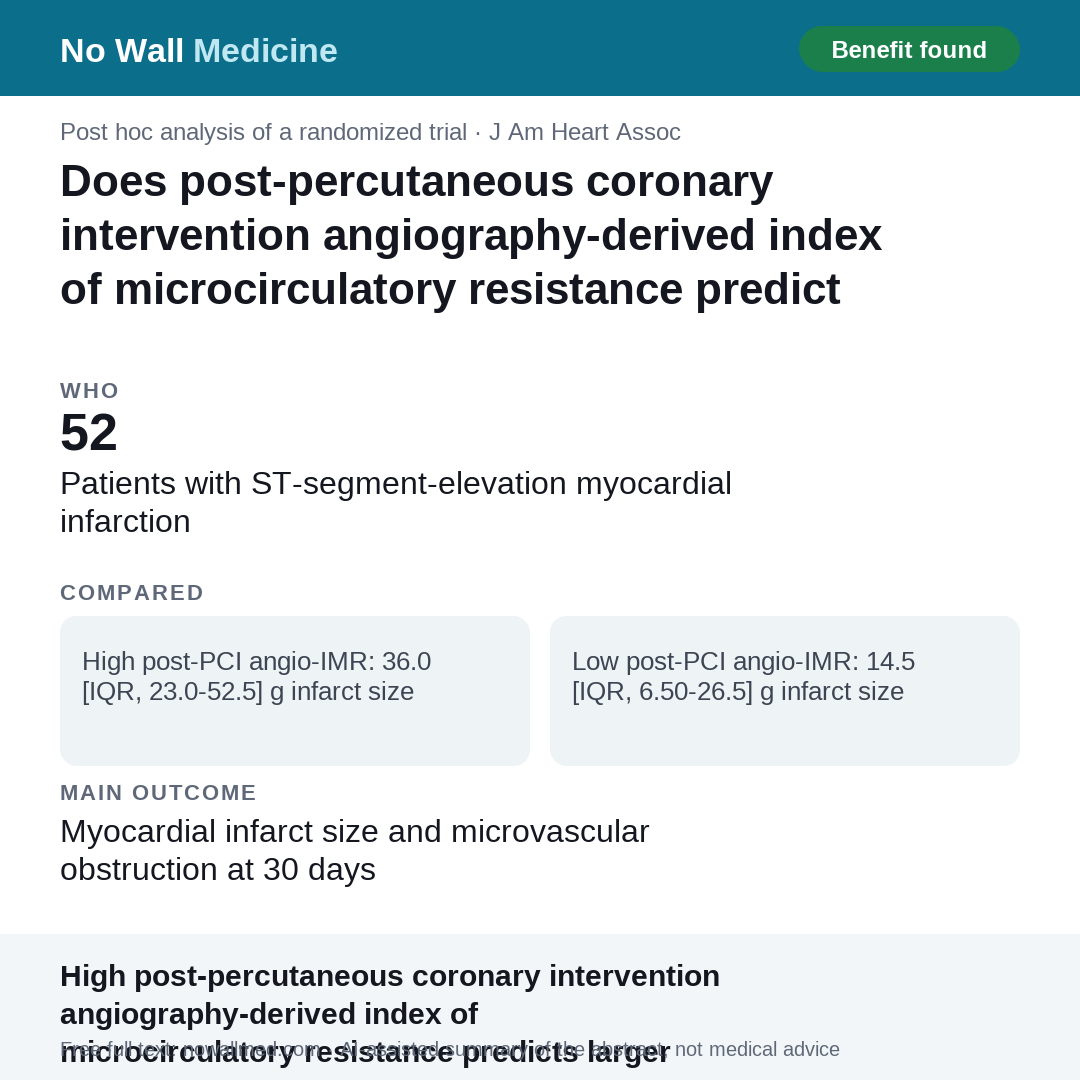
Does post-percutaneous coronary intervention angiography-derived index of microcirculatory resistance predict myocardial damage?
Who
52
Patients with ST-segment-elevation myocardial infarction
Compared
High post-PCI angio-IMR: 36.0 [IQR, 23.0-52.5] g infarct size
Low post-PCI angio-IMR: 14.5 [IQR, 6.50-26.5] g infarct size
Main outcome
Myocardial infarct size and microvascular obstruction at 30 days
Bottom line: High post-percutaneous coronary intervention angiography-derived index of microcirculatory resistance predicts larger myocardial infarct size and microvascular obstruction.
J Am Heart Assoc · 2025-02-08Download image
Clinical question: Does post-percutaneous coronary intervention angiography-derived index of microcirculatory resistance predict myocardial damage?
Why it matters: It is unknown if the angiography-derived index of microcirculatory resistance can predict the extent of heart muscle damage and scarring after a primary percutaneous coronary intervention.
Key points
- Researchers analyzed 52 patients with ST-segment-elevation myocardial infarction to measure the angiography-derived index of microcirculatory resistance, which assesses blood flow in small vessels.
- High resistance values were associated with a larger myocardial infarct size of 36.0 g compared to 14.5 g and a lower left ventricular ejection fraction of 46.5% versus 55.0%.
- High resistance was also linked to a greater extent of microvascular obstruction, which is the blockage of small blood vessels within the heart muscle.
Headline and key points written with AI from the paper’s abstract, with every number checked against it. Read the paper before relying on them.
Topics
Cite this article
Candreva A, Gotschy A, Stehli J, Bissig L, Lodi Rizzini M, Chiastra C. Microcirculatory Resistance After Primary Percutaneous Coronary Intervention Predicts Residual Myocardial Damage and Scar Formation. J Am Heart Assoc. 2025. doi:10.1161/JAHA.124.036033
Spotted a mistake? Suggest a correction
Top studies every Monday
The week’s key trials and guidelines in your specialties, by email. Free.
Get the weekly digest