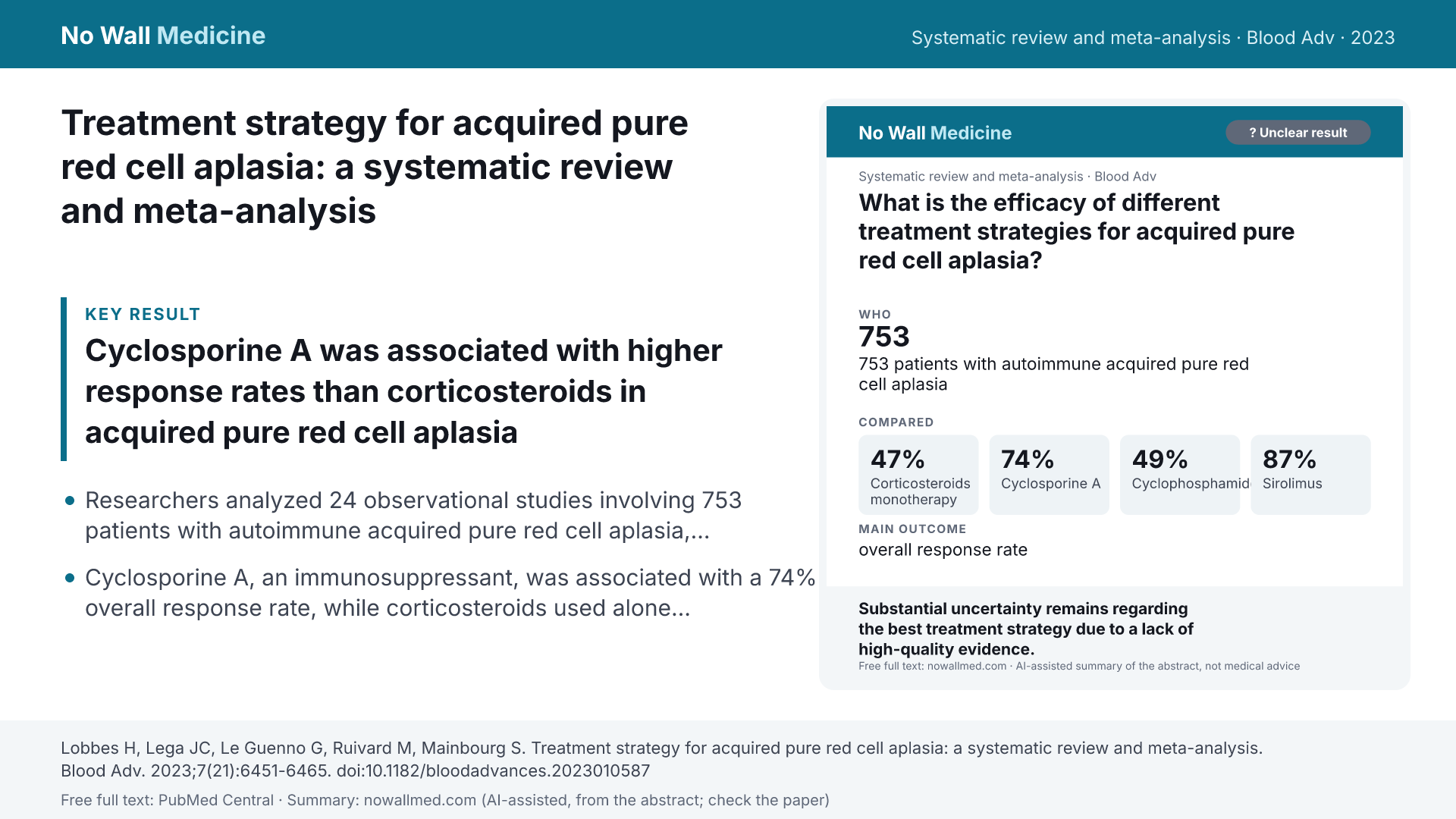
Cyclosporine A was associated with higher response rates than corticosteroids in acquired pure red cell aplasia
Treatment strategy for acquired pure red cell aplasia: a systematic review and meta-analysis
Systematic review and meta-analysisUnclear result
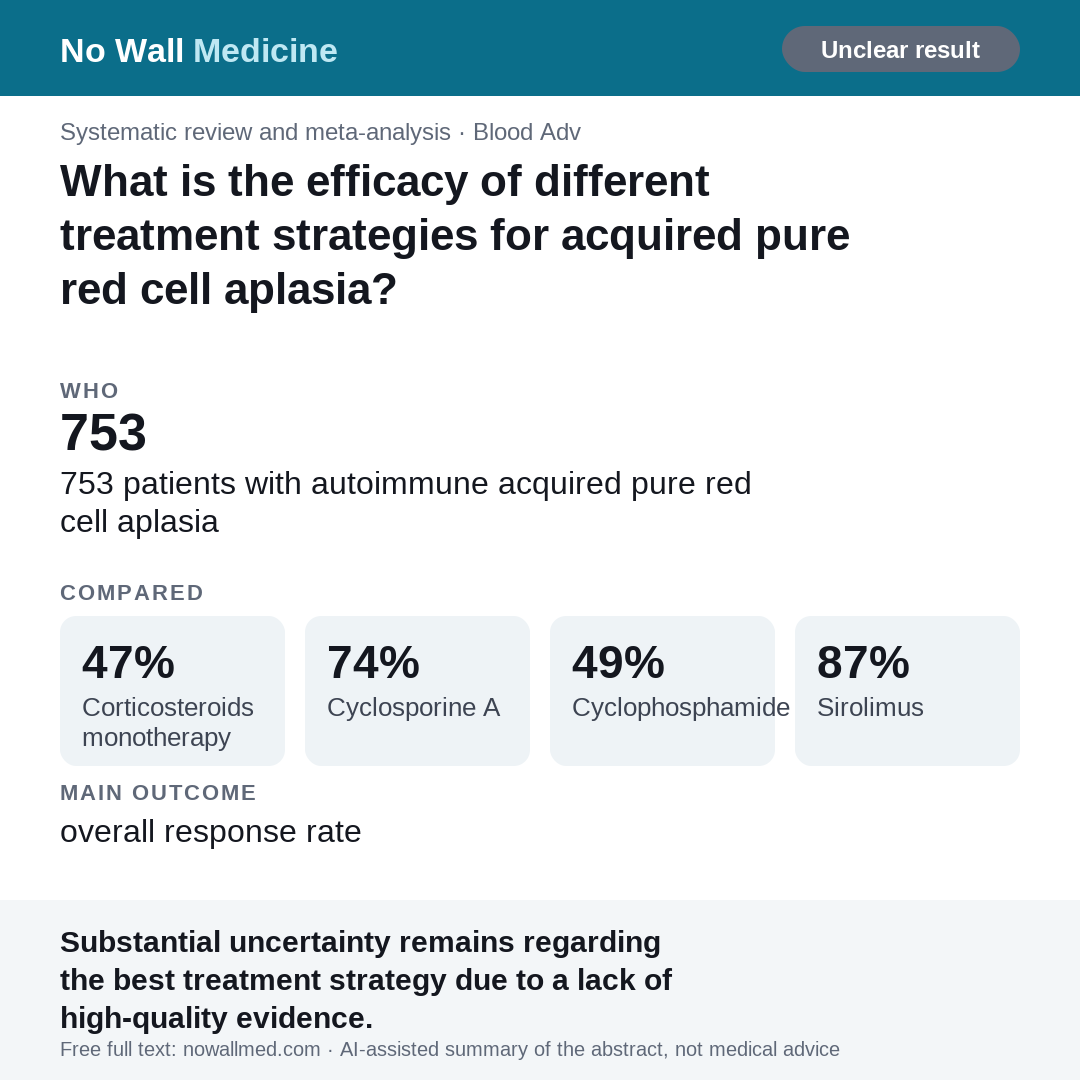
What is the efficacy of different treatment strategies for acquired pure red cell aplasia?
Who
753
753 patients with autoimmune acquired pure red cell aplasia
Compared
47%Corticosteroids monotherapy (95% confidence interval 34-60)
74%Cyclosporine A (95% CI 66-82)
49%Cyclophosphamide (95% CI 35-64)
87%Sirolimus (95% CI 68-100)
Main outcome
overall response rate
Bottom line: Substantial uncertainty remains regarding the best treatment strategy due to a lack of high-quality evidence.
Limitation: Moderate to high risk of bias and substantial heterogeneity in included observational studies.
Blood Adv · 2023-08-25Download image
Clinical question: What is the efficacy of different treatment strategies for acquired pure red cell aplasia?
Why it matters: Clinical guidelines for treating autoimmune acquired pure red cell aplasia rely on expert recommendations because controlled trials are currently unavailable.
Key points
- Researchers analyzed 24 observational studies involving 753 patients with autoimmune acquired pure red cell aplasia, a condition where the body attacks its own red blood cell precursors.
- Cyclosporine A, an immunosuppressant, was associated with a 74% overall response rate, while corticosteroids used alone as first-line treatment had a 47% response rate.
- Cyclophosphamide, a chemotherapy drug, was associated with a 49% response rate, and sirolimus was associated with an 87% response rate after cyclosporine A failure.
Limitation the authors note: The included studies were observational with moderate to high risk of bias and substantial heterogeneity.
Headline and key points written with AI from the paper’s abstract, with every number checked against it. Read the paper before relying on them.
Was this summary helpful?
Abstract
The treatment of autoimmune acquired pure red cell aplasia (aPRCA) is challenging. Guidelines are based on expert recommendations in the absence of controlled trials. We assessed the efficacy of the main treatment strategy through a systematic review and meta-analysis using MEDLINE, EMBASE, and the Cochrane Library up to September 2022. The overall response rate (ORR) was pooled using random-effects models. In total, 24 observational studies (19 retrospective, median follow-up of 48 months) encompassing 753 patients (49% male) were included. Primary aPRCA represented 57% of the cases. The risk of bias was moderate to high using the ROBINS-I tool. Substantial heterogeneity (I2 > 50%) was retrieved. Corticosteroids as monotherapy as first-line treatment (186 patients, 13 studies) provided an ORR of 47% (95% confidence interval [CI], 34-60). Cyclosporine A was the most frequently used immunosuppressant agent (384 patients, 18 studies), providing an ORR of 74% (95% CI, 66-82) with a similar ORR in first- (73%) and second-line (76%) treatment and when cyclosporin was used as monotherapy (83%) or with corticosteroids (77%). A total of 112 patients (10 studies) received cyclophosphamide, with an ORR of 49% (95% CI, 35-64), which was higher when cyclophosphamide was combined with corticosteroids (48%) and used in second-line treatment (58%) than in monotherapy (31%), and in first-line treatment (44%). Sirolimus use was reported only after cyclosporine A failure and provided an ORR of 87% (95% CI, 68-100; 64 patients, 3 studies). Substantial uncertainty remains regarding the best treatment strategy in the absence of high-quality evidence. This study was registered on the PROPERO database as #CRD42022360452.
Abstract reproduced under the article’s CC BY NC ND licence.
Subject terms
Cite this article
Lobbes H, Lega JC, Le Guenno G, Ruivard M, Mainbourg S. Treatment strategy for acquired pure red cell aplasia: a systematic review and meta-analysis. Blood Adv. 2023. doi:10.1182/bloodadvances.2023010587
Spotted a mistake? Suggest a correction