Human studies showed little difference between TAAR1 agonists and placebo for schizophrenia symptoms
Triangulating evidence from the GALENOS living systematic review on trace amine-associated receptor 1 (TAAR1) agonists in psychosis
Living systematic review triangulationMixed results
What is the evidence for trace amine-associated receptor 1 agonists in psychosis?
Who
1291
Adults with acute schizophrenia
Compared
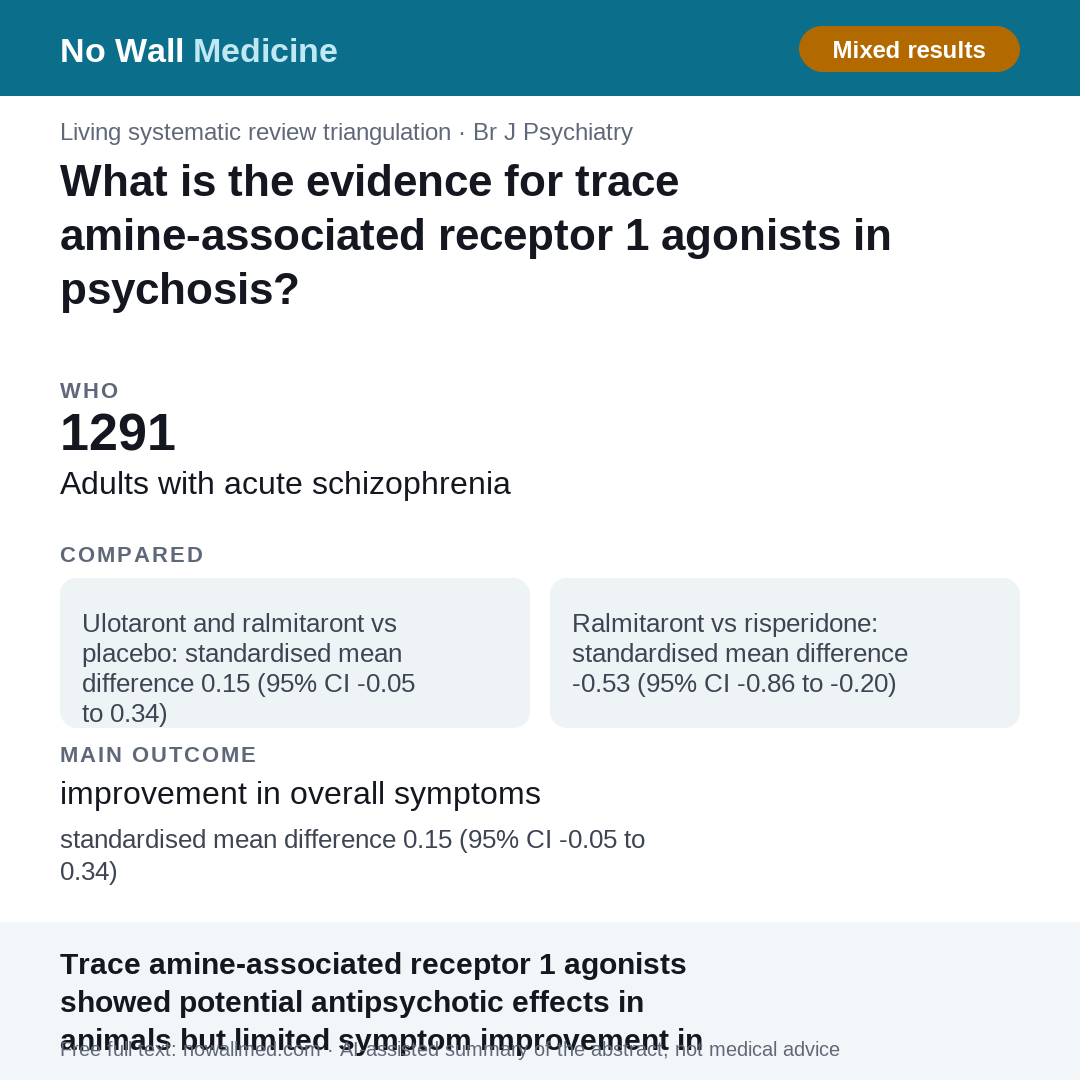
Ulotaront and ralmitaront vs placebo: standardised mean difference 0.15 (95% CI -0.05 to 0.34)
Ralmitaront vs risperidone: standardised mean difference -0.53 (95% CI -0.86 to -0.20)
Main outcome
improvement in overall symptoms
Result: standardised mean difference 0.15 (95% CI -0.05 to 0.34)
Bottom line: Trace amine-associated receptor 1 agonists showed potential antipsychotic effects in animals but limited symptom improvement in human schizophrenia studies.
Limitation: Difficulties assessing risk of bias, reproducibility, and translating animal models to clinical outcomes.
Br J Psychiatry · 2024-12-23Download image
Clinical question: What is the evidence for trace amine-associated receptor 1 agonists in psychosis?
Why it matters: Uncertainty exists regarding the effects, exact mechanism of action, and potential role of trace amine-associated receptor 1 (TAAR1) agonists in treating psychosis.
Key points
- Experts appraised living systematic reviews of animal and human studies regarding trace amine-associated receptor 1 (TAAR1) agonists for psychosis.
- Four human studies with 1291 participants found no significant difference between ulotaront or ralmitaront and placebo for schizophrenia symptoms (SMD 0.15, 95% CI -0.05 to 0.34).
- One study of 156 participants showed ralmitaront was less efficacious than the antipsychotic risperidone (SMD = -0.53, 95% CI -0.86 to -0.20).
Limitation the authors note: Challenges included difficulties in assessing risk of bias, reproducibility, and the translation of animal models to clinical outcomes.
Headline and key points written with AI from the paper’s abstract, with every number checked against it. Read the paper before relying on them.
Was this summary helpful?
Subject terms
Cite this article
Smith KA, Boyce N, Chevance A, Chiocchia V, Correll CU, Donoghue K. Triangulating evidence from the GALENOS living systematic review on trace amine-associated receptor 1 (TAAR1) agonists in psychosis. Br J Psychiatry. 2024. doi:10.1192/bjp.2024.237
Spotted a mistake? Suggest a correction
Top studies every Monday
The week’s key trials and guidelines in your specialties, plus any topics you follow. By email, free.
Get the weekly digest