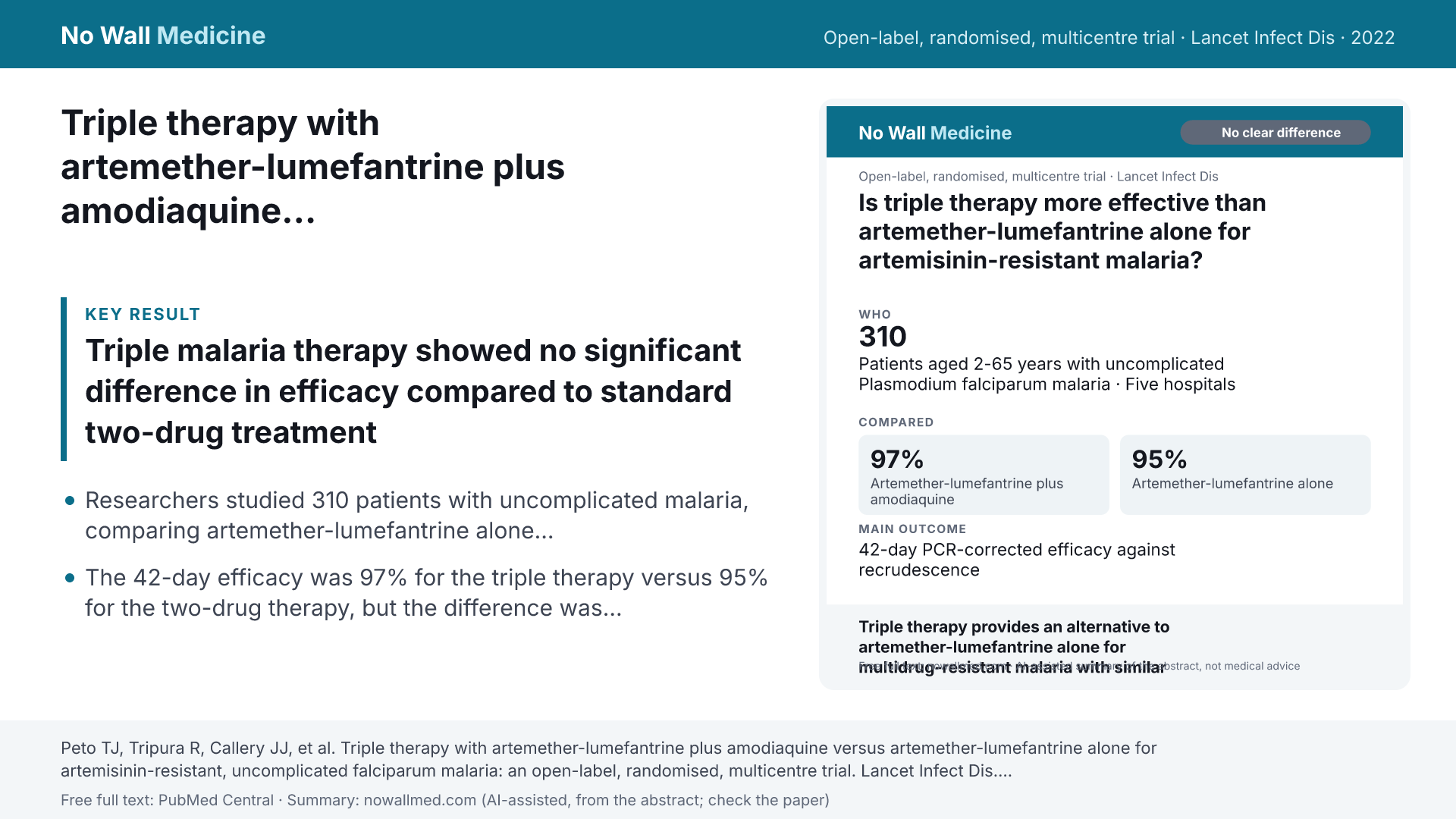
Triple malaria therapy showed no significant difference in efficacy compared to standard two-drug treatment
Triple therapy with artemether-lumefantrine plus amodiaquine versus artemether-lumefantrine alone for artemisinin-resistant, uncomplicated falciparum malaria: an open-label, randomised, multicentre trial
Open-label, randomised, multicentre trialNo clear difference
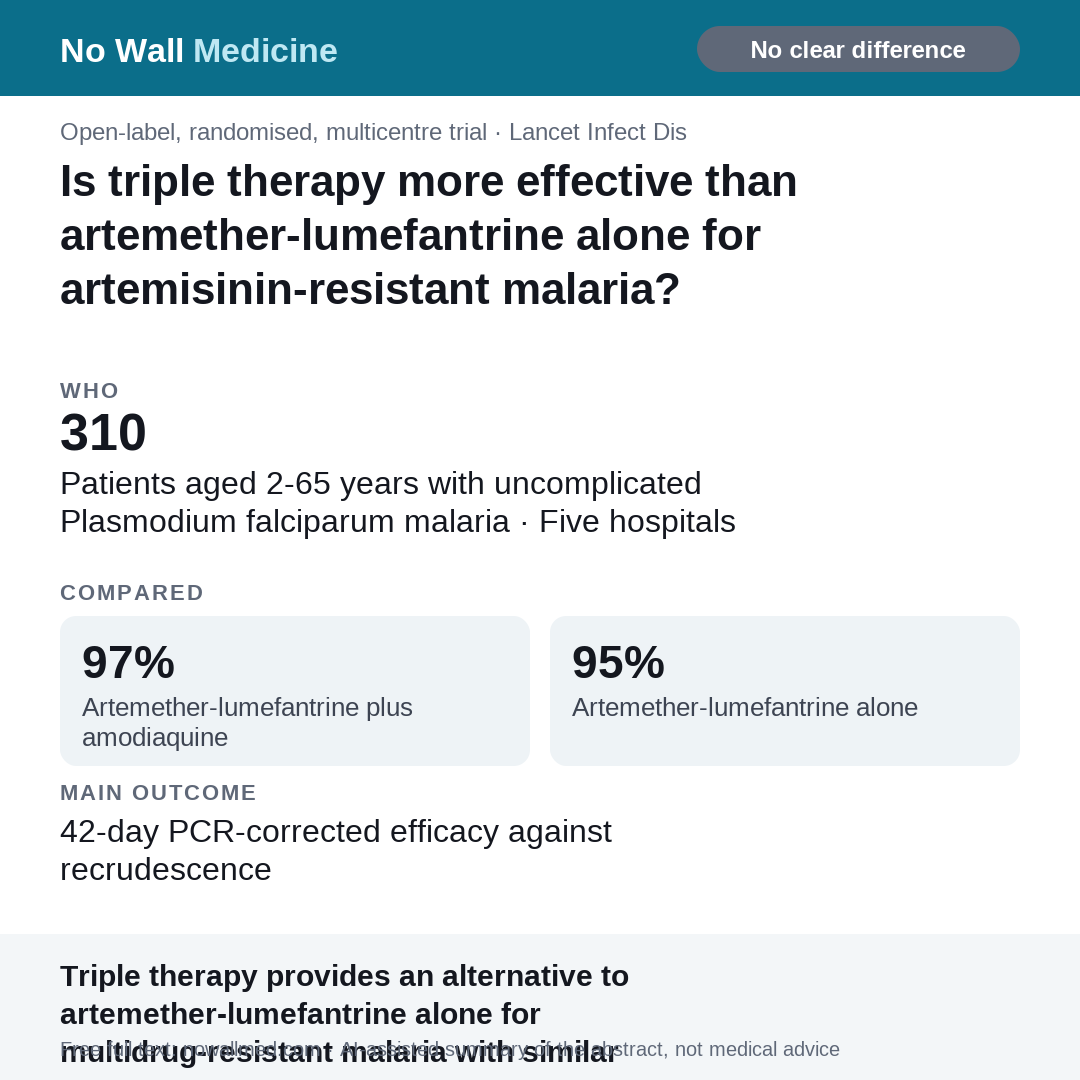
Is triple therapy more effective than artemether-lumefantrine alone for artemisinin-resistant malaria?
Who
310
Patients aged 2-65 years with uncomplicated Plasmodium falciparum malaria · Five hospitals or health centres in Cambodia and Vietnam
Compared
97%Artemether-lumefantrine plus amodiaquine (151/156)
95%Artemether-lumefantrine alone (146/154)
Main outcome
42-day PCR-corrected efficacy against recrudescence
Result: hazard ratio 0·6 (95% CI 0·2-1·9)
Bottom line: Triple therapy provides an alternative to artemether-lumefantrine alone for multidrug-resistant malaria with similar efficacy.
Funded by: Bill & Melinda Gates Foundation, Wellcome Trust
Lancet Infect Dis · 2022-03-08Download image
Clinical question: Is triple therapy more effective than artemether-lumefantrine alone for artemisinin-resistant malaria?
Why it matters: Late treatment failures for malaria have increased in the Greater Mekong subregion due to rising resistance to standard artemisinin-based combination therapies.
Key points
- Researchers studied 310 patients with uncomplicated malaria, comparing artemether-lumefantrine alone to artemether-lumefantrine plus amodiaquine.
- The 42-day efficacy was 97% for the triple therapy versus 95% for the two-drug therapy, but the difference was not statistically significant (p=0.38).
- The triple therapy group had more mild gastrointestinal side effects, including vomiting (8% versus 2%) and nausea (7% versus 2%).
Headline and key points written with AI from the paper’s abstract, with every number checked against it. Read the paper before relying on them.
Was this summary helpful?
Abstract
Background
Late treatment failures after artemisinin-based combination therapies (ACTs) for falciparum malaria have increased in the Greater Mekong subregion in southeast Asia. Addition of amodiaquine to artemether-lumefantrine could provide an efficacious treatment for multidrug-resistant infections. Methods
We conducted an open-label, randomised trial at five hospitals or health centres in three locations (western Cambodia, eastern Cambodia, and Vietnam). Eligible participants were male and female patients aged 2-65 years with uncomplicated Plasmodium falciparum malaria. Patients were randomly allocated (1:1 in blocks of eight to 12) to either artemether-lumefantrine alone (dosed according to WHO guidelines) or artemether-lumefantrine plus amodiaquine (10 mg base per kg/day), both given orally as six doses over 3 days. All received a single dose of primaquine (0·25 mg/kg) 24 h after the start of study treatment to limit transmission of the parasite. Parasites were genotyped, identifying artemisinin resistance. The primary outcome was Kaplan-Meier 42-day PCR-corrected efficacy against recrudescence of the original parasite, assessed by intent-to-treat. Safety was a secondary outcome. This completed trial is registered at ClinicalTrials.gov (NCT03355664). Findings
Between March 18, 2018, and Jan 30, 2020, 310 patients received randomly allocated treatment; 154 received artemether-lumefantrine alone and 156 received artemether-lumefantrine plus amodiaquine. Parasites from 305 of these patients were genotyped. 42-day PCR-corrected treatment efficacy was noted in 151 (97%, 95% CI 92-99) of 156 patients with artemether-lumefantrine plus amodiaquine versus 146 (95%, 89-97) of 154 patients with artemether-lumefantrine alone; hazard ratio (HR) for recrudescence 0·6 (95% CI 0·2-1·9, p=0·38). Of the 13 recrudescences, 12 were in 174 (57%) of 305 infections with pfkelch13 mutations indicating artemisinin resistance, for which 42-day efficacy was noted in 89 (96%) of 93 infections with artemether-lumefantrine plus amodiaquine versus 73 (90%) of 81 infections with artemether-lumefantrine alone; HR for recrudescence 0·44 (95% CI 0·14-1·40, p=0·17). Artemether-lumefantrine plus amodiaquine was generally well tolerated, but the number of mild (grade 1-2) adverse events, mainly gastrointestinal, was greater in this group compared with artemether-lumefantrine alone (vomiting, 12 [8%] with artemether-lumefantrine plus amodiaquine vs three [2%] with artemether-lumefantrine alone, p=0·03; and nausea, 11 [7%] with artemether-lumefantrine plus amodiaquine vs three [2%] with artemether-lumefantrine alone, p=0·05). Early vomiting within 1 h of treatment, requiring retreatment, occurred in no patients of 154 with artemether-lumefantrine alone versus five (3%) of 156 with artemether-lumefantrine plus amodiaquine, p=0·06. Bradycardia (≤54 beats/min) of any grade was noted in 59 (38%) of 154 patients with artemether-lumefantrine alone and 95 (61%) of 156 with artemether-lumefantrine plus amodiaquine, p=0·0001. Interpretation
Artemether-lumefantrine plus amodiaquine provides an alternative to artemether-lumefantrine alone as first-line treatment for multidrug-resistant P falciparum malaria in the Greater Mekong subregion, and could prolong the therapeutic lifetime of artemether-lumefantrine in malaria-endemic populations. Funding
Bill & Melinda Gates Foundation, Wellcome Trust.
Abstract reproduced under the article’s CC BY licence.
Subject terms
Cite this article
Peto TJ, Tripura R, Callery JJ, Lek D, Nghia HDT, Nguon C. Triple therapy with artemether-lumefantrine plus amodiaquine versus artemether-lumefantrine alone for artemisinin-resistant, uncomplicated falciparum malaria: an open-label, randomised, multicentre trial. Lancet Infect Dis. 2022. doi:10.1016/S1473-3099(21)00692-7
Spotted a mistake? Suggest a correction