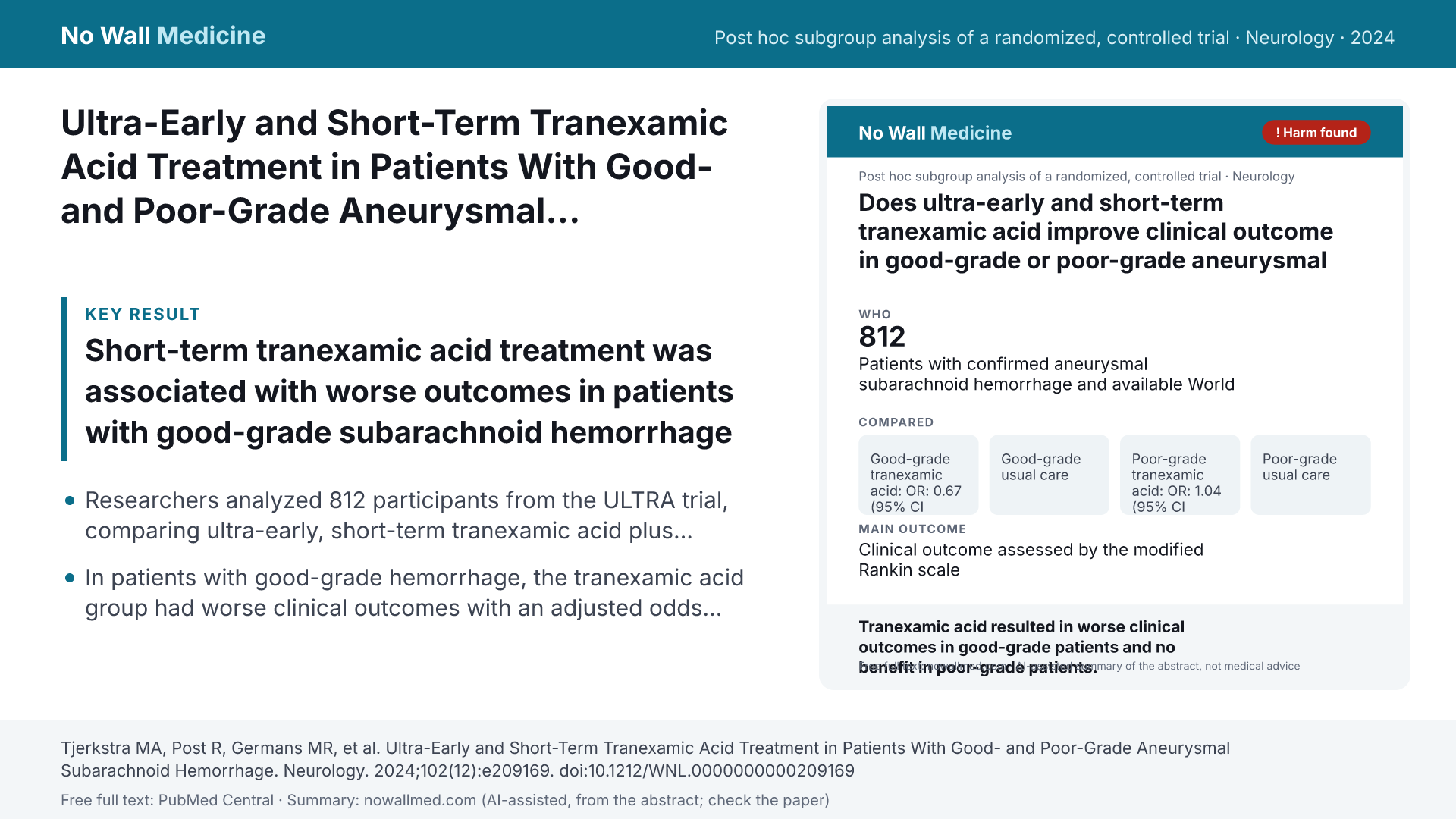
Short-term tranexamic acid treatment was associated with worse outcomes in patients with good-grade subarachnoid hemorrhage
Ultra-Early and Short-Term Tranexamic Acid Treatment in Patients With Good- and Poor-Grade Aneurysmal Subarachnoid Hemorrhage
Post hoc subgroup analysis of a randomized, controlled trialHarm found
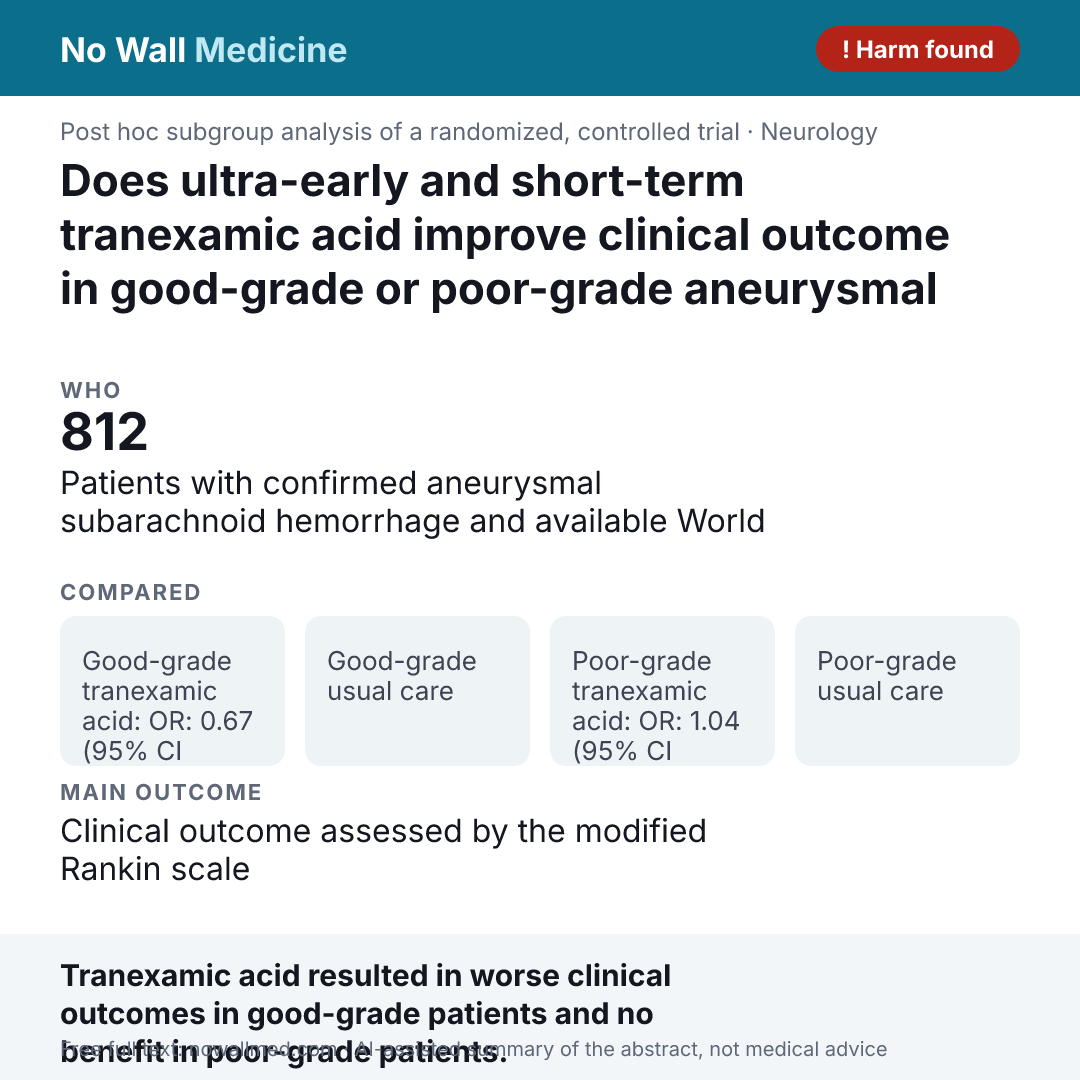
Does ultra-early and short-term tranexamic acid improve clinical outcome in good-grade or poor-grade aneurysmal subarachnoid hemorrhage?
Who
812
Patients with confirmed aneurysmal subarachnoid hemorrhage and available World Federation of Neurosurgical Societies grade · Multicenter
Compared
Good-grade tranexamic acid: OR: 0.67 (95% CI 0.48-0.94)
Good-grade usual care
Poor-grade tranexamic acid: OR: 1.04 (95% CI 0.70-1.55)
Poor-grade usual care
Main outcome
Clinical outcome assessed by the modified Rankin scale
Result: aOR 0.68 (95% CI 0.48-0.94) for good-grade; aOR 1.05 (95% CI 0.70-1.56) for poor-grade
Bottom line: Tranexamic acid resulted in worse clinical outcomes in good-grade patients and no benefit in poor-grade patients.
Neurology · 2024-05-24 · NCT02684812
Limitation the authors note: This was a post hoc subgroup analysis.
Headline and visual abstract written with AI from the paper’s abstract, with every number checked against it. Read the paper before relying on them.
Was this summary helpful?
Subject terms
Cite this article
Tjerkstra MA, Post R, Germans MR, et al. Ultra-Early and Short-Term Tranexamic Acid Treatment in Patients With Good- and Poor-Grade Aneurysmal Subarachnoid Hemorrhage. Neurology. 2024;102(12):e209169. doi:10.1212/WNL.0000000000209169
Spotted a mistake? Suggest a correction