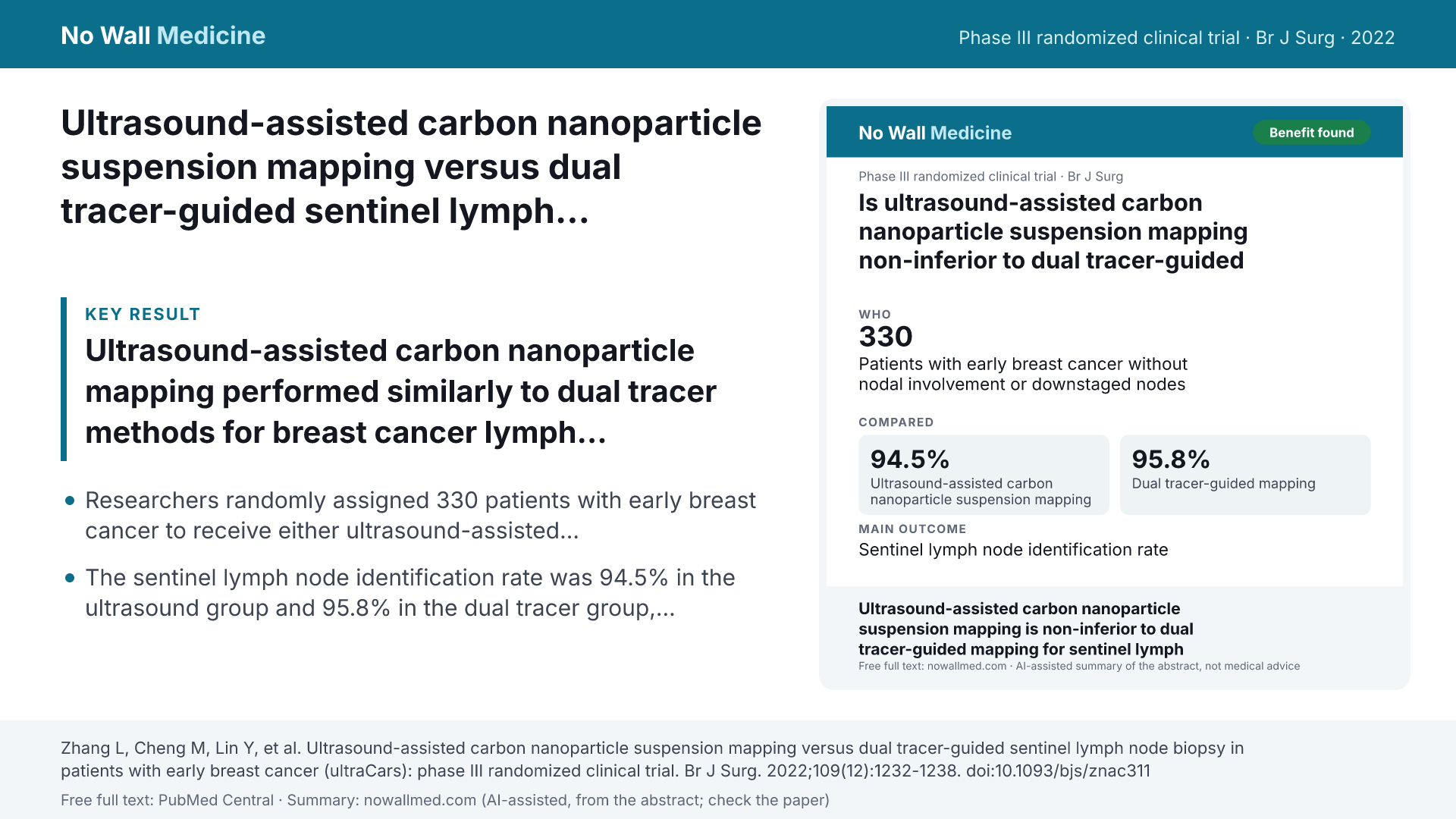
Ultrasound-assisted carbon nanoparticle mapping performed similarly to dual tracer methods for breast cancer lymph node identification
Ultrasound-assisted carbon nanoparticle suspension mapping versus dual tracer-guided sentinel lymph node biopsy in patients with early breast cancer (ultraCars): phase III randomized clinical trial
Phase III randomized clinical trialBenefit found
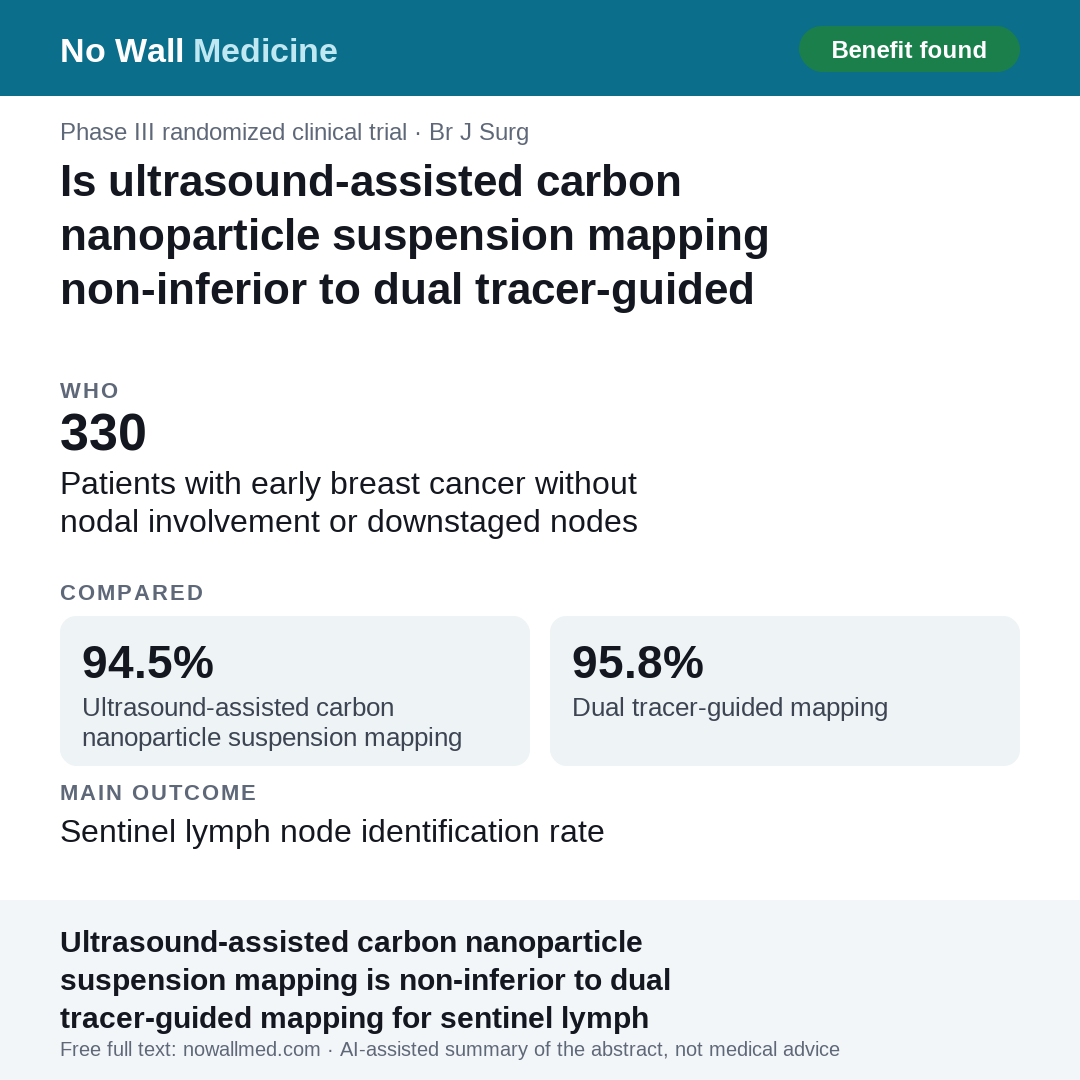
Is ultrasound-assisted carbon nanoparticle suspension mapping non-inferior to dual tracer-guided mapping?
Who
330
Patients with early breast cancer without nodal involvement or downstaged nodes
Compared
94.5%Ultrasound-assisted carbon nanoparticle suspension mapping (95% confidence interval 90.9 to 98.0%)
95.8%Dual tracer-guided mapping (92.7 to 98.9%)
Main outcome
Sentinel lymph node identification rate
Result: -1.3% (-5.9 to 3.3%)
Bottom line: Ultrasound-assisted carbon nanoparticle suspension mapping is non-inferior to dual tracer-guided mapping for sentinel lymph node identification.
Br J Surg · 2022-09-09Download image
Clinical question: Is ultrasound-assisted carbon nanoparticle suspension mapping non-inferior to dual tracer-guided mapping?
Why it matters: It was unknown if ultrasound-assisted carbon nanoparticle suspension mapping is as effective as dual tracer-guided mapping for identifying sentinel lymph nodes in early breast cancer.
Key points
- Researchers randomly assigned 330 patients with early breast cancer to receive either ultrasound-assisted carbon nanoparticle suspension mapping or dual tracer-guided mapping using carbon nanoparticles plus indocyanine green.
- The sentinel lymph node identification rate was 94.5% in the ultrasound group and 95.8% in the dual tracer group, meeting the criteria for non-inferiority.
- No significant differences were found between groups regarding the rate of metastatic nodes, the number of lymph nodes harvested, or the duration of surgery.
Headline and key points written with AI from the paper’s abstract, with every number checked against it. Read the paper before relying on them.
Was this summary helpful?
Subject terms
Cite this article
Zhang L, Cheng M, Lin Y, Zhang J, Shen B, Chen Y. Ultrasound-assisted carbon nanoparticle suspension mapping versus dual tracer-guided sentinel lymph node biopsy in patients with early breast cancer (ultraCars): phase III randomized clinical trial. Br J Surg. 2022. doi:10.1093/bjs/znac311
Spotted a mistake? Suggest a correction
Top studies every Monday
The week’s key trials and guidelines in your specialties, plus any topics you follow. By email, free.
Get the weekly digest