Transcranial pulse stimulation showed cognitive benefits in younger patients with Alzheimer disease
Ultrasound Neuromodulation With Transcranial Pulse Stimulation in Alzheimer Disease: A Randomized Clinical Trial
Randomized, double-blind, sham-controlled, crossover clinical trialMixed results
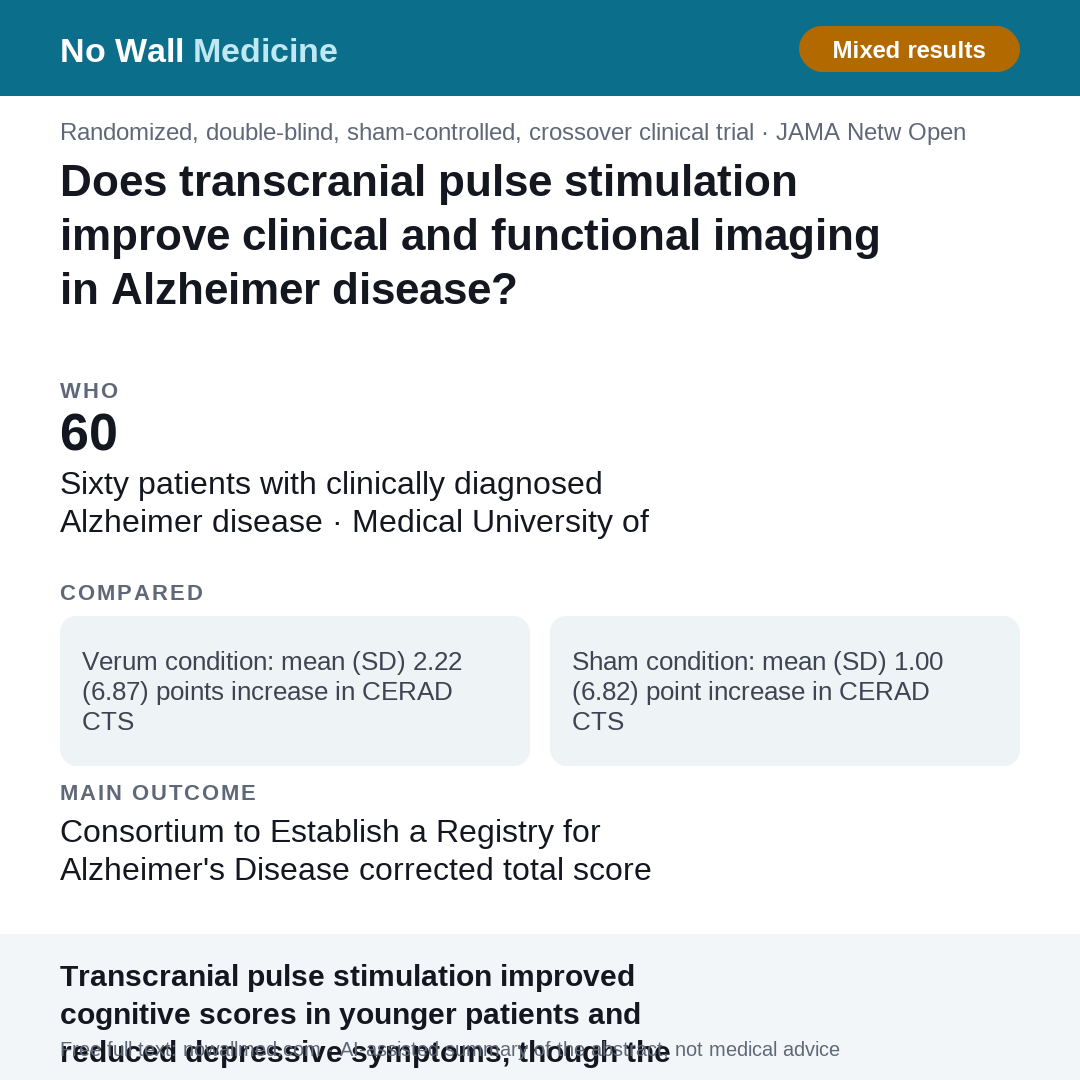
Does transcranial pulse stimulation improve clinical and functional imaging in Alzheimer disease?
Who
60
Sixty patients with clinically diagnosed Alzheimer disease · Medical University of Vienna
Compared
Verum condition: mean (SD) 2.22 (6.87) points increase in CERAD CTS
Sham condition: mean (SD) 1.00 (6.82) point increase in CERAD CTS
Main outcome
Consortium to Establish a Registry for Alzheimer's Disease corrected total score
Bottom line: Transcranial pulse stimulation improved cognitive scores in younger patients and reduced depressive symptoms, though the overall interaction was not significant.
Limitation: The primary data analysis of the condition by session interaction was not significant.
JAMA Netw Open · 2025-02-03Download image
Clinical question: Does transcranial pulse stimulation improve clinical and functional imaging in Alzheimer disease?
Why it matters: The potential of ultrasound neuromodulation as an additional therapy for Alzheimer disease remains unknown due to its early stage of research.
Key points
- Sixty patients with Alzheimer disease were randomized in a crossover trial to receive either transcranial pulse stimulation or a sham treatment.
- In the younger subgroup aged 70 years or less, the primary cognitive score increased by a mean of 3.91 (7.86) points after stimulation.
- The study also found higher brain activation in certain areas and a reduction in depression scores 3 months after the active treatment.
Headline and key points written with AI from the paper’s abstract, with every number checked against it. Read the paper before relying on them.
Was this summary helpful?
Subject terms
Cite this article
Matt E, Mitterwallner M, Radjenovic S, Grigoryeva D, Weber A, Stögmann E. Ultrasound Neuromodulation With Transcranial Pulse Stimulation in Alzheimer Disease: A Randomized Clinical Trial. JAMA Netw Open. 2025. doi:10.1001/jamanetworkopen.2024.59170
Spotted a mistake? Suggest a correction
Top studies every Monday
The week’s key trials and guidelines in your specialties, plus any topics you follow. By email, free.
Get the weekly digest