Machine learning identifies four distinct clinical profiles of postthrombotic syndrome in patients
Untangling profiles of postthrombotic syndrome using unsupervised machine learning
Randomized trial analysisMixed results
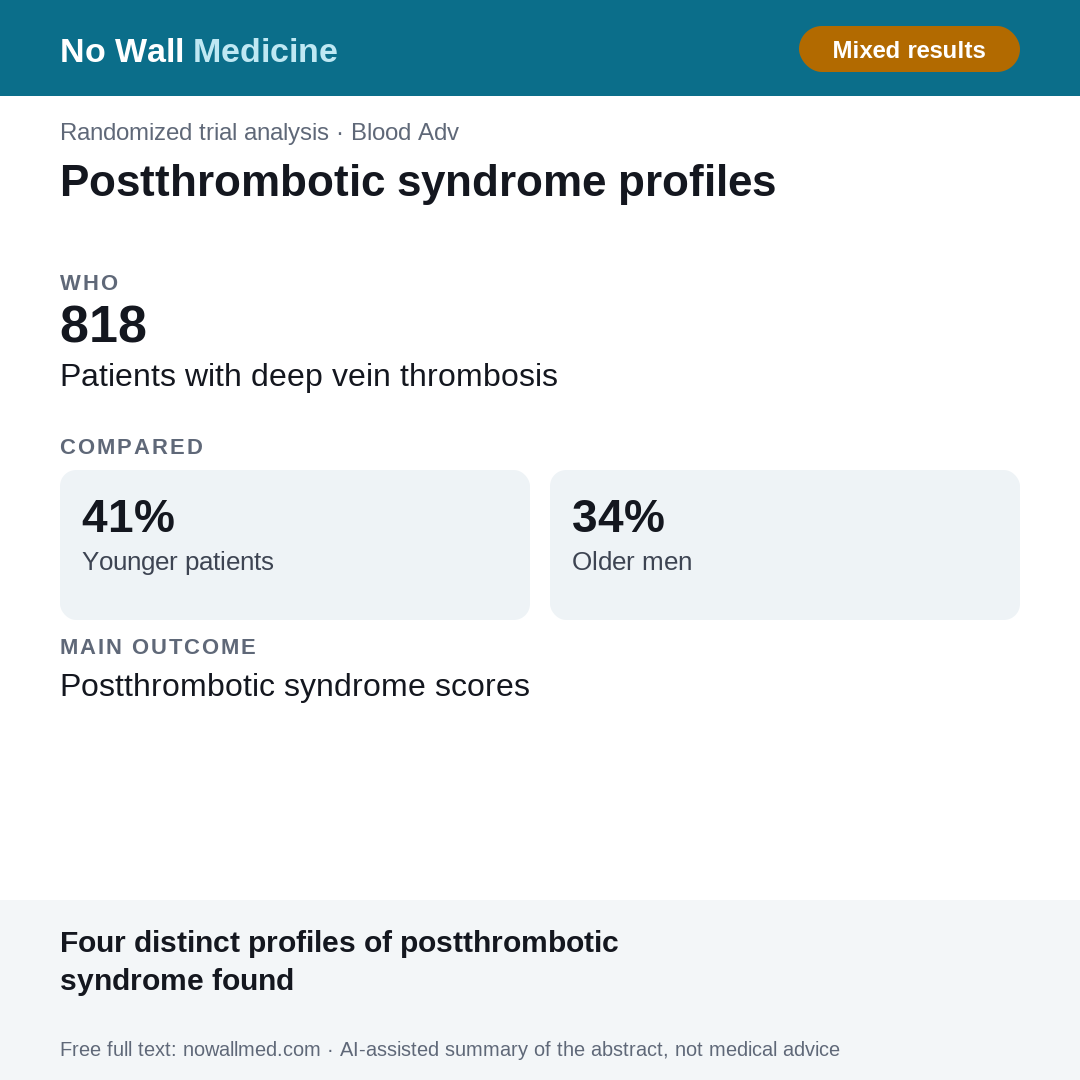
Postthrombotic syndrome profiles
Who
818
Patients with deep vein thrombosis
Compared
41%Younger patients (≥ 3 symptoms)
34%Older men (≥ 3 signs)
Main outcome
Postthrombotic syndrome scores
Bottom line: Four distinct profiles of postthrombotic syndrome found
Blood Adv · 2025-03-15Download image
Why it matters: It is unknown how much clinical variety exists within postthrombotic syndrome and whether the Villalta scale distinguishes between physical signs and patient symptoms.
Key points
- Researchers analyzed 818 patients from the IDEAL deep vein thrombosis study using unsupervised machine learning to identify different patterns of postthrombotic syndrome.
- The analysis identified four profiles, including younger patients with provoked deep vein thrombosis and older men with diabetes and femoral vein involvement.
- At 6 months, profile 1 had more symptoms (41% with a Villalta score ≥ 3) compared to profile 4 (21% with a Villalta score ≥ 3).
Headline and key points written with AI from the paper’s abstract, with every number checked against it. Read the paper before relying on them.
Abstract
Postthrombotic syndrome (PTS) is a chronic condition that can develop after deep vein thrombosis (DVT) and is diagnosed using the Villalta scale. This study applied unsupervised machine learning to investigate the heterogeneity of PTS among patients and within the Villalta scale. In 818 patients from the IDEAL DVT study, clustering identified 4 clinical profiles: (1) younger patients with provoked DVT, (2) women with joint pain, (3) men with isolated popliteal DVT, and (4) older men with diabetes and femoral vein involvement. Clustering of Villalta items revealed a distinction between signs and symptoms. Sign scores increased with older age, male sex, higher body mass index (BMI), and DVT extent, whereas symptom scores increased with younger age, female sex, higher BMI, and provoked DVT. Residual venous obstruction was significantly associated with the sign score (odds ratio, 1.18 per point) but not the symptom score. Quality of life was related to the symptom score more than the sign score. At 6 months, sign and symptom scores differed significantly across profiles, especially between profile 1 and 4, because the former had most symptoms (41% vs 21% ≥ 3; P < .001), whereas the latter had most signs (18% vs 34% ≥ 3; P = .004]). After 2 years, symptoms decreased in profile 1 but increased in profile 4. Other profiles showed intermediate scores over time. These findings suggest that reappraising the PTS scoring system to distinguish its dimensions would enable more personalized risk prediction and prevention. This trial was registered at www.ClinicalTrials.gov as #NCT01429714.
Abstract reproduced under the article’s CC BY NC ND licence.
Topics
Cite this article
Iding AFJ, Ten Cate V, Ten Cate H, Wild PS, Ten Cate-Hoek AJ. Untangling profiles of postthrombotic syndrome using unsupervised machine learning. Blood Adv. 2025. doi:10.1182/bloodadvances.2025015829
Spotted a mistake? Suggest a correction
Top studies every Monday
The week’s key trials and guidelines in your specialties, by email. Free.
Get the weekly digest