Upper-arm access for secondary site during heart valve implantation was associated with less bleeding
Upper- vs Lower-Extremity Secondary Access During Transcatheter Aortic Valve Implantation: A Randomized Clinical Trial
Randomized clinical trialBenefit found
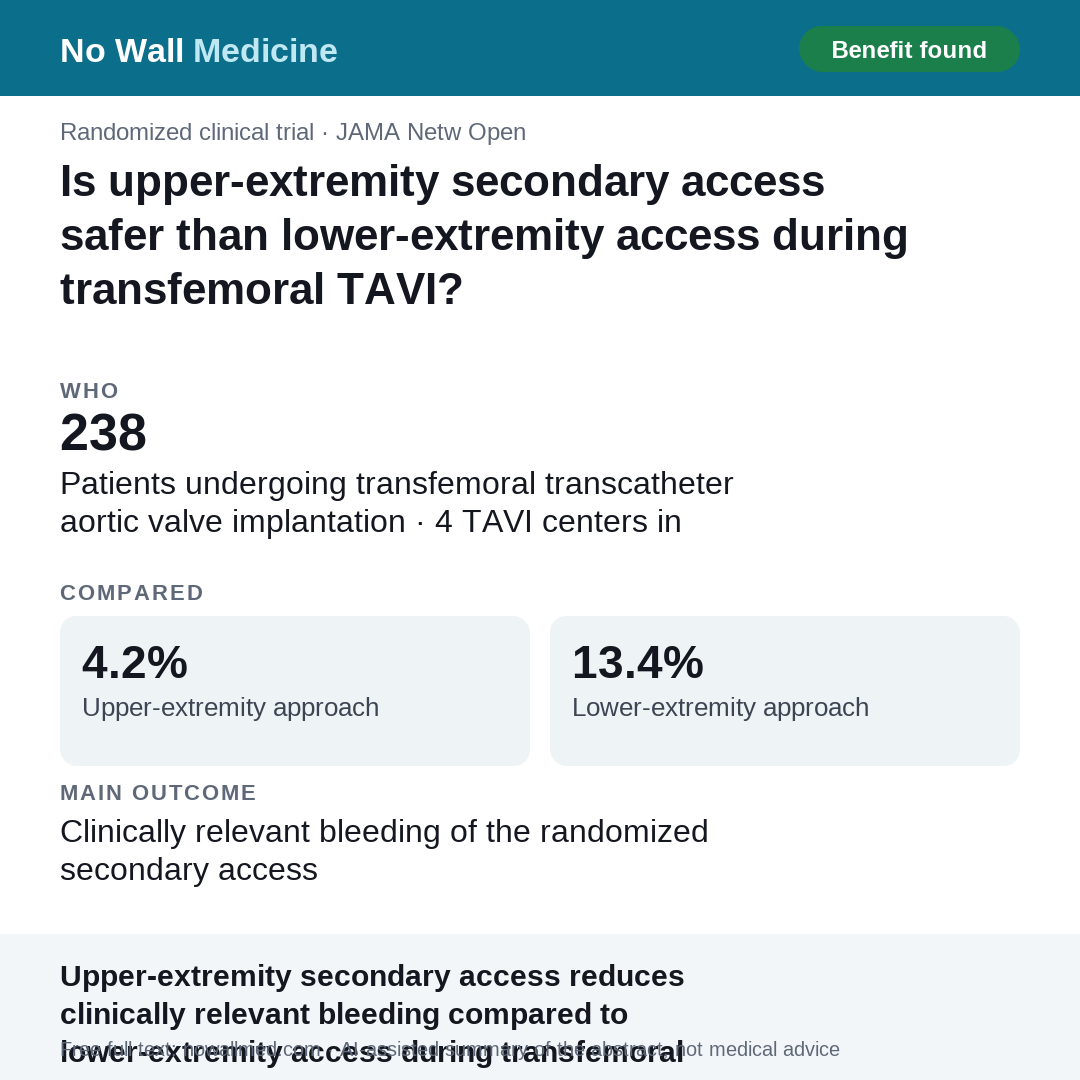
Is upper-extremity secondary access safer than lower-extremity access during transfemoral TAVI?
Who
238
Patients undergoing transfemoral transcatheter aortic valve implantation · 4 TAVI centers in the Netherlands
Compared
4.2%Upper-extremity approach
13.4%Lower-extremity approach
Main outcome
Clinically relevant bleeding of the randomized secondary access
Result: odds ratio 0.28 (95% CI 0.10-0.80)
Bottom line: Upper-extremity secondary access reduces clinically relevant bleeding compared to lower-extremity access during transfemoral TAVI.
JAMA Netw Open · 2024-10-01Download image
Clinical question: Is upper-extremity secondary access safer than lower-extremity access during transfemoral TAVI?
Why it matters: It was unknown if using the arm instead of the leg for secondary access during heart valve implantation could reduce bleeding complications.
Key points
- Researchers randomized 238 patients undergoing transfemoral transcatheter aortic valve implantation to either an upper-extremity or lower-extremity approach for secondary access.
- Clinically relevant bleeding occurred in 4.2% of the upper-extremity group compared to 13.4% in the lower-extremity group.
- The upper-extremity approach was associated with higher rates of secondary access failure and longer procedural times.
Headline and key points written with AI from the paper’s abstract, with every number checked against it. Read the paper before relying on them.
Topics
Cite this article
Versteeg GAA, Rooijakkers MJP, Hemelrijk KI, Vlaar PJ, Overduin DC, van Wely MH. Upper- vs Lower-Extremity Secondary Access During Transcatheter Aortic Valve Implantation: A Randomized Clinical Trial. JAMA Netw Open. 2024. doi:10.1001/jamanetworkopen.2024.38578
Spotted a mistake? Suggest a correction
Top studies every Monday
The week’s key trials and guidelines in your specialties, plus any topics you follow. By email, free.
Get the weekly digest