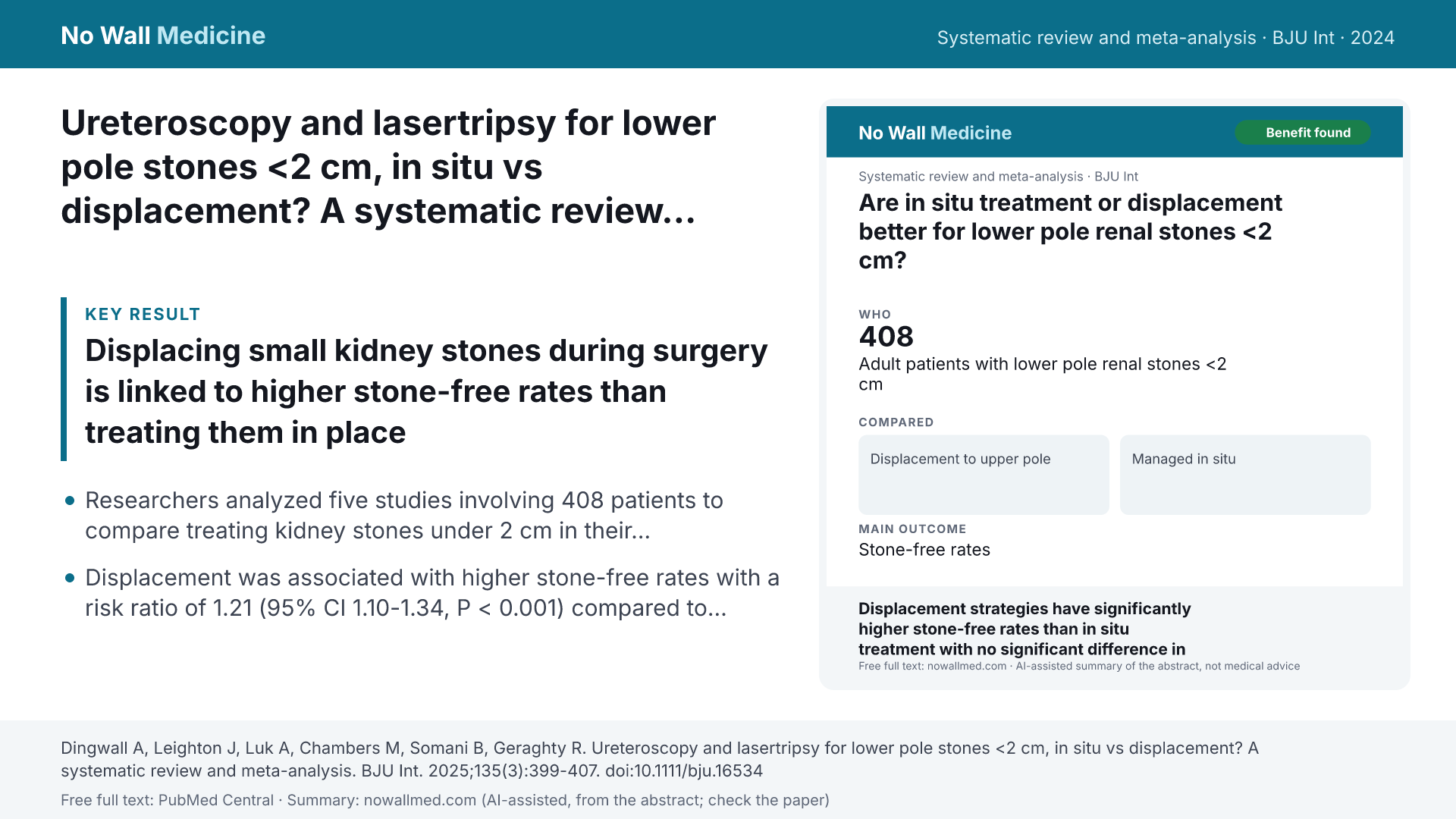
Displacing small kidney stones during surgery is linked to higher stone-free rates than treating them in place
Ureteroscopy and lasertripsy for lower pole stones <2 cm, in situ vs displacement? A systematic review and meta-analysis
Systematic review and meta-analysisBenefit found
Are in situ treatment or displacement better for lower pole renal stones <2 cm?
Who
408
Adult patients with lower pole renal stones <2 cm
Compared
Displacement to upper pole
Managed in situ
Main outcome
Stone-free rates
Result: risk ratio 1.21 (95% CI 1.10-1.34)
Bottom line: Displacement strategies have significantly higher stone-free rates than in situ treatment with no significant difference in complications.
Limitation: Certainty of evidence was very low for all outcomes except stone-free status.
BJU Int · 2024-10-13 · Save PNG
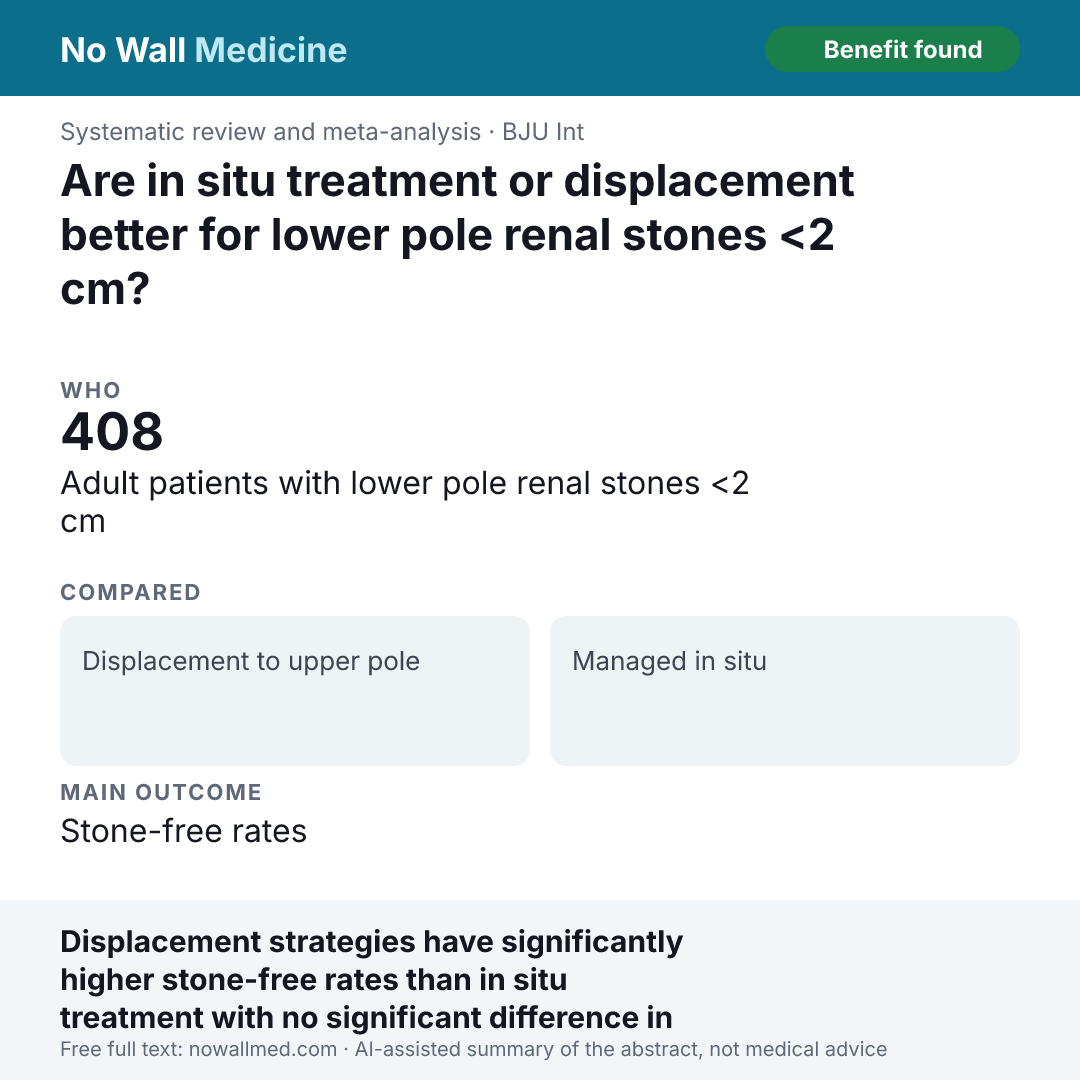
Clinical question: Are in situ treatment or displacement better for lower pole renal stones <2 cm?
Key points
- Researchers analyzed five studies involving 408 patients to compare treating kidney stones under 2 cm in their original position versus moving them to the upper part of the kidney.
- Displacement was associated with higher stone-free rates with a risk ratio of 1.21 (95% CI 1.10-1.34, P < 0.001) compared to in situ treatment.
- The displacement group had a longer mean operative time by 5.62 min (95% CI 0.40-10.83 min; P = 0.03), but complication rates showed no significant difference.
Limitation the authors note: The certainty of evidence was very low for all outcomes except for stone-free status, and the overall risk of bias was moderate.
Headline and key points written with AI from the paper’s abstract, with every number checked against it. Read the paper before relying on them.
Was this summary helpful?
Subject terms
Headline, design, result, key points, caveat and citation as plain text.
Cite this article
Dingwall A, Leighton J, Luk A, Chambers M, Somani B, Geraghty R. Ureteroscopy and lasertripsy for lower pole stones <2 cm, in situ vs displacement? A systematic review and meta-analysis. BJU Int. 2025;135(3):399-407. doi:10.1111/bju.16534
Spotted a mistake? Suggest a correction