Selective or empiric treatment strategies showed no difference in kidney stone risk factors
Urinary Supersaturation in a Randomized Trial Among Individuals With Recurrent Nephrolithiasis Comparing Empiric vs Selective Preventive Therapy: The URINE Trial
Randomized trialNo clear difference
Does selective therapy compare to empiric therapy for urinary supersaturation in recurrent nephrolithiasis?
Who
56
Adult individuals with recurrent idiopathic calcium stone disease · Single-center trial
Compared
Empiric therapy: calcium oxalate 4.7 [2.9], calcium phosphate 1.3 [0.9]
Selective therapy: calcium oxalate 5.0 [2.9], calcium phosphate 1.4 [1.1]
Main outcome
Urinary supersaturation of calcium oxalate and calcium phosphate
Bottom line: Selective therapy showed no significant difference in urinary stone risk compared to empiric therapy at 8 weeks.
J Urol · 2026-06-30Download image
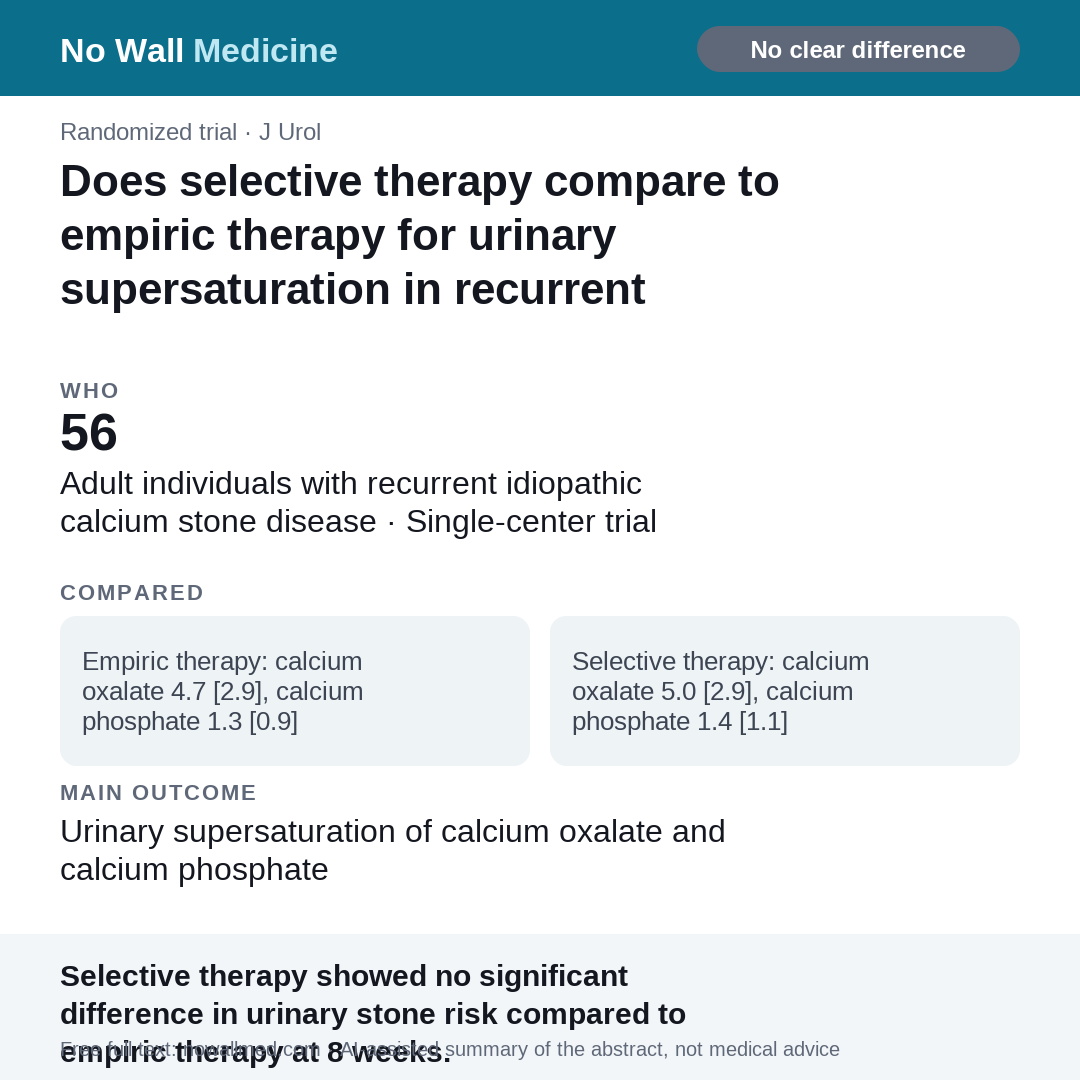
Clinical question: Does selective therapy compare to empiric therapy for urinary supersaturation in recurrent nephrolithiasis?
Why it matters: It is unclear whether tailoring kidney stone prevention treatments to individual urine test results is more effective than starting standard treatments immediately.
Key points
- Researchers studied 56 adults with recurrent idiopathic calcium stone disease, comparing treatment based on urine testing to treatment provided without testing.
- At 8 weeks, there were no significant differences in the mean urinary supersaturation of calcium oxalate (4.7 [2.9] vs 5.0 [2.9]) or calcium phosphate (1.3 [0.9] vs 1.4 [1.1]).
- No significant differences were found between groups regarding urine volume, pH, or the excretion of calcium, oxalate, citrate, uric acid, and sodium.
Limitation the authors note: This was a single-center, short-term trial.
Headline and key points written with AI from the paper’s abstract, with every number checked against it. Read the paper before relying on them.
Topics
Spotted a mistake? Suggest a correction