Urine collection devices did not reduce sample contamination compared to standard verbal instructions
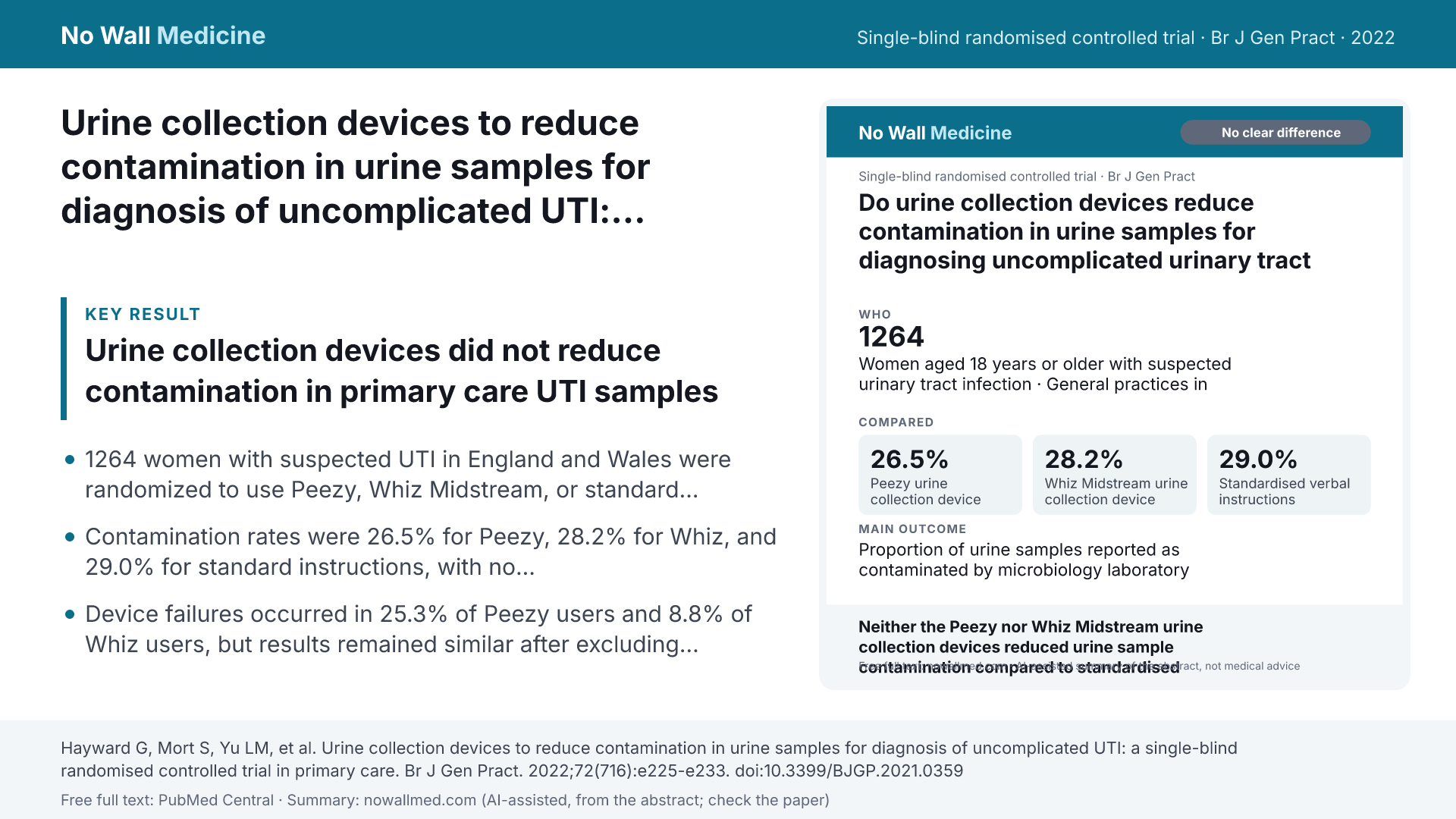
Urine collection devices to reduce contamination in urine samples for diagnosis of uncomplicated UTI: a single-blind randomised controlled trial in primary care
Single-blind randomised controlled trialNo clear difference
Do urine collection devices reduce contamination in urine samples for diagnosing uncomplicated urinary tract infection?
Who
1264
Women aged 18 years or older with suspected urinary tract infection · General practices in England and Wales
Compared
26.5%Peezy urine collection device
28.2%Whiz Midstream urine collection device
29.0%Standardised verbal instructions
Main outcome
Proportion of urine samples reported as contaminated by microbiology laboratory analysis
Result: relative risk Peezy UCD versus SVI = 0.91, 95% CI = 0.76 to 1.09
Bottom line: Neither the Peezy nor Whiz Midstream urine collection devices reduced urine sample contamination compared to standardised verbal instructions.
Br J Gen Pract · 2022-02-24Download image
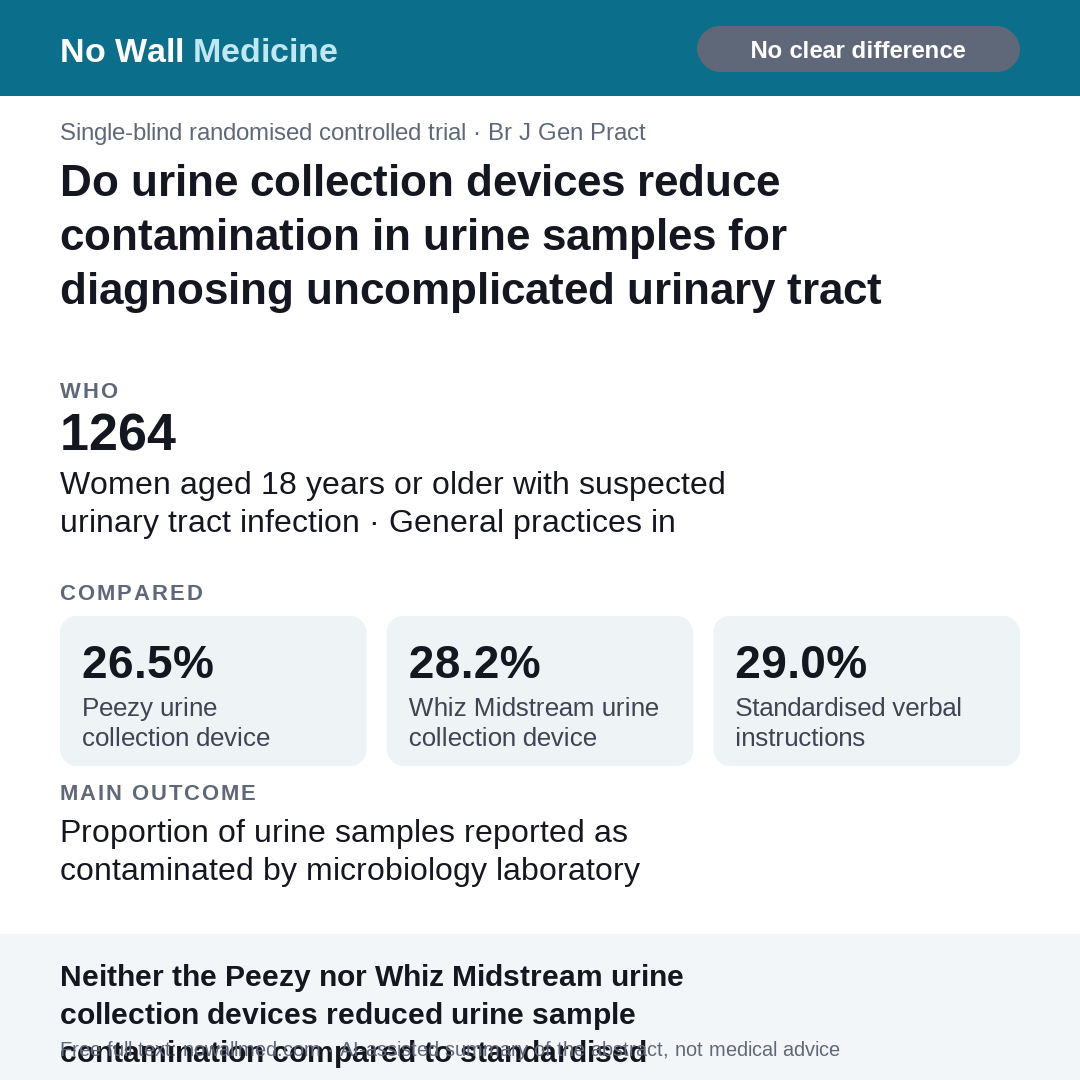
Clinical question: Do urine collection devices reduce contamination in urine samples for diagnosing uncomplicated urinary tract infection?
Why it matters: It is unknown if specialized urine collection devices actually reduce the rate of contaminated samples compared to standard instructions in primary care settings.
Key points
- Researchers studied 1174 women with suspected urinary tract infections who were randomized to use the Peezy device, the Whiz Midstream device, or receive standard verbal instructions.
- The proportion of contaminated samples was 26.5% with the Peezy device, 28.2% with the Whiz Midstream device, and 29.0% with standard verbal instructions.
- Device failure rates were 25.3% for the Peezy device and 8.8% for the Whiz Midstream device.
Headline and key points written with AI from the paper’s abstract, with every number checked against it. Read the paper before relying on them.
Was this summary helpful?
Subject terms
Cite this article
Hayward G, Mort S, Yu LM, et al. Urine collection devices to reduce contamination in urine samples for diagnosis of uncomplicated UTI: a single-blind randomised controlled trial in primary care. Br J Gen Pract. 2022. doi:10.3399/BJGP.2021.0359
Spotted a mistake? Suggest a correction