Elacestrant improves progression-free survival in patients with ESR1-mutated advanced or metastatic breast cancer
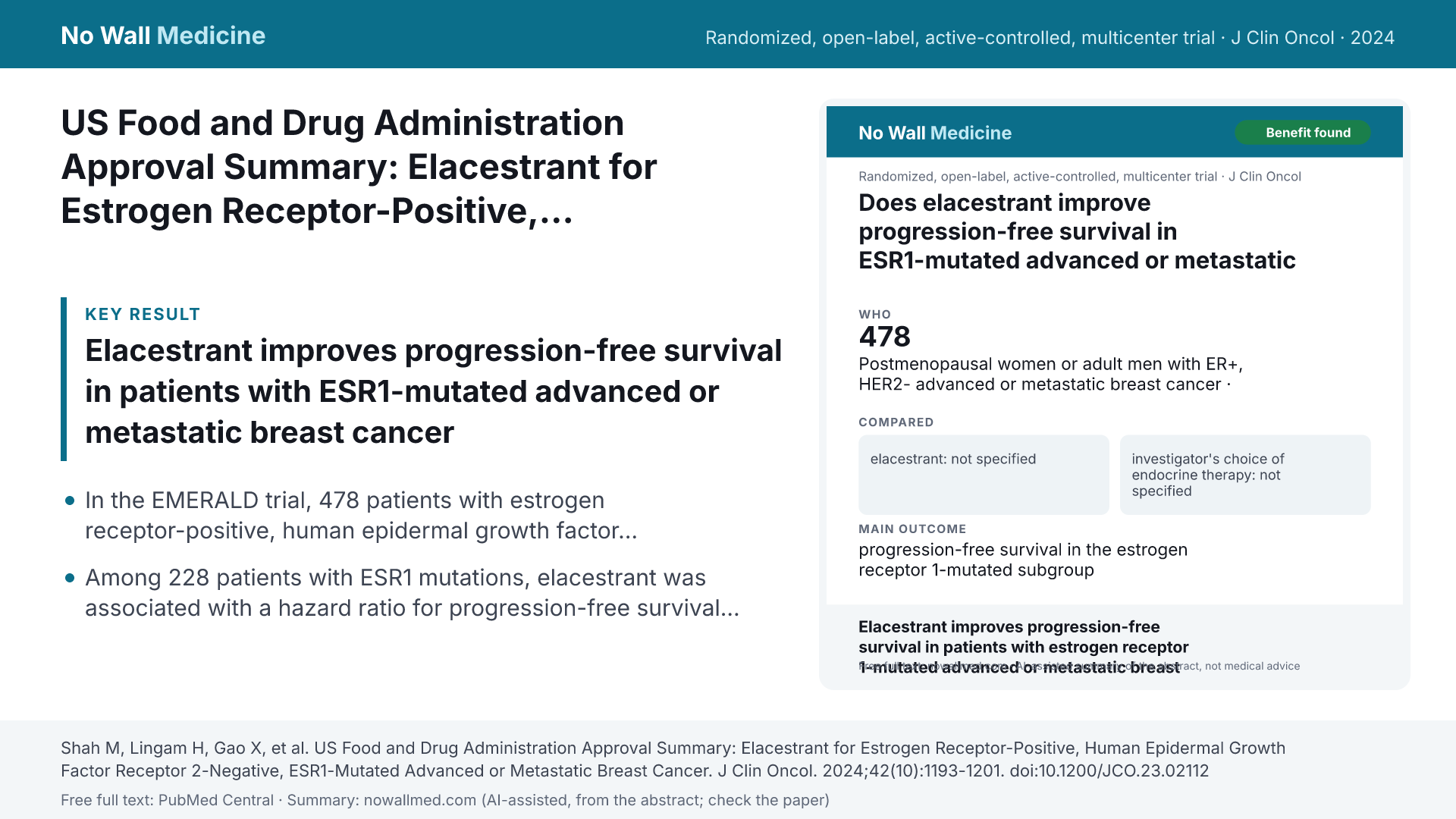
US Food and Drug Administration Approval Summary: Elacestrant for Estrogen Receptor-Positive, Human Epidermal Growth Factor Receptor 2-Negative, ESR1-Mutated Advanced or Metastatic Breast Cancer
Randomized, open-label, active-controlled, multicenter trialBenefit found
Does elacestrant improve progression-free survival in ESR1-mutated advanced or metastatic breast cancer?
Who
478
Postmenopausal women or adult men with ER+, HER2- advanced or metastatic breast cancer · multicenter
Compared
elacestrant: not specified
investigator's choice of endocrine therapy: not specified
Main outcome
progression-free survival in the estrogen receptor 1-mutated subgroup
Result: hazard ratio 0.55 (95% CI 0.39 to 0.77)
Bottom line: Elacestrant improves progression-free survival in patients with estrogen receptor 1-mutated advanced or metastatic breast cancer.
Limitation: overall survival end point was not met
J Clin Oncol · 2024-02-21Download image
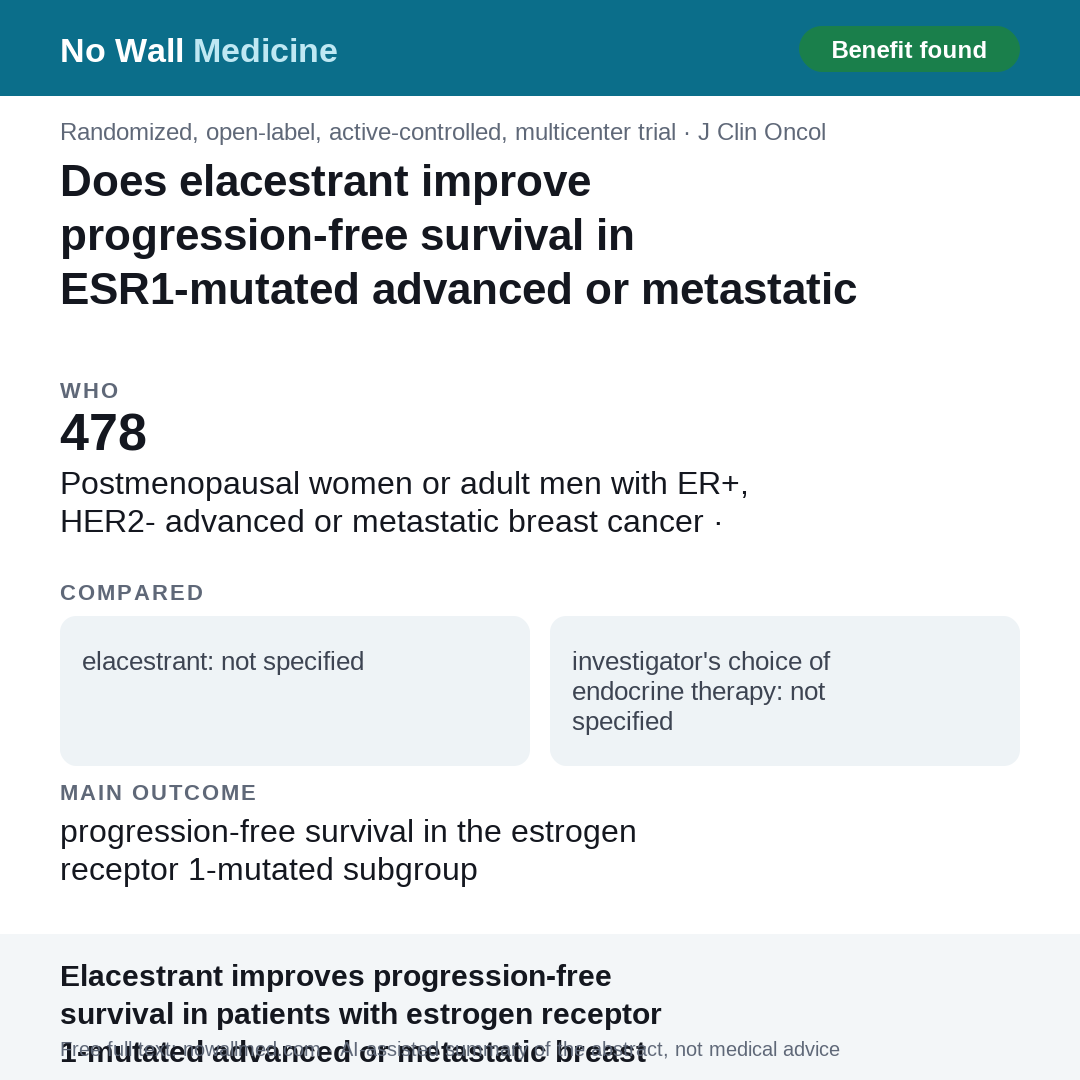
Clinical question: Does elacestrant improve progression-free survival in ESR1-mutated advanced or metastatic breast cancer?
Key points
- In the EMERALD trial, 478 patients with estrogen receptor-positive, human epidermal growth factor receptor 2-negative breast cancer were compared using elacestrant or investigator's choice of endocrine therapy.
- Among 228 patients with ESR1 mutations, elacestrant was associated with a hazard ratio for progression-free survival of 0.55 and an overall survival hazard ratio of 0.90.
- More patients receiving elacestrant experienced nausea, vomiting, and dyslipidemia compared to those receiving the investigator's choice of endocrine therapy.
Headline and key points written with AI from the paper’s abstract, with every number checked against it. Read the paper before relying on them.
Was this summary helpful?
Subject terms
Cite this article
Shah M, Lingam H, Gao X, et al. US Food and Drug Administration Approval Summary: Elacestrant for Estrogen Receptor-Positive, Human Epidermal Growth Factor Receptor 2-Negative, ESR1-Mutated Advanced or Metastatic Breast Cancer. J Clin Oncol. 2024. doi:10.1200/JCO.23.02112
Spotted a mistake? Suggest a correction