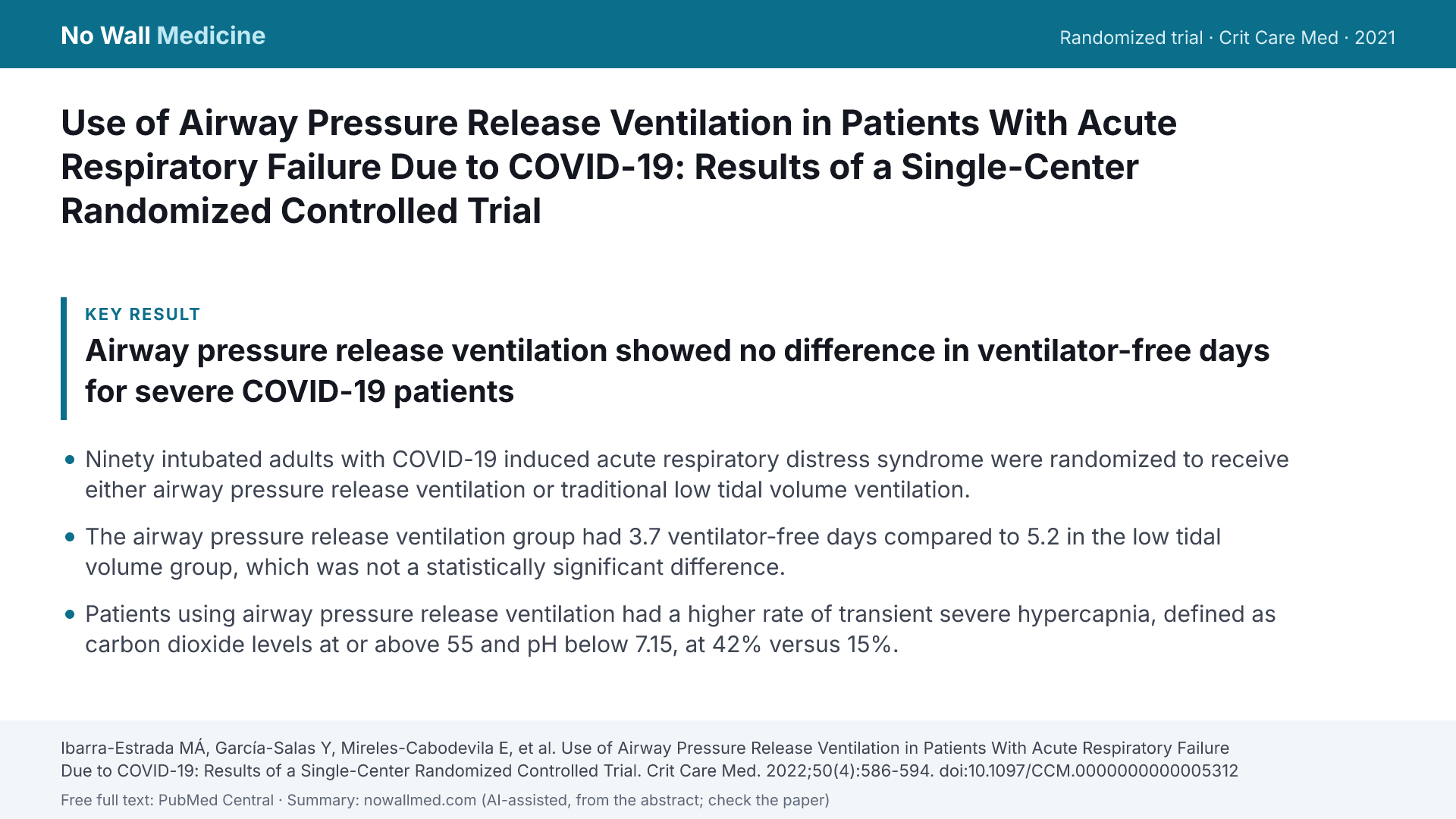
Airway pressure release ventilation showed no difference in ventilator-free days for severe COVID-19 patients
Use of Airway Pressure Release Ventilation in Patients With Acute Respiratory Failure Due to COVID-19: Results of a Single-Center Randomized Controlled Trial
Key points
- Ninety intubated adults with COVID-19 induced acute respiratory distress syndrome were randomized to receive either airway pressure release ventilation or traditional low tidal volume ventilation.
- The airway pressure release ventilation group had 3.7 ventilator-free days compared to 5.2 in the low tidal volume group, which was not a statistically significant difference.
- Patients using airway pressure release ventilation had a higher rate of transient severe hypercapnia, defined as carbon dioxide levels at or above 55 and pH below 7.15, at 42% versus 15%.
Headline and key points written with AI from the paper’s abstract, with every number checked against it. Read the paper before relying on them.
Was this summary helpful?
Subject terms
Headline, design, result, key points, caveat and citation as plain text.
Cite this article
Ibarra-Estrada MÁ, García-Salas Y, Mireles-Cabodevila E, et al. Use of Airway Pressure Release Ventilation in Patients With Acute Respiratory Failure Due to COVID-19: Results of a Single-Center Randomized Controlled Trial. Crit Care Med. 2022;50(4):586-594. doi:10.1097/CCM.0000000000005312
Spotted a mistake? Suggest a correction