Use of artificial intelligence for the prediction of lymph node metastases in early-stage colorectal cancer: systematic review
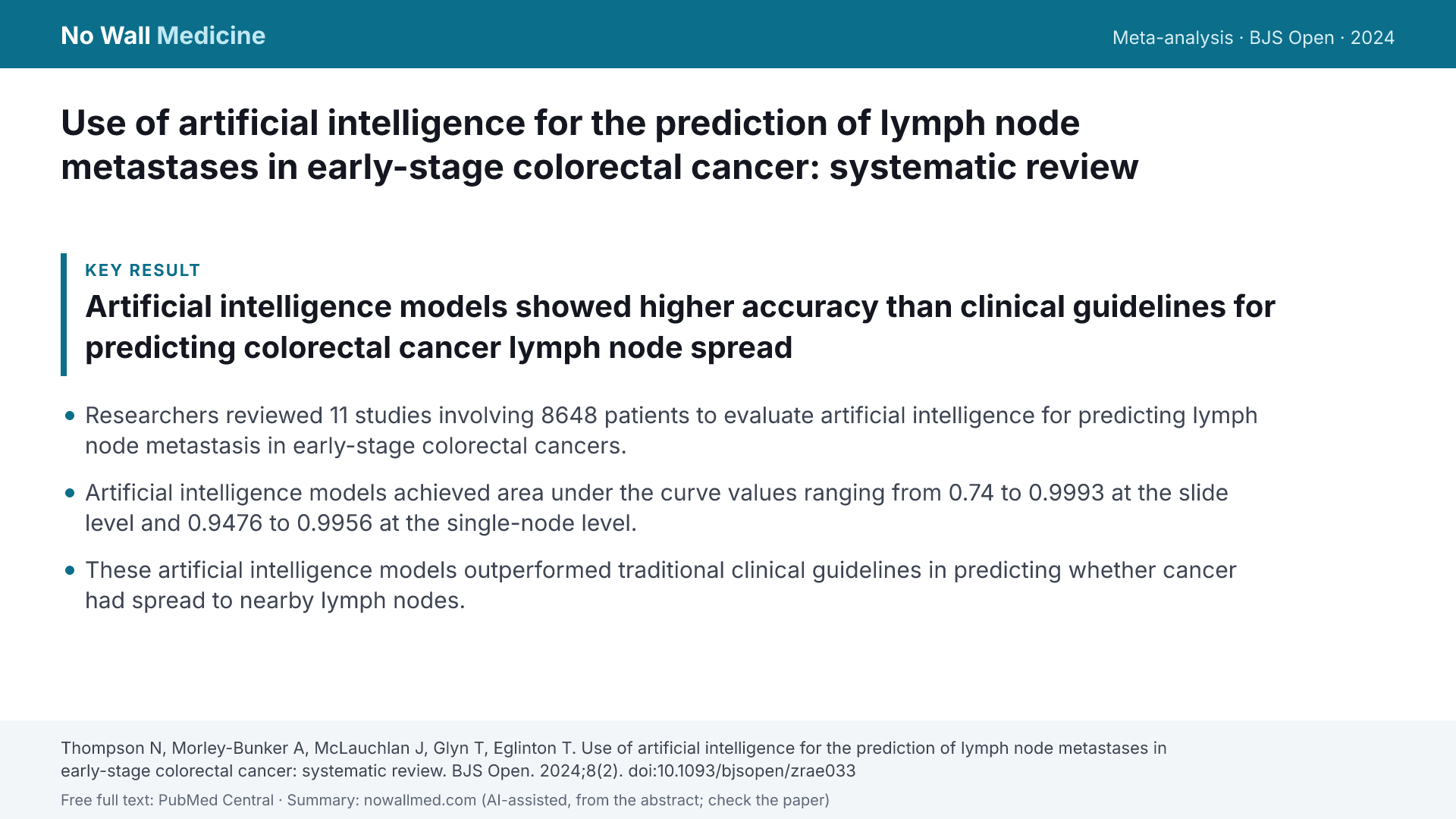
Key result: Artificial intelligence models showed higher accuracy than clinical guidelines for predicting colorectal cancer lymph node spread
Key points
- Researchers reviewed 11 studies involving 8648 patients to evaluate artificial intelligence for predicting lymph node metastasis in early-stage colorectal cancers.
- Artificial intelligence models achieved area under the curve values ranging from 0.74 to 0.9993 at the slide level and 0.9476 to 0.9956 at the single-node level.
- These artificial intelligence models outperformed traditional clinical guidelines in predicting whether cancer had spread to nearby lymph nodes.
Why it matters: Traditional methods for predicting lymph node metastasis in early-stage colorectal cancers have limited accuracy.
Limitation the authors note: No data synthesis was performed due to diverse artificial intelligence models and varied metrics used across the included studies.
Discussion prompts
- Would these patients look like yours? Who was left out?
- Is the main outcome one that matters to patients?
- Is the difference large enough to change what you do?
Cite: Thompson N, Morley-Bunker A, McLauchlan J, Glyn T, Eglinton T. Use of artificial intelligence for the prediction of lymph node metastases in early-stage colorectal cancer: systematic review. BJS Open. 2024;8(2). doi:10.1093/bjsopen/zrae033
Free full text: PubMed Central · Summary and visual abstract: nowallmed.com/a/use-of-artificial-intelligence-for-the-prediction-of-lymph-node-6t4waq/ (AI-assisted from the abstract; check the paper before relying on it).