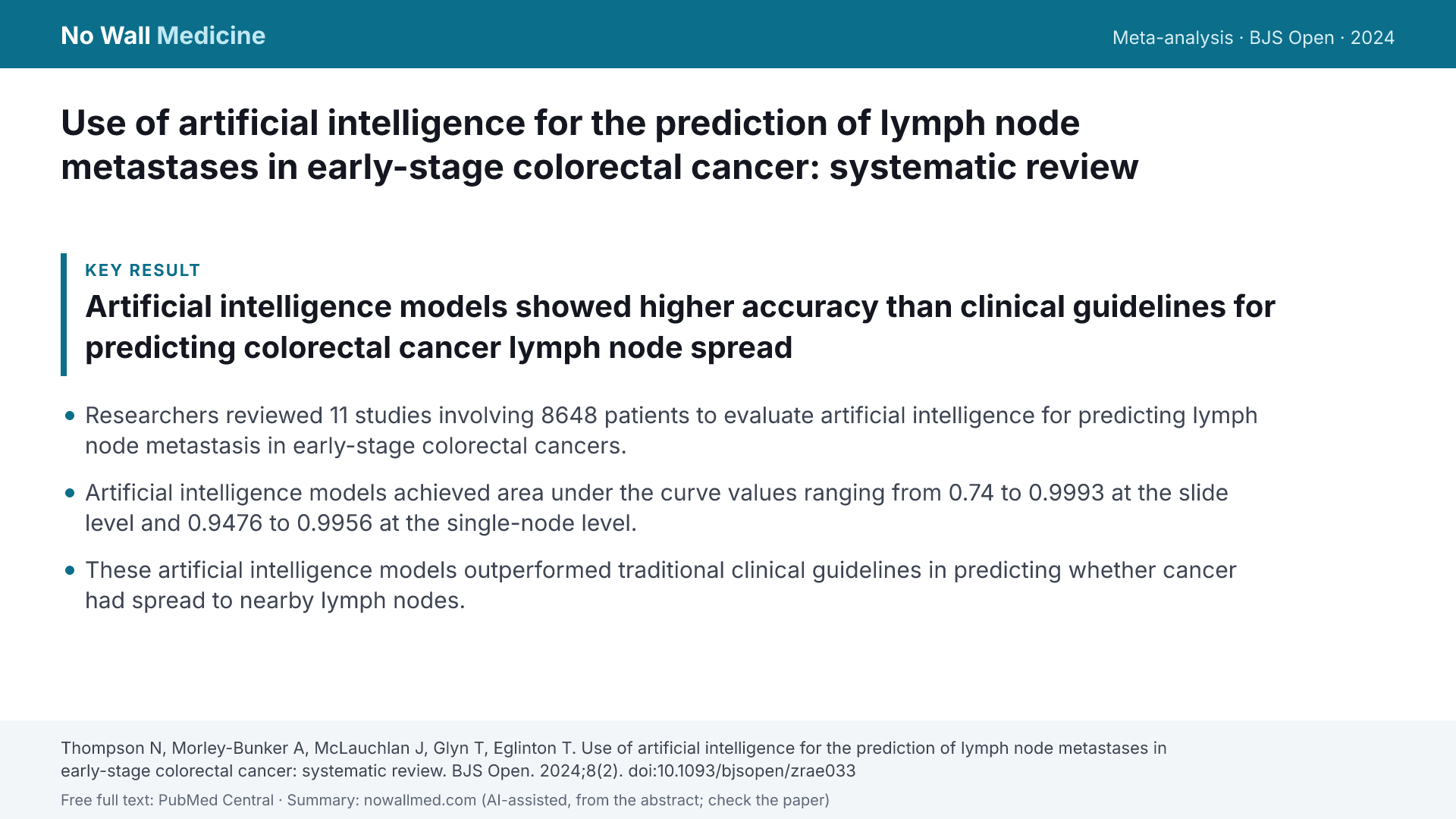
Artificial intelligence models showed higher accuracy than clinical guidelines for predicting colorectal cancer lymph node spread
Use of artificial intelligence for the prediction of lymph node metastases in early-stage colorectal cancer: systematic review
Systematic reviewBenefit found
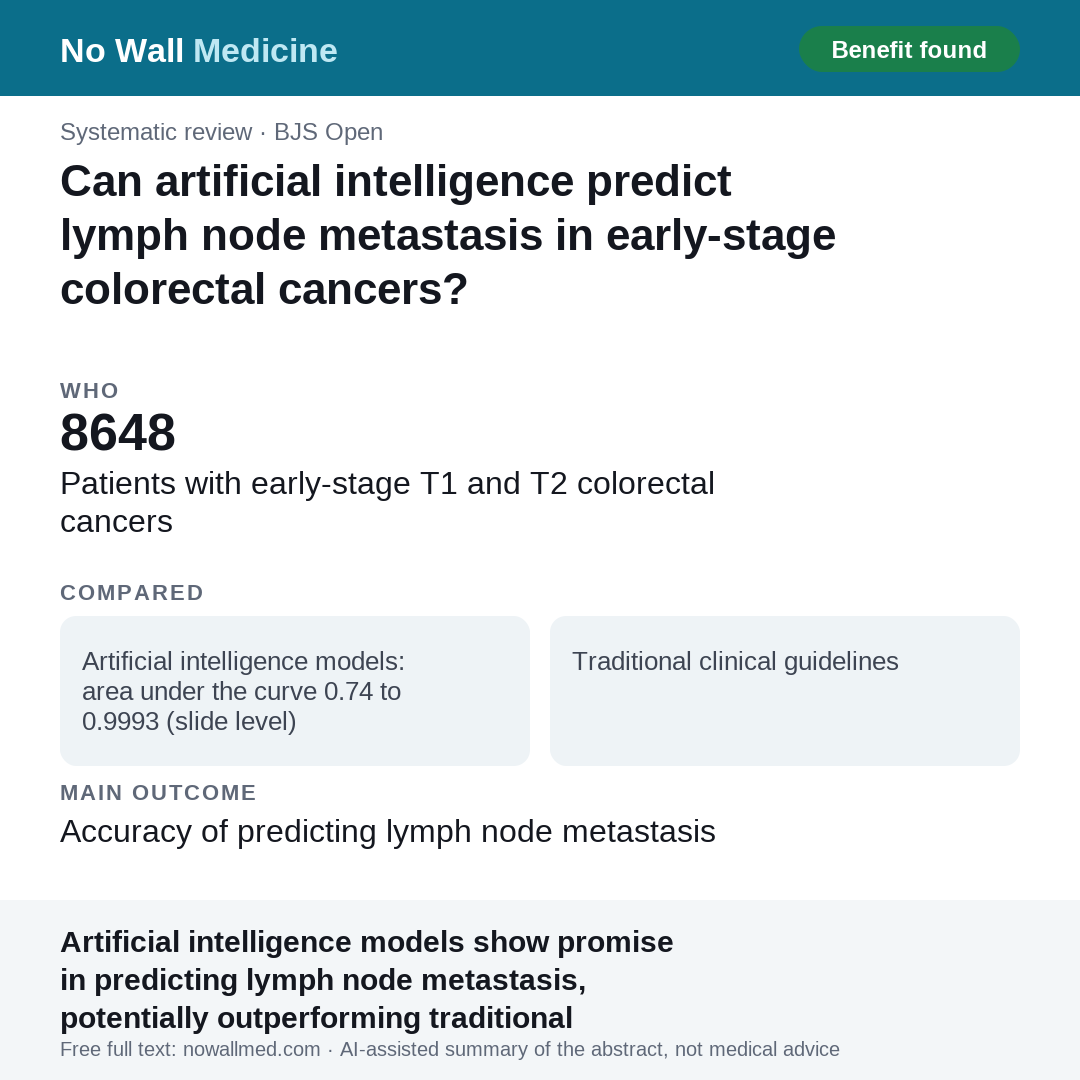
Can artificial intelligence predict lymph node metastasis in early-stage colorectal cancers?
Who
8648
Patients with early-stage T1 and T2 colorectal cancers
Compared
Artificial intelligence models: area under the curve 0.74 to 0.9993 (slide level)
Traditional clinical guidelines
Main outcome
Accuracy of predicting lymph node metastasis
Bottom line: Artificial intelligence models show promise in predicting lymph node metastasis, potentially outperforming traditional clinical guidelines.
Limitation: Diverse artificial intelligence models and varied metrics prevented data synthesis.
BJS Open · 2024-04-19Download image
Clinical question: Can artificial intelligence predict lymph node metastasis in early-stage colorectal cancers?
Why it matters: Traditional methods for predicting lymph node metastasis in early-stage colorectal cancers have limited accuracy.
Key points
- Researchers reviewed 11 studies involving 8648 patients to evaluate artificial intelligence for predicting lymph node metastasis in early-stage colorectal cancers.
- Artificial intelligence models achieved area under the curve values ranging from 0.74 to 0.9993 at the slide level and 0.9476 to 0.9956 at the single-node level.
- These artificial intelligence models outperformed traditional clinical guidelines in predicting whether cancer had spread to nearby lymph nodes.
Limitation the authors note: No data synthesis was performed due to diverse artificial intelligence models and varied metrics used across the included studies.
Headline and key points written with AI from the paper’s abstract, with every number checked against it. Read the paper before relying on them.
Was this summary helpful?
Subject terms
Cite this article
Thompson N, Morley-Bunker A, McLauchlan J, Glyn T, Eglinton T. Use of artificial intelligence for the prediction of lymph node metastases in early-stage colorectal cancer: systematic review. BJS Open. 2024. doi:10.1093/bjsopen/zrae033
Spotted a mistake? Suggest a correction