Bayesian analysis suggests balanced transfusion strategy may have higher probability of reducing mortality in trauma patients
Use of Bayesian Statistics to Reanalyze Data From the Pragmatic Randomized Optimal Platelet and Plasma Ratios Trial
Post hoc Bayesian analysis of a randomized trialBenefit found
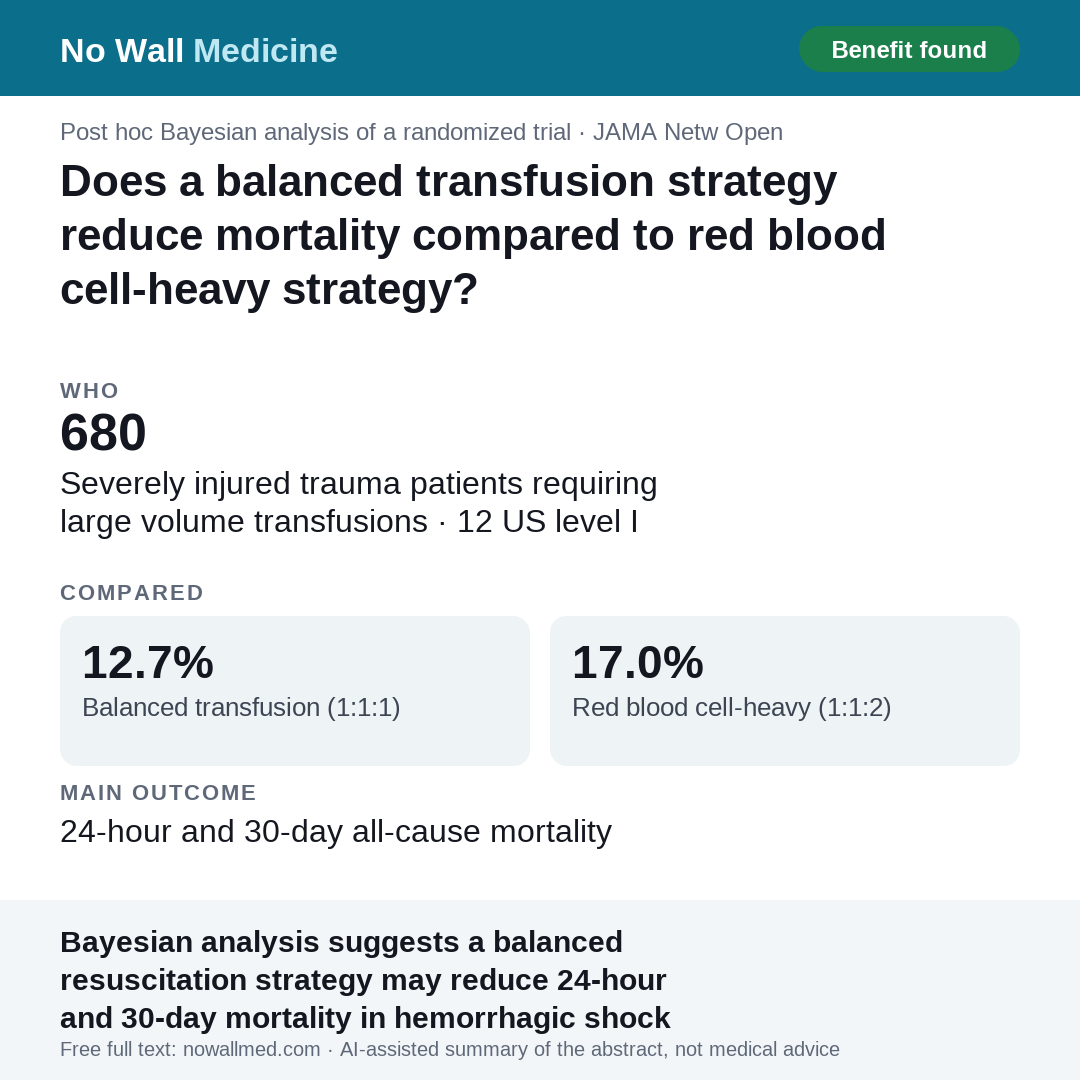
Does a balanced transfusion strategy reduce mortality compared to red blood cell-heavy strategy?
Who
680
Severely injured trauma patients requiring large volume transfusions · 12 US level I trauma centers
Compared
12.7%Balanced transfusion (1:1:1) (24-hour mortality)
17.0%Red blood cell-heavy (1:1:2) (24-hour mortality)
Main outcome
24-hour and 30-day all-cause mortality
Result: RR 0.75 (95% credible interval 0.45-1.11) for 24-hour mortality
Bottom line: Bayesian analysis suggests a balanced resuscitation strategy may reduce 24-hour and 30-day mortality in hemorrhagic shock patients.
JAMA Netw Open · 2023-02-01Download image
Clinical question: Does a balanced transfusion strategy reduce mortality compared to red blood cell-heavy strategy?
Why it matters: Frequentist statistical approaches are common, but it is unknown if Bayesian trial design provides more optimal techniques for trauma-related studies.
Key points
- Researchers reanalyzed data from 680 severely injured trauma patients who received either a balanced 1:1:1 transfusion ratio or a 1:1:2 red blood cell-heavy ratio.
- Using Bayesian methods, the 1:1:1 ratio had a 93% probability of being superior for 24-hour mortality and an 87% probability for 30-day mortality.
- Original frequentist methods showed no significant differences in mortality at 24 hours (12.7% vs 17.0%) or 30 days (22.4% vs 26.1%).
Headline and key points written with AI from the paper’s abstract, with every number checked against it. Read the paper before relying on them.
Was this summary helpful?
Subject terms
Cite this article
Lammers D, Richman J, Holcomb JB, Jansen JO. Use of Bayesian Statistics to Reanalyze Data From the Pragmatic Randomized Optimal Platelet and Plasma Ratios Trial. JAMA Netw Open. 2023. doi:10.1001/jamanetworkopen.2023.0421
Spotted a mistake? Suggest a correction
Top studies every Monday
The week’s key trials and guidelines in your specialties, plus any topics you follow. By email, free.
Get the weekly digest