Operative videos show benefits for surgical training compared to methods without real-life content
Use of Operative Video Technology in Surgical Education: A Systematic Review
Systematic reviewBenefit found
How do real-life operative videos compare to alternative teaching methods in surgical education?
Who
Surgical trainees
Compared
Operative videos
Alternative teaching methods
Main outcome
Educational impact including knowledge, skills, and clinical behaviors
Bottom line: Operative videos provide significant benefits for surgical training across knowledge, skills, and clinical behaviors.
Ann Surg Open · 2026-07-09 · Save PNG
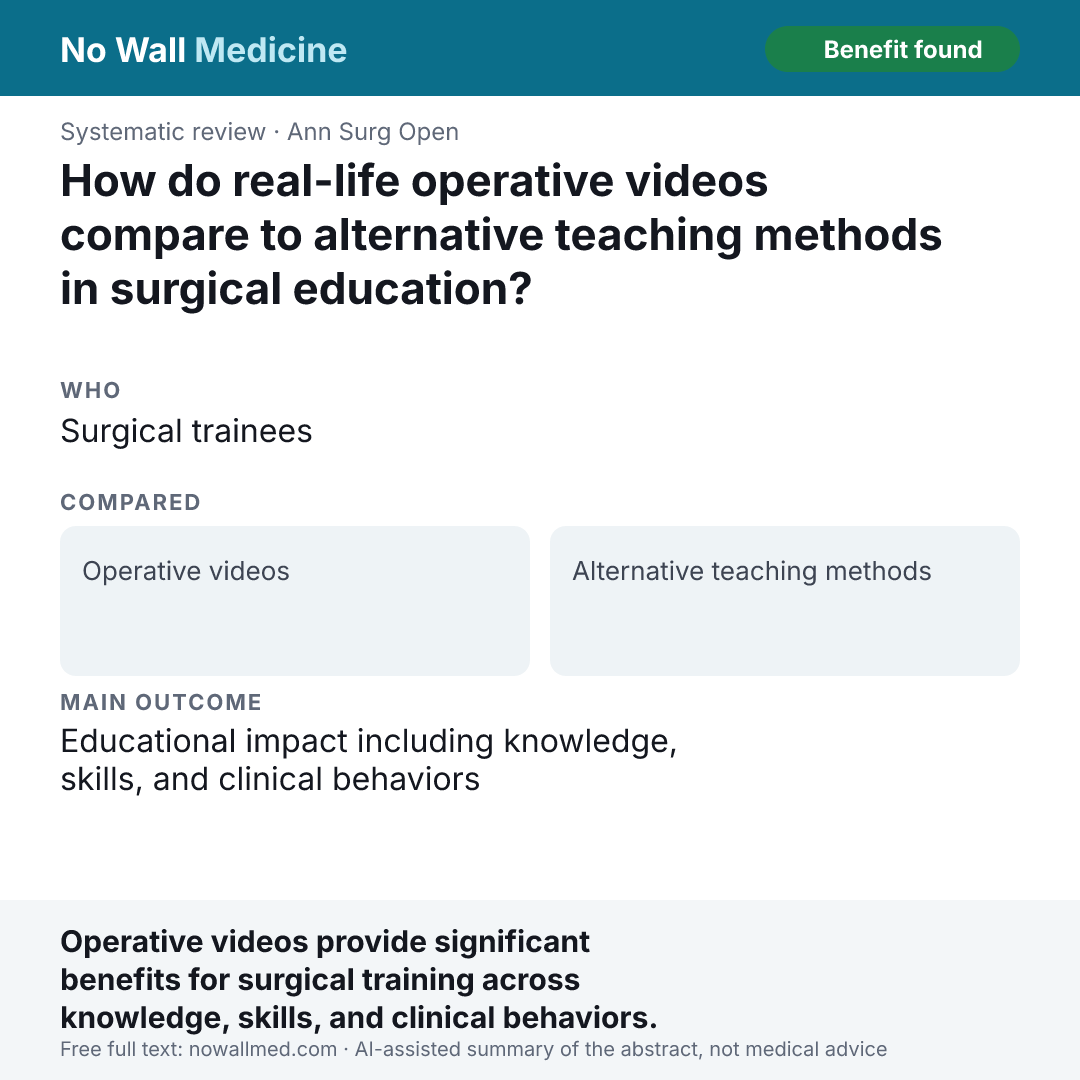
Clinical question: How do real-life operative videos compare to alternative teaching methods in surgical education?
Why it matters: Surgical trainees face challenges in developing competence due to changing working patterns and increasing procedure complexity.
Key points
- Researchers reviewed 35 articles to evaluate how real-life surgical videos compare to other teaching methods for trainees.
- Out of 24 comparative studies, 20 showed favorable results in areas like knowledge acquisition (64%) and skill demonstration (66%).
- Trainees using 3-dimensional or virtual reality platforms showed more benefit than those using 2-dimensional video formats.
Limitation the authors note: Further research is needed to determine the optimal formats and their impact on patient outcomes.
Headline and key points written with AI from the paper’s abstract, with every number checked against it. Read the paper before relying on them.
Was this summary helpful?
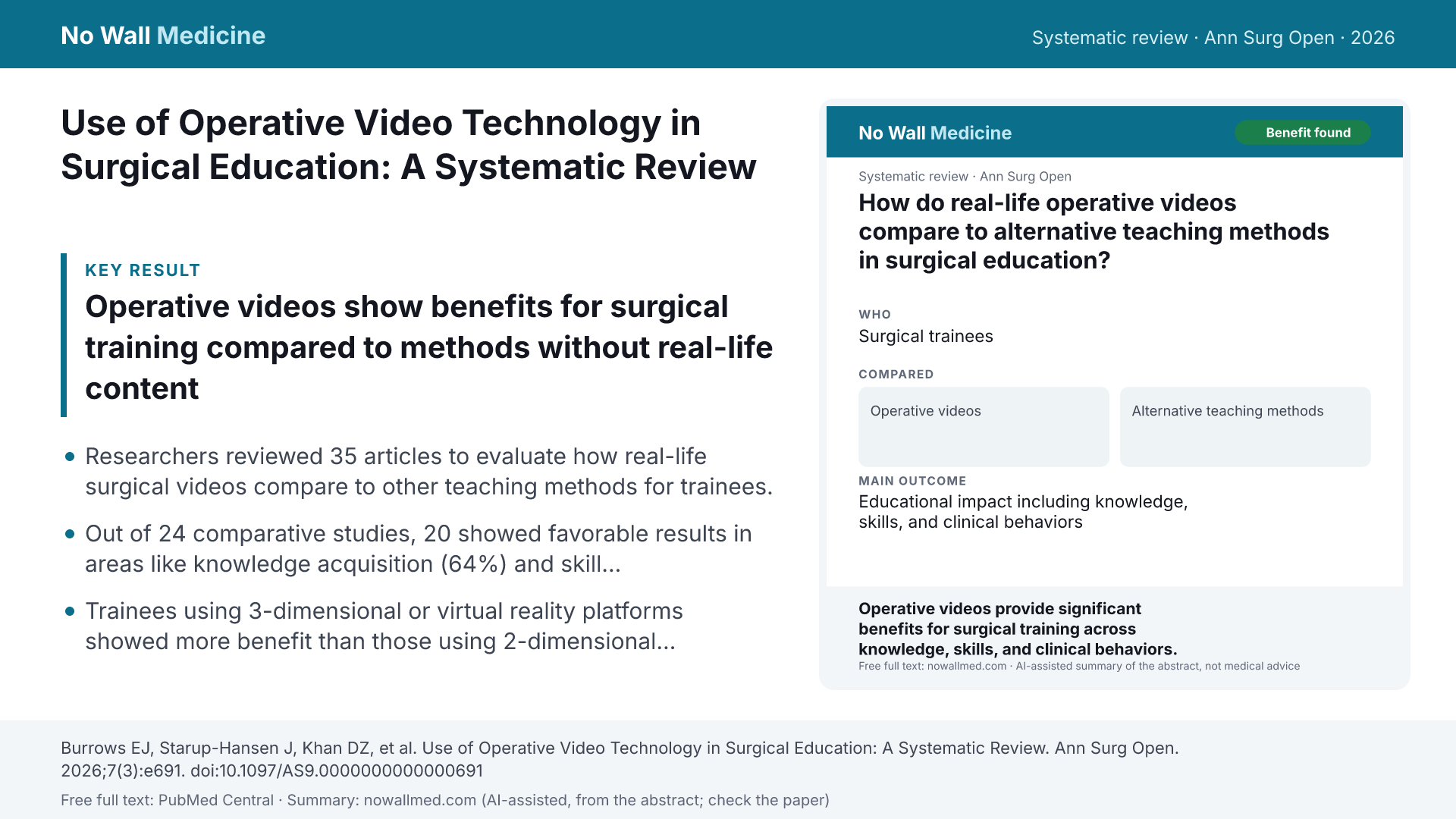
Headline, design, result, key points, caveat and citation as plain text.
Cite this article
Burrows EJ, Starup-Hansen J, Khan DZ, et al. Use of Operative Video Technology in Surgical Education: A Systematic Review. Ann Surg Open. 2026;7(3):e691. doi:10.1097/AS9.0000000000000691
Spotted a mistake? Suggest a correction