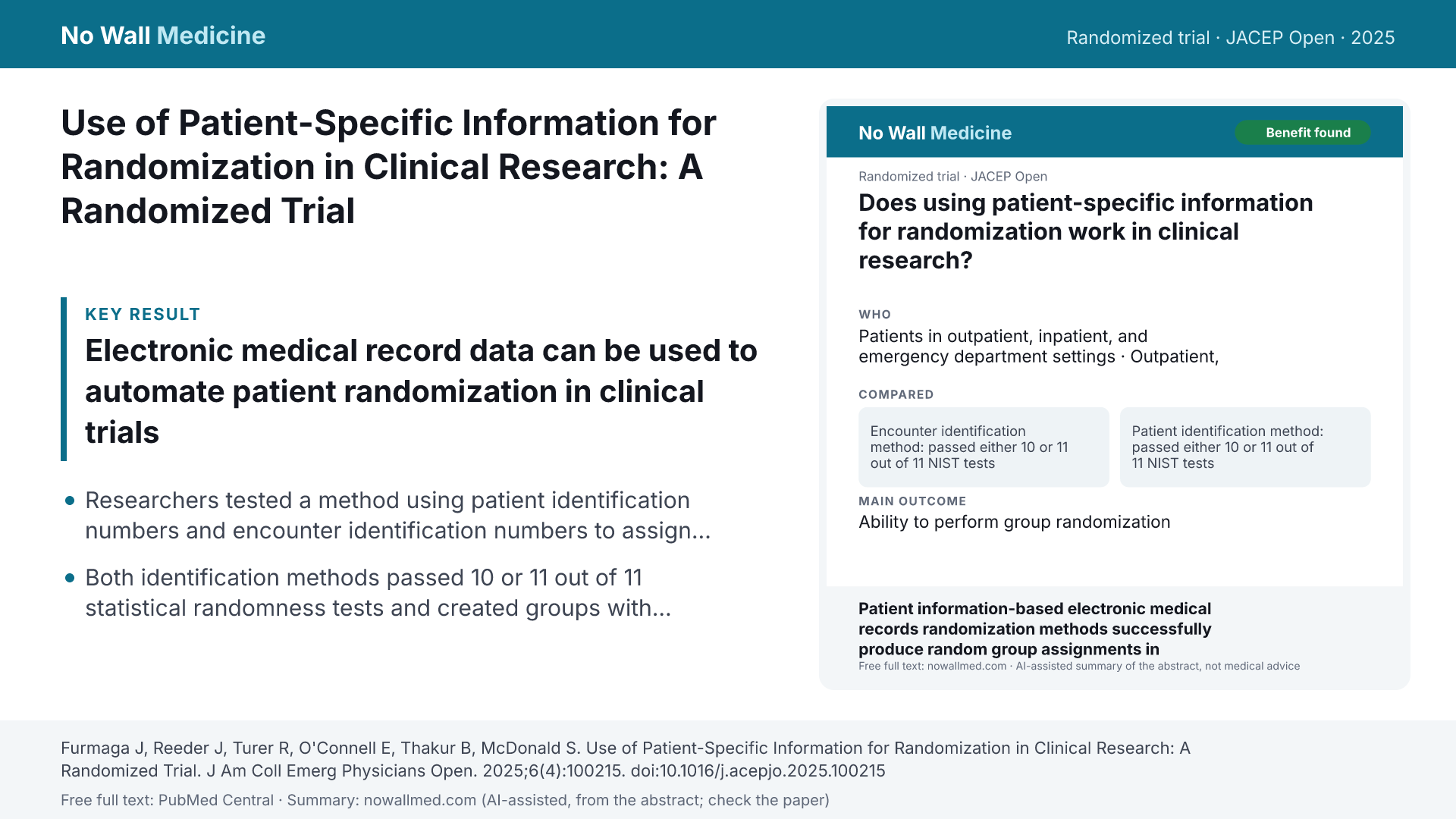
Use of Patient-Specific Information for Randomization in Clinical Research: A Randomized Trial
Key result: Electronic medical record data can be used to automate patient randomization in clinical trials
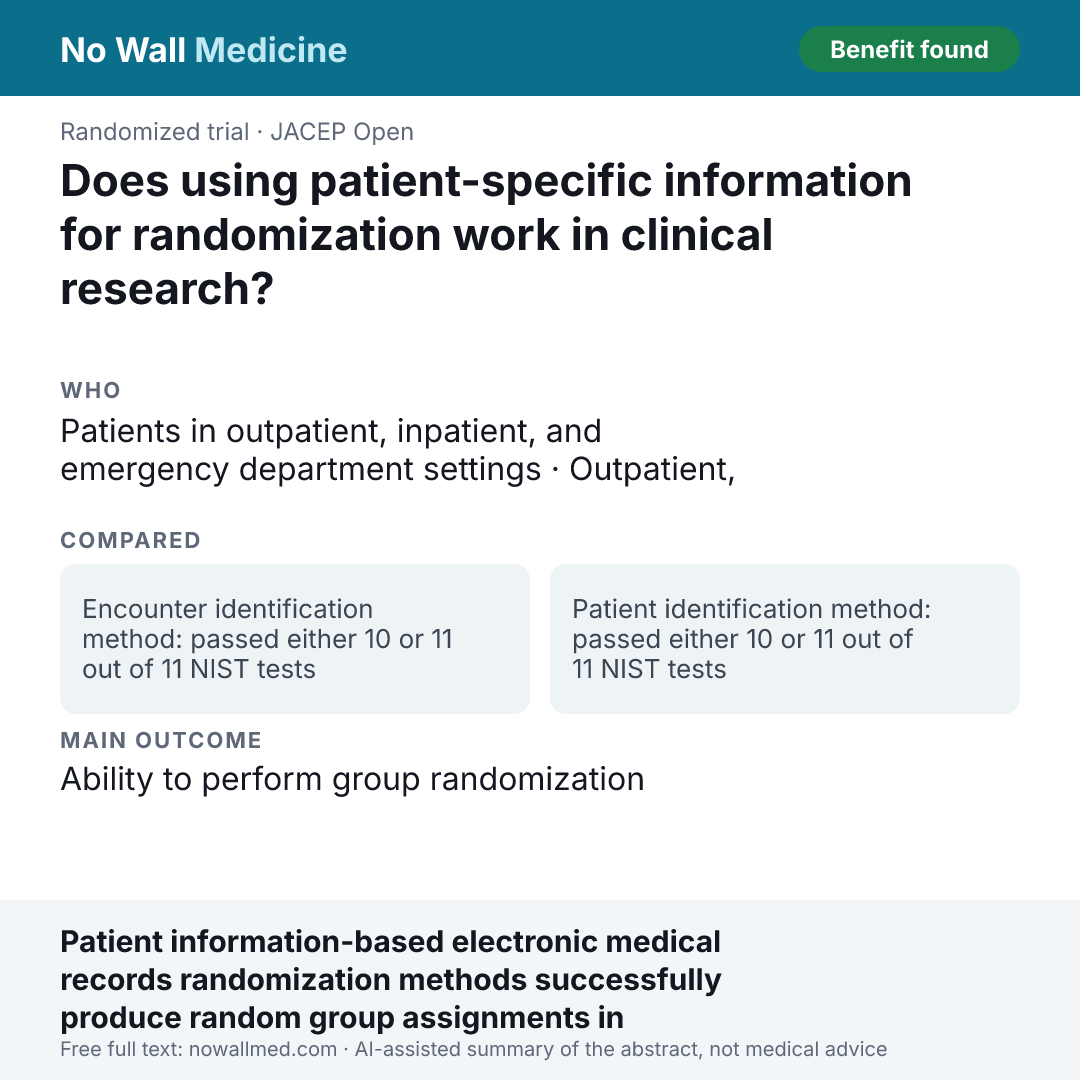
Randomized trialBenefit found
Does using patient-specific information for randomization work in clinical research?
Who
Patients in outpatient, inpatient, and emergency department settings · Outpatient, inpatient, and emergency department settings
Compared
Encounter identification method: passed either 10 or 11 out of 11 NIST tests
Patient identification method: passed either 10 or 11 out of 11 NIST tests
Main outcome
Ability to perform group randomization
Bottom line: Patient information-based electronic medical records randomization methods successfully produce random group assignments in pragmatic trials.
JACEP Open · 2025-06-30 · Save PNG
Key points
- Researchers tested a method using patient identification numbers and encounter identification numbers to assign patients to two random groups in outpatient, inpatient, and emergency settings.
- Both identification methods passed 10 or 11 out of 11 statistical randomness tests and created groups with similar demographics, laboratory tests, and hospital admission rates.
- The methods successfully randomized patients into groups with equivalent lengths of stay.
Discussion prompts
- Would these patients look like yours? Who was left out?
- Is the main outcome one that matters to patients?
- Is the difference large enough to change what you do?
Cite: Furmaga J, Reeder J, Turer R, O'Connell E, Thakur B, McDonald S. Use of Patient-Specific Information for Randomization in Clinical Research: A Randomized Trial. J Am Coll Emerg Physicians Open. 2025;6(4):100215. doi:10.1016/j.acepjo.2025.100215
Free full text: PubMed Central · Summary and visual abstract: nowallmed.com/a/use-of-patient-specific-information-for-randomization-in-clinical-138xgvz/ (AI-assisted from the abstract; check the paper before relying on it).