Assessment tool identifies healthcare needs for older adults with chronic diseases in general practice
Usefulness of the BRIEF-Multidimensional Prognostic Index (BRIEF-MPI) to identify older adults' healthcare needs to be addressed with a Personalized Prevention Program in general practice: preliminary data from the PrimaCare_P3 study
Preliminary data from a randomized trialBenefit found
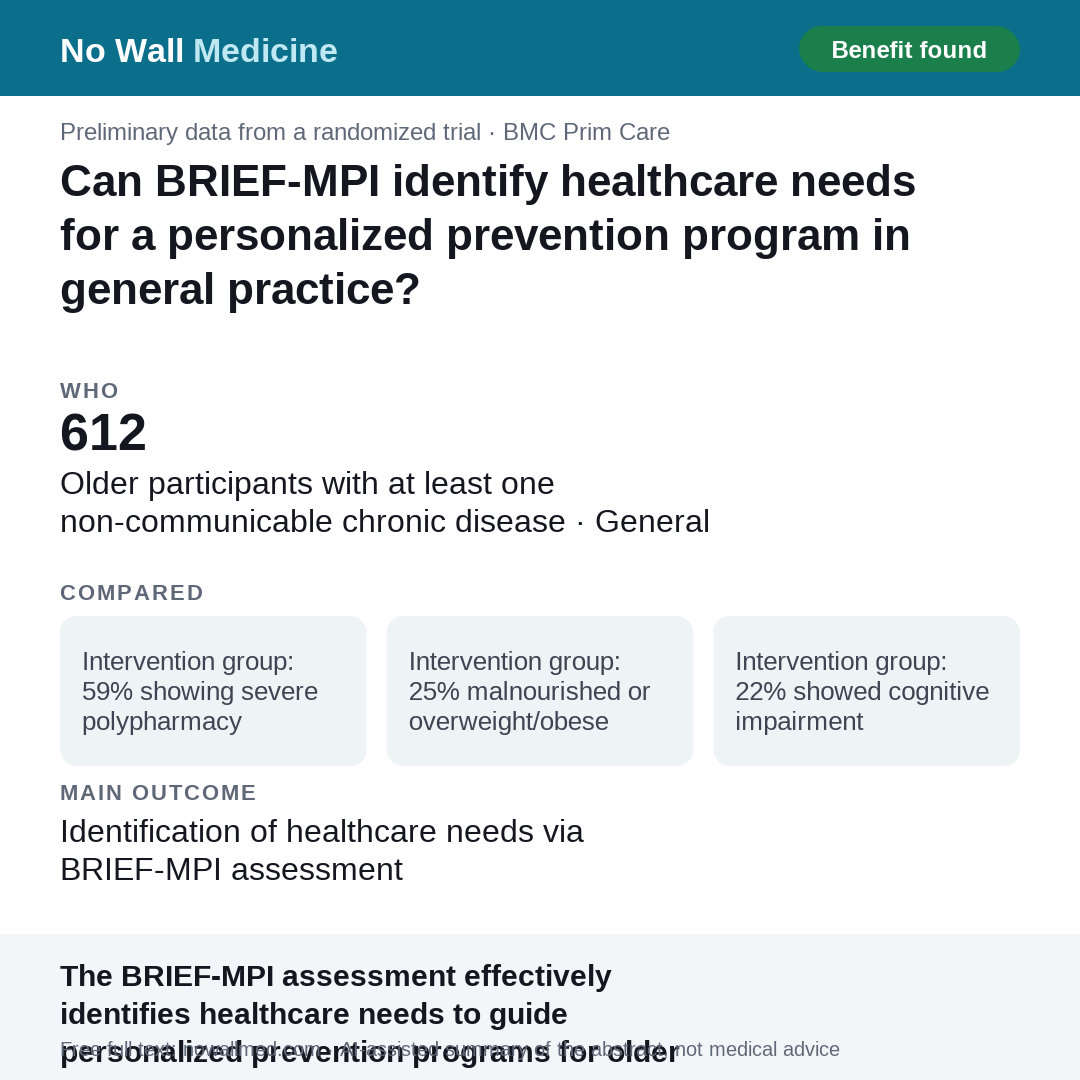
Can BRIEF-MPI identify healthcare needs for a personalized prevention program in general practice?
Who
612
Older participants with at least one non-communicable chronic disease · General practice, four geographical areas
Compared
Intervention group: 59% showing severe polypharmacy
Intervention group: 25% malnourished or overweight/obese
Intervention group: 22% showed cognitive impairment
Main outcome
Identification of healthcare needs via BRIEF-MPI assessment
Bottom line: The BRIEF-MPI assessment effectively identifies healthcare needs to guide personalized prevention programs for older adults in general practice.
BMC Prim Care · 2025-10-27Download image
Clinical question: Can BRIEF-MPI identify healthcare needs for a personalized prevention program in general practice?
Why it matters: Healthcare providers need tools to identify the specific needs of older adults with multiple chronic diseases to plan personalized prevention programs.
Key points
- Researchers studied 612 participants with at least one non-communicable chronic disease to assess healthcare needs using a short version of the Multidimensional Prognostic Index.
- The assessment found that 59% of participants had severe polypharmacy, 25% were malnourished or overweight/obese, and 22% showed cognitive impairment.
- Other identified needs included social isolation or loneliness in 18.5% of participants and functional impairments in activities of daily living in 16.5%.
Headline and key points written with AI from the paper’s abstract, with every number checked against it. Read the paper before relying on them.
Was this summary helpful?
Subject terms
Cite this article
Pilotto A, Morganti W, Seminerio E, Lacorte E, Custodero C, Veronese N. Usefulness of the BRIEF-Multidimensional Prognostic Index (BRIEF-MPI) to identify older adults' healthcare needs to be addressed with a Personalized Prevention Program in general practice: preliminary data from the PrimaCare_P3 study. BMC Prim Care. 2025. doi:10.1186/s12875-025-02951-6
Spotted a mistake? Suggest a correction
Top studies every Monday
The week’s key trials and guidelines in your specialties, plus any topics you follow. By email, free.
Get the weekly digest