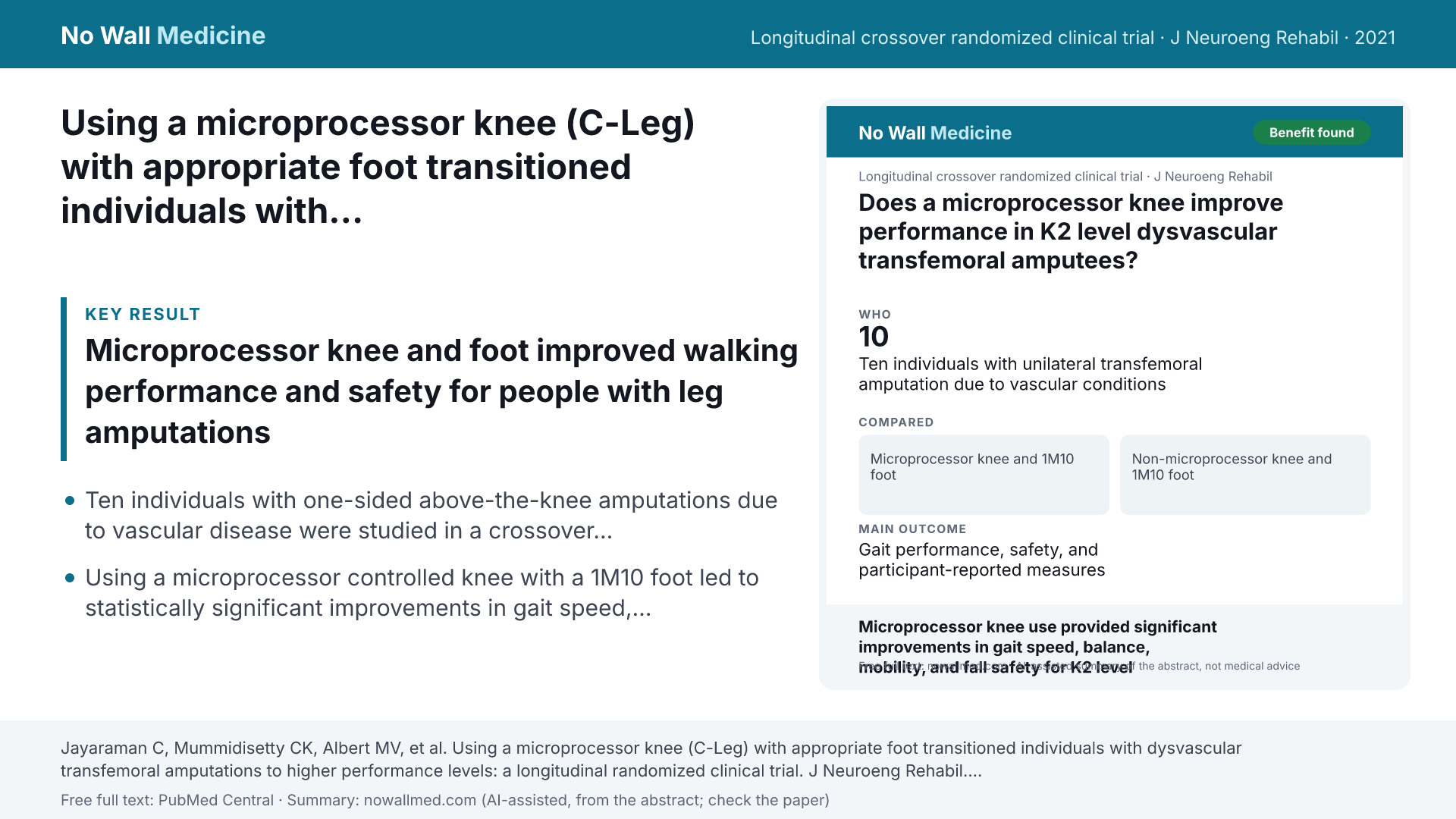
Microprocessor knee and foot improved walking performance and safety for people with leg amputations
Using a microprocessor knee (C-Leg) with appropriate foot transitioned individuals with dysvascular transfemoral amputations to higher performance levels: a longitudinal randomized clinical trial
Longitudinal crossover randomized clinical trialBenefit found
Does a microprocessor knee improve performance in K2 level dysvascular transfemoral amputees?
Who
10
Ten individuals with unilateral transfemoral amputation due to vascular conditions
Compared
Microprocessor knee and 1M10 foot
Non-microprocessor knee and 1M10 foot
Main outcome
Gait performance, safety, and participant-reported measures
Bottom line: Microprocessor knee use provided significant improvements in gait speed, balance, mobility, and fall safety for K2 level individuals.
J Neuroeng Rehabil · 2021-05-25 · Save PNG
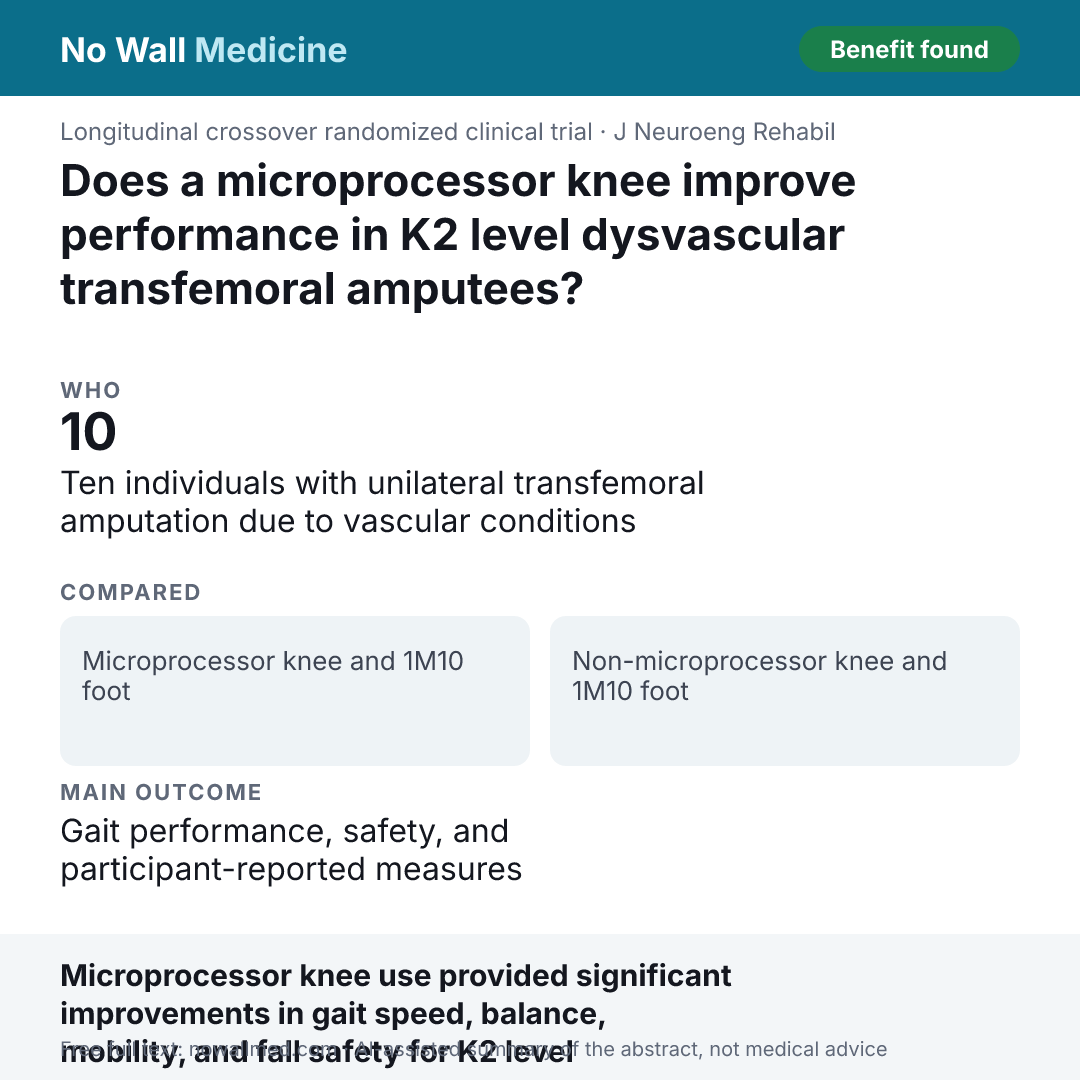
Clinical question: Does a microprocessor knee improve performance in K2 level dysvascular transfemoral amputees?
Why it matters: Insurance policy restrictions often prevent individuals with limited walking ability from accessing advanced microprocessor controlled knees despite potential benefits.
Key points
- Ten individuals with one-sided above-the-knee amputations due to vascular disease were studied in a crossover randomized clinical trial.
- Using a microprocessor controlled knee with a 1M10 foot led to statistically significant improvements in gait speed, balance, mobility, and fall safety compared to a non-microprocessor knee.
- The improvements in clinical scores were within the range reported in previous studies for individuals with a higher functional classification level.
Headline and key points written with AI from the paper’s abstract, with every number checked against it. Read the paper before relying on them.
Was this summary helpful?
Subject terms
Headline, design, result, key points, caveat and citation as plain text.
Cite this article
Jayaraman C, Mummidisetty CK, Albert MV, et al. Using a microprocessor knee (C-Leg) with appropriate foot transitioned individuals with dysvascular transfemoral amputations to higher performance levels: a longitudinal randomized clinical trial. J Neuroeng Rehabil. 2021. doi:10.1186/s12984-021-00879-3
Spotted a mistake? Suggest a correction