Intensive blood pressure control shows different absolute benefits across PREVENT cardiovascular risk levels
Using PREVENT Equations to Compare Intensive vs Standard Systolic Blood Pressure Control for Primary Prevention in SPRINT
Secondary analysis of a randomized trialMixed results
Does intensive versus standard systolic blood pressure control benefit different PREVENT risk levels?
Who
6554
Participants without prevalent cardiovascular disease
Compared
Intensive systolic blood pressure treatment
Standard systolic blood pressure treatment
Main outcome
Composite cardiovascular disease events and serious adverse events
Result: hazard ratio 0.70 (95% CI: 0.52 to 0.93) for intermediate risk
Bottom line: Intensive blood pressure control provides consistent relative risk reduction but varying absolute benefits across PREVENT risk strata.
JACC · 2025-10-23Download image
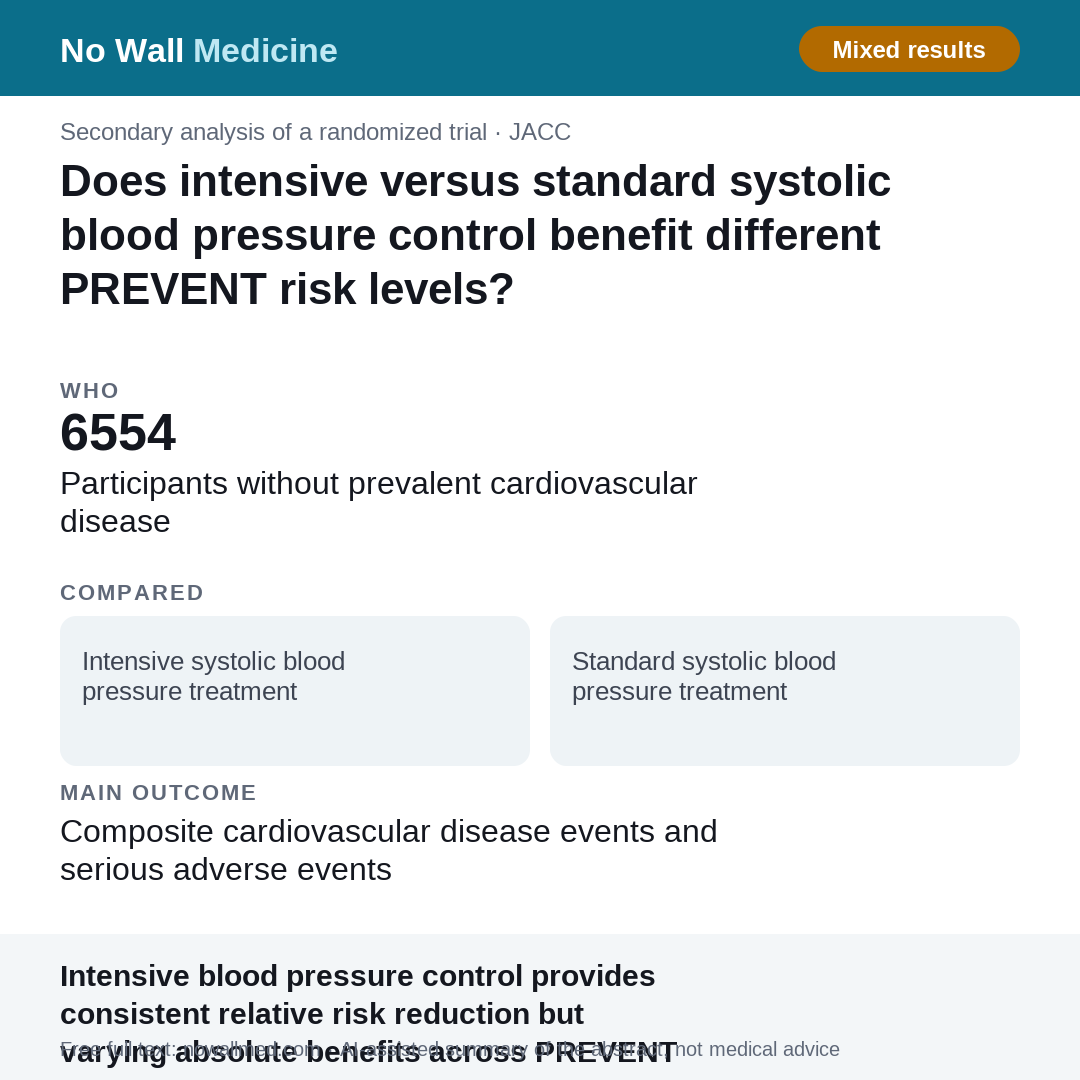
Clinical question: Does intensive versus standard systolic blood pressure control benefit different PREVENT risk levels?
Why it matters: It is unclear how the absolute benefits and harms of intensive versus standard blood pressure control vary across different risk levels calculated by the PREVENT equations.
Key points
- Researchers analyzed 6,554 SPRINT participants without existing cardiovascular disease to compare intensive versus standard systolic blood pressure treatment using PREVENT risk categories.
- The 4-year absolute risk difference for cardiovascular events was 0.002 for low or borderline risk, 0.015 for intermediate risk, and 0.024 for high risk.
- Hazard ratios for cardiovascular events were 0.74 for low or borderline risk, 0.70 for intermediate risk, and 0.85 for high risk.
Headline and key points written with AI from the paper’s abstract, with every number checked against it. Read the paper before relying on them.
Topics
Cite this article
Derington CG, Berchie RO, Greene T, Jacobs JA, Moran AE, Xu Y. Using PREVENT Equations to Compare Intensive vs Standard Systolic Blood Pressure Control for Primary Prevention in SPRINT. JACC. 2025. doi:10.1016/j.jacc.2025.07.037
Spotted a mistake? Suggest a correction