Using psychometric ability to improve education in ultrasound-guided regional anaesthesia: a multicentre randomised controlled trial
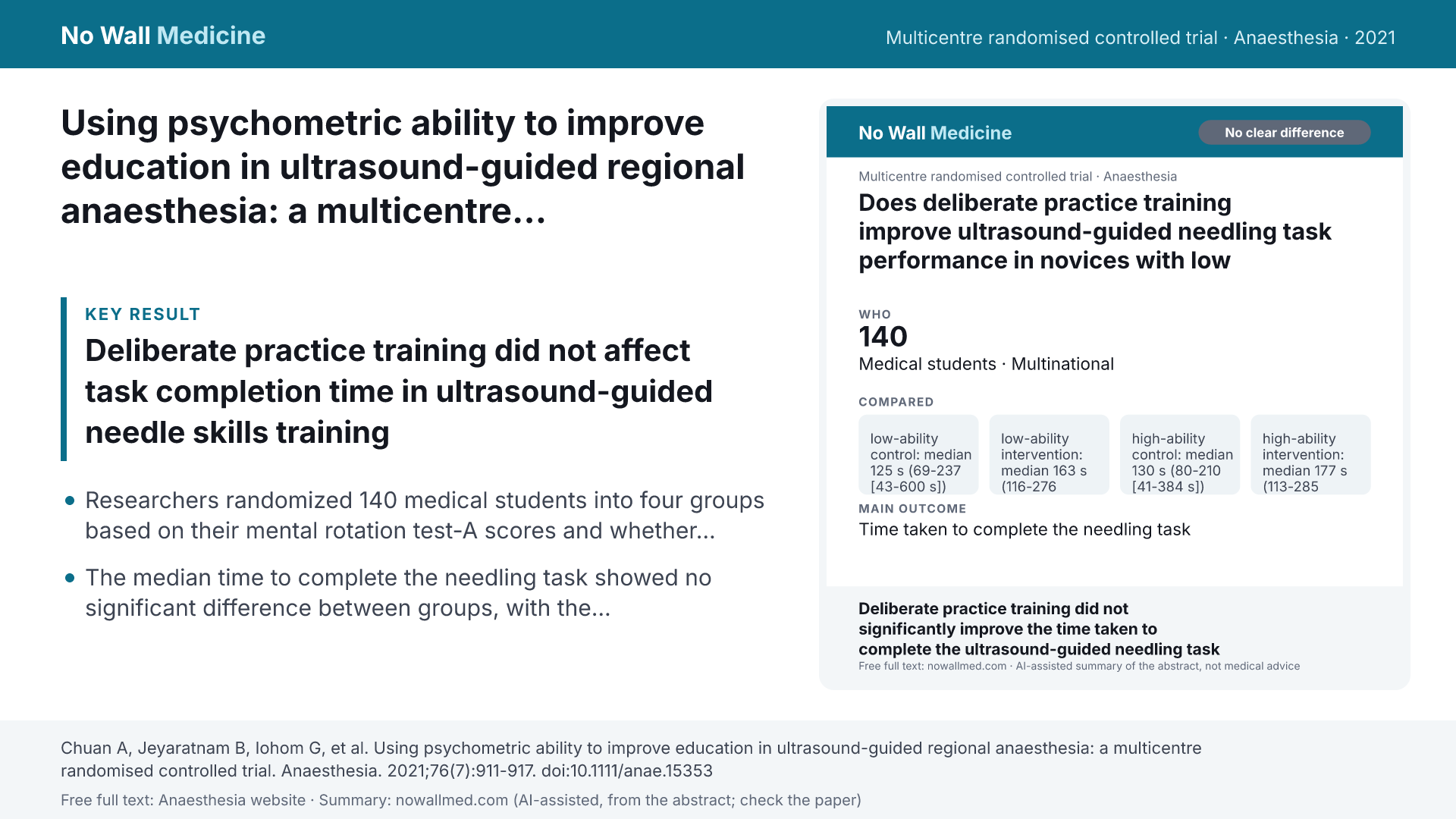
Key result: Deliberate practice training did not affect task completion time in ultrasound-guided needle skills training
Multicentre randomised controlled trialNo clear difference
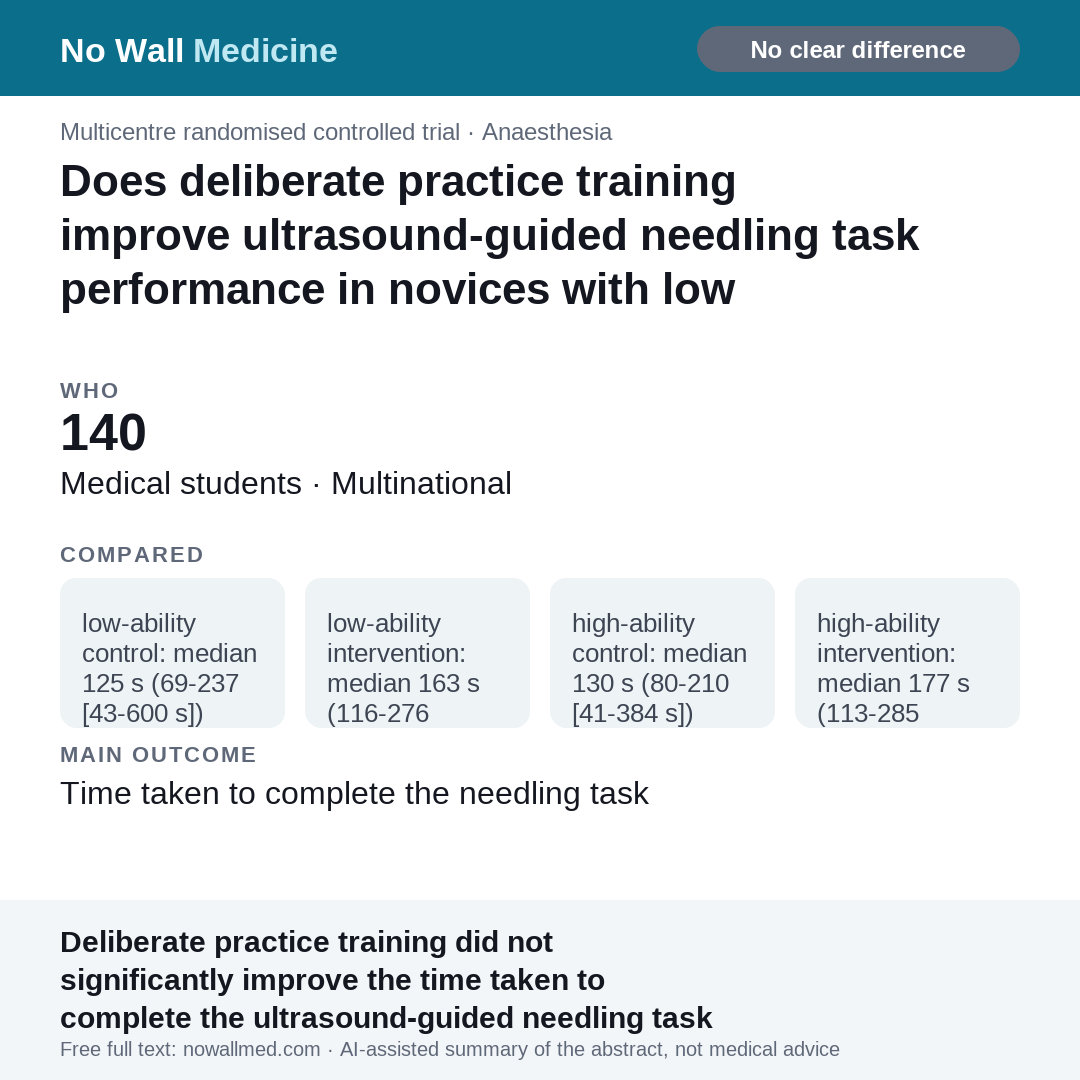
Does deliberate practice training improve ultrasound-guided needling task performance in novices with low visuospatial ability?
Who
140
Medical students · Multinational
Compared
low-ability control: median 125 s (69-237 [43-600 s])
low-ability intervention: median 163 s (116-276 [44-600 s])
high-ability control: median 130 s (80-210 [41-384 s])
high-ability intervention: median 177 s (113-285 [43-547 s])
Main outcome
Time taken to complete the needling task
Bottom line: Deliberate practice training did not significantly improve the time taken to complete the ultrasound-guided needling task across groups.
Anaesthesia · 2021-01-18Download image
Key points
- Researchers randomized 140 medical students into four groups based on their mental rotation test-A scores and whether they received deliberate practice or discovery learning.
- The median time to complete the needling task showed no significant difference between groups, with the low-ability intervention group at 163 s and the high-ability intervention group at 177 s.
- The low-ability control group had a pass rate of 42% (14/33), which was significantly lower than the low-ability intervention (69%), high-ability control (68%), and high-ability intervention (85%) groups.
Discussion prompts
- Would these patients look like yours? Who was left out?
- Is the main outcome one that matters to patients?
- Is the difference large enough to change what you do?
Cite: Chuan A, Jeyaratnam B, Iohom G, et al. Using psychometric ability to improve education in ultrasound-guided regional anaesthesia: a multicentre randomised controlled trial. Anaesthesia. 2021. doi:10.1111/anae.15353
Free full text: Anaesthesia website · Summary and visual abstract: nowallmed.com/a/using-psychometric-ability-to-improve-education-in-ultrasound-guided-8gepuj/ (AI-assisted from the abstract; check the paper before relying on it).