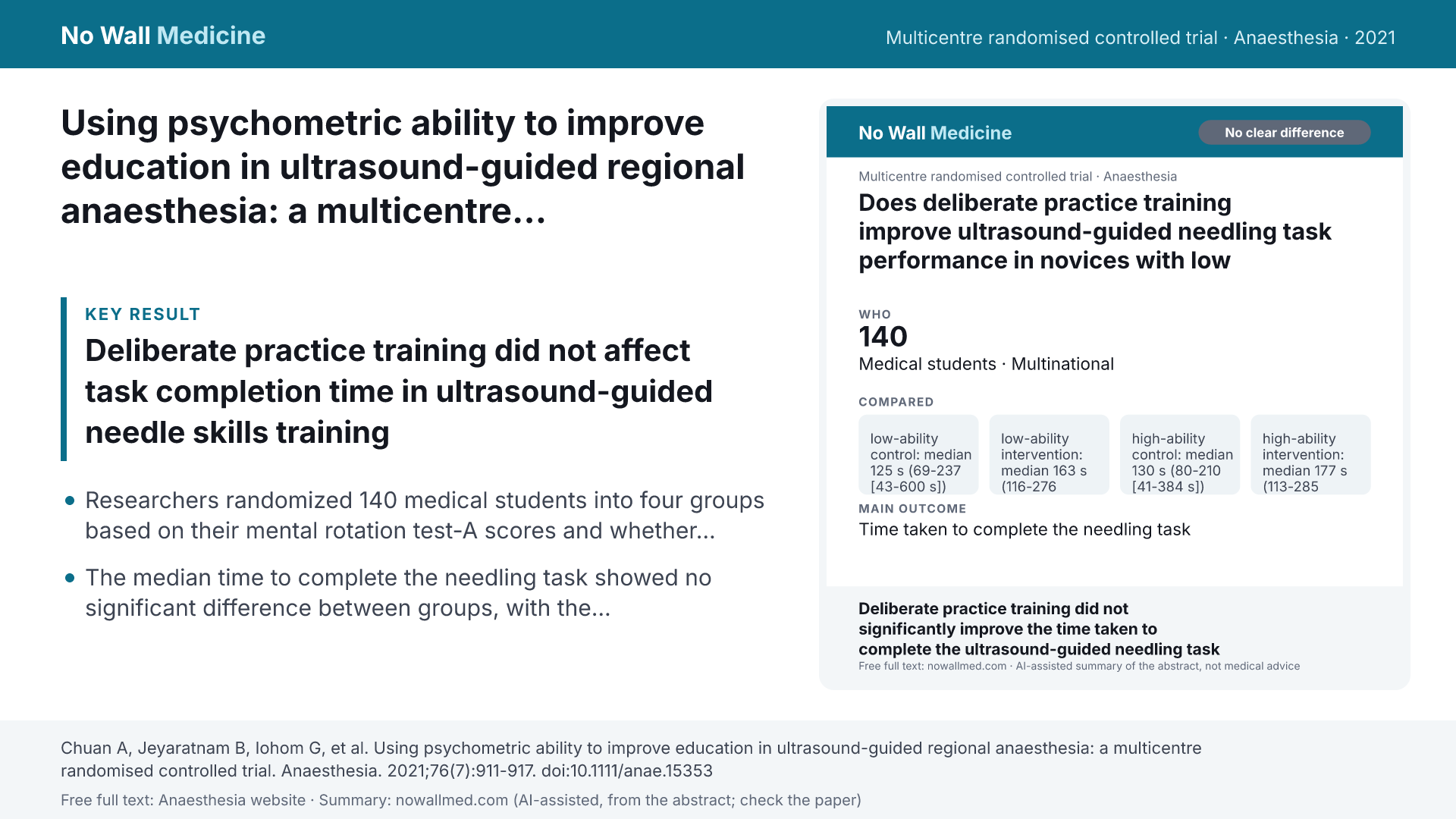
Deliberate practice training did not affect task completion time in ultrasound-guided needle skills training
Using psychometric ability to improve education in ultrasound-guided regional anaesthesia: a multicentre randomised controlled trial
Multicentre randomised controlled trialNo clear difference
Does deliberate practice training improve ultrasound-guided needling task performance in novices with low visuospatial ability?
Who
140
Medical students · Multinational
Compared
low-ability control: median 125 s (69-237 [43-600 s])
low-ability intervention: median 163 s (116-276 [44-600 s])
high-ability control: median 130 s (80-210 [41-384 s])
high-ability intervention: median 177 s (113-285 [43-547 s])
Main outcome
Time taken to complete the needling task
Bottom line: Deliberate practice training did not significantly improve the time taken to complete the ultrasound-guided needling task across groups.
Anaesthesia · 2021-01-18Download image
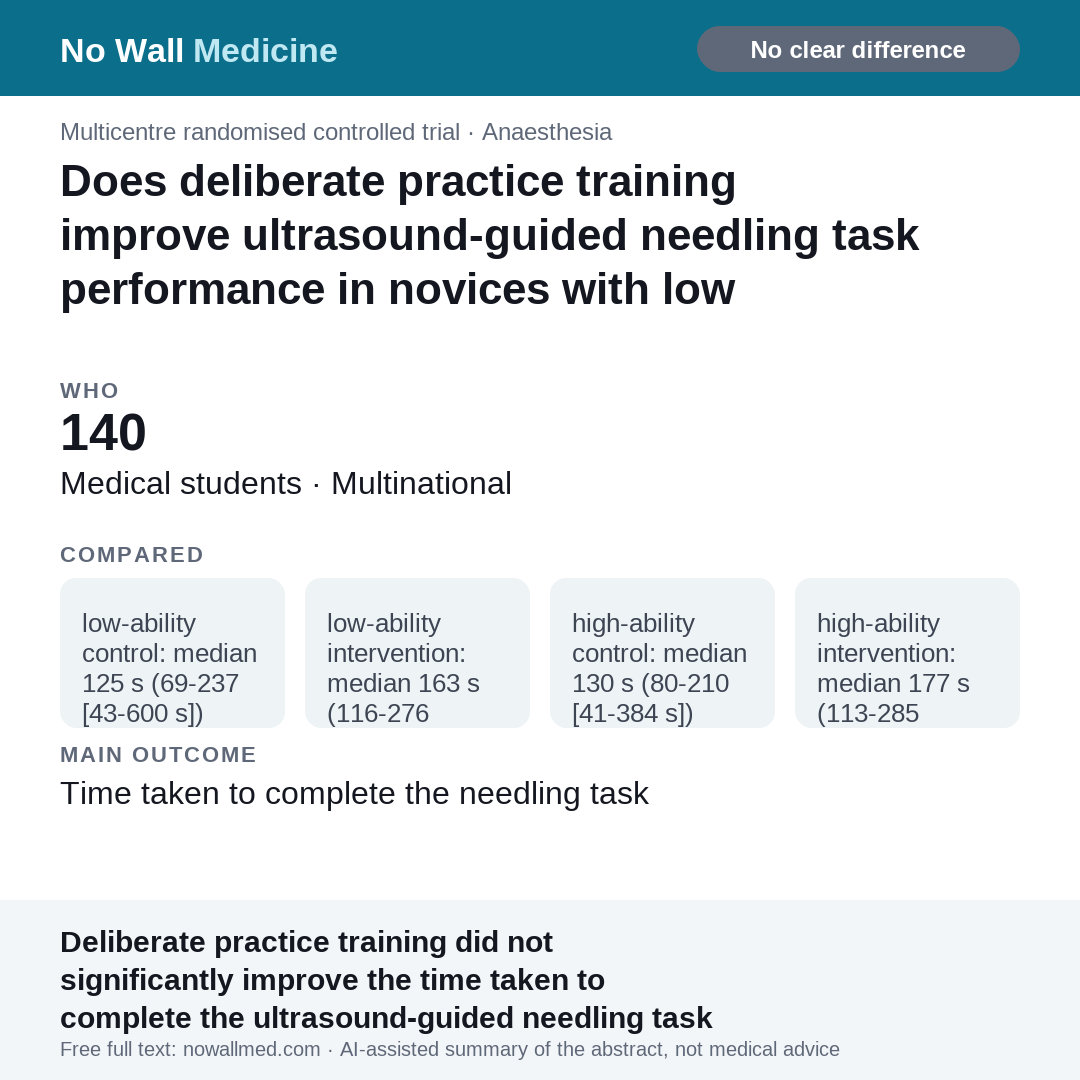
Clinical question: Does deliberate practice training improve ultrasound-guided needling task performance in novices with low visuospatial ability?
Why it matters: It is unknown if innate visuospatial ability affects how novices learn real-time ultrasound-guided needle manipulation through different training methods.
Key points
- Researchers randomized 140 medical students into four groups based on their mental rotation test-A scores and whether they received deliberate practice or discovery learning.
- The median time to complete the needling task showed no significant difference between groups, with the low-ability intervention group at 163 s and the high-ability intervention group at 177 s.
- The low-ability control group had a pass rate of 42% (14/33), which was significantly lower than the low-ability intervention (69%), high-ability control (68%), and high-ability intervention (85%) groups.
Headline and key points written with AI from the paper’s abstract, with every number checked against it. Read the paper before relying on them.
Was this summary helpful?
Subject terms
Cite this article
Chuan A, Jeyaratnam B, Iohom G, Shorten G, Lee P, Miglani S. Using psychometric ability to improve education in ultrasound-guided regional anaesthesia: a multicentre randomised controlled trial. Anaesthesia. 2021. doi:10.1111/anae.15353
Spotted a mistake? Suggest a correction
Top studies every Monday
The week’s key trials and guidelines in your specialties, plus any topics you follow. By email, free.
Get the weekly digest