Deep cervical plexus blocks were associated with more diaphragm movement reduction than superficial blocks
Depth of cervical plexus block and phrenic nerve blockade: a randomized trial
Observer blinded randomized controlled trialHarm found
Does the depth of cervical plexus block impact phrenic nerve blockade and diaphragmatic motion?
Who
45
Patients scheduled for elective, awake carotid endarterectomy
Compared
Superficial cervical plexus block: 4.34±1.06 cm
Intermediate cervical plexus block: 3.86±1.24 cm
Deep cervical plexus block: 2.04±1.20 cm
Main outcome
Ipsilateral difference of hemi-diaphragmatic motion during forced inspiration
Result: p<0.001
Bottom line: Deep cervical plexus blocks caused the most pronounced diaphragmatic dysfunction compared to intermediate and superficial blocks.
Reg Anesth Pain Med · 2022-01-10Download image
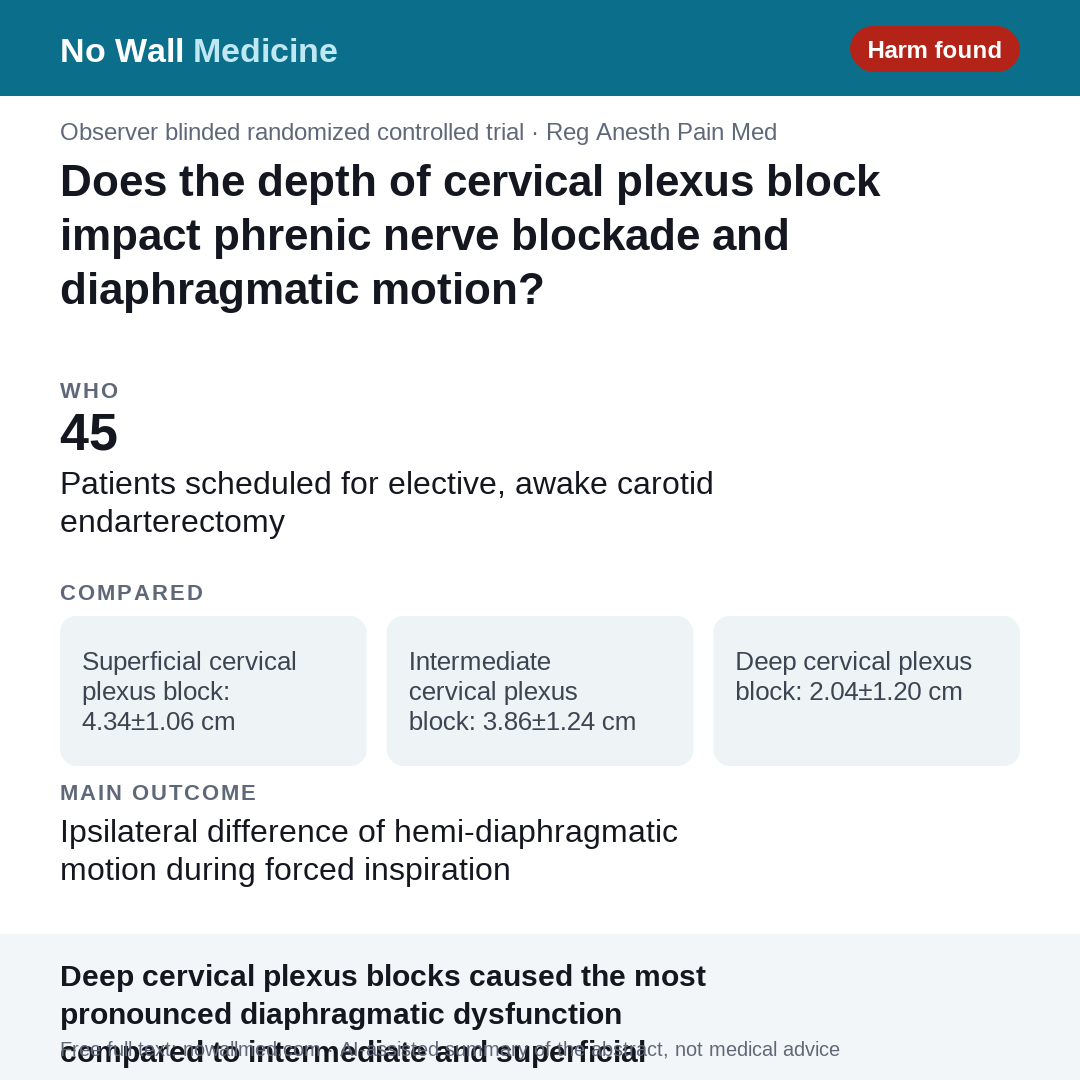
Clinical question: Does the depth of cervical plexus block impact phrenic nerve blockade and diaphragmatic motion?
Why it matters: It was unknown how the depth of a cervical plexus block, which is a local anesthetic injection in the neck, affects the phrenic nerve and diaphragm movement.
Key points
- Researchers conducted a randomized trial with 45 patients undergoing awake carotid endarterectomy, comparing superficial, intermediate, and deep cervical plexus blocks.
- During forced inspiration, mean ipsilateral diaphragm movement was 4.34±1.06 cm for superficial, 3.86±1.24 cm for intermediate, and 2.04±1.20 cm for deep blocks (p<0.001).
- Lung function, oxygen saturation, complication rates, and patient satisfaction showed no differences between the three block depths.
Headline and key points written with AI from the paper’s abstract, with every number checked against it. Read the paper before relying on them.
Was this summary helpful?
Abstract
Background and objectives
Cervical plexus blocks are commonly used to facilitate carotid endarterectomy (CEA) in the awake patient. These blocks can be divided into superficial, intermediate, and deep blocks by their relation to the fasciae of the neck. We hypothesized that the depth of block would have a significant impact on phrenic nerve blockade and consequently hemi-diaphragmatic motion. Methods
We enrolled 45 patients in an observer blinded randomized controlled trial, scheduled for elective, awake CEA. Patients received either deep, intermediate, or superficial cervical plexus blocks, using 20 mL of 0.5% ropivacaine mixed with an MRI contrast agent. Before and after placement of the block, transabdominal ultrasound measurements of diaphragmatic movement were performed. Patients underwent MRI of the neck to evaluate spread of the injectate, as well as lung function measurements. The primary outcome was ipsilateral difference of hemi-diaphragmatic motion during forced inspiration between study groups. Results
Postoperatively, forced inspiration movement of the ipsilateral diaphragm (4.34±1.06, 3.86±1.24, 2.04±1.20 (mean in cm±SD for superficial, intermediate and deep, respectively)) was statistically different between block groups (p<0.001). Differences were also seen during normal inspiration. Lung function, oxygen saturation, complication rates, and patient satisfaction did not differ. MRI studies indicated pronounced permeation across the superficial fascia, but nevertheless easily distinguishable spread of injectate within the targeted compartments. Conclusions
We studied the characteristics and side effects of cervical plexus blocks by depth of injection. Diaphragmatic dysfunction was most pronounced in the deep cervical plexus block group. Trial registration number
EudraCT 2017-001300-30.
Abstract reproduced under the article’s CC BY NC licence.
Subject terms
Cite this article
Opperer M, Kaufmann R, Meissnitzer M, Enzmann FK, Dinges C, Hitzl W. Depth of cervical plexus block and phrenic nerve blockade: a randomized trial. Reg Anesth Pain Med. 2022. doi:10.1136/rapm-2021-102851
Spotted a mistake? Suggest a correction
Top studies every Monday
The week’s key trials and guidelines in your specialties, plus any topics you follow. By email, free.
Get the weekly digest