Differential time to positivity shows high accuracy for diagnosing central line-associated bloodstream infections
Utility of Differential Time to Positivity in Diagnosing Central Line-Associated Bloodstream Infections: A Systematic Review and Meta-Analysis
Key points
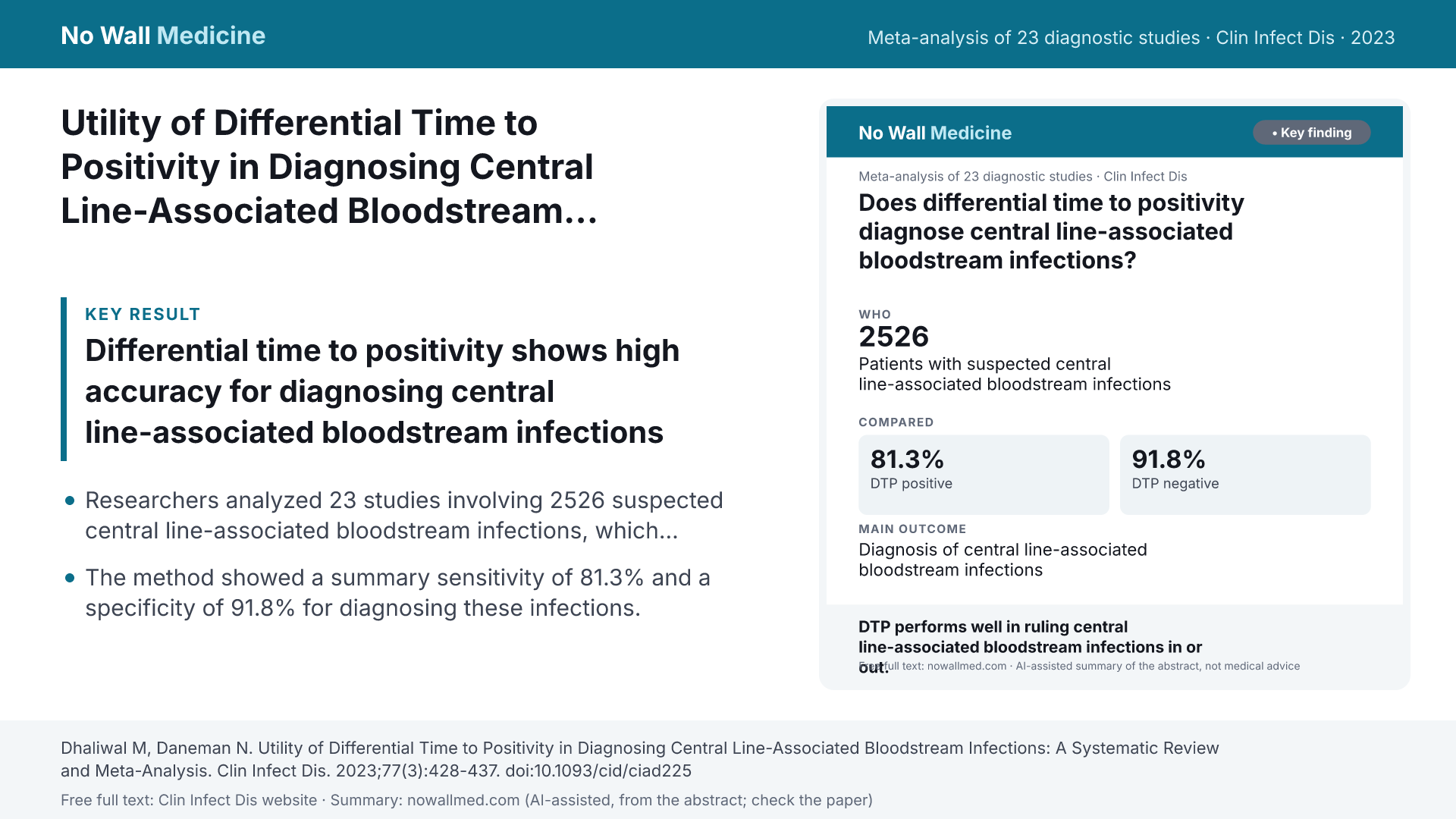
- Researchers analyzed 23 studies involving 2526 suspected central line-associated bloodstream infections, which are infections occurring in the bloodstream due to a central venous catheter.
- The method showed a summary sensitivity of 81.3% and a specificity of 91.8% for diagnosing these infections.
- Performance varied by organism, with Staphylococcus aureus showing low sensitivity and Candida showing high sensitivity but low specificity.
Headline and key points written with AI from the paper’s abstract, with every number checked against it. Read the paper before relying on them.
Was this summary helpful?
Subject terms
Cite this article
Dhaliwal M, Daneman N. Utility of Differential Time to Positivity in Diagnosing Central Line-Associated Bloodstream Infections: A Systematic Review and Meta-Analysis. Clin Infect Dis. 2023;77(3):428-437. doi:10.1093/cid/ciad225
Spotted a mistake? Suggest a correction