Utilization of wearable technology to assess gait and mobility post-stroke: a systematic review
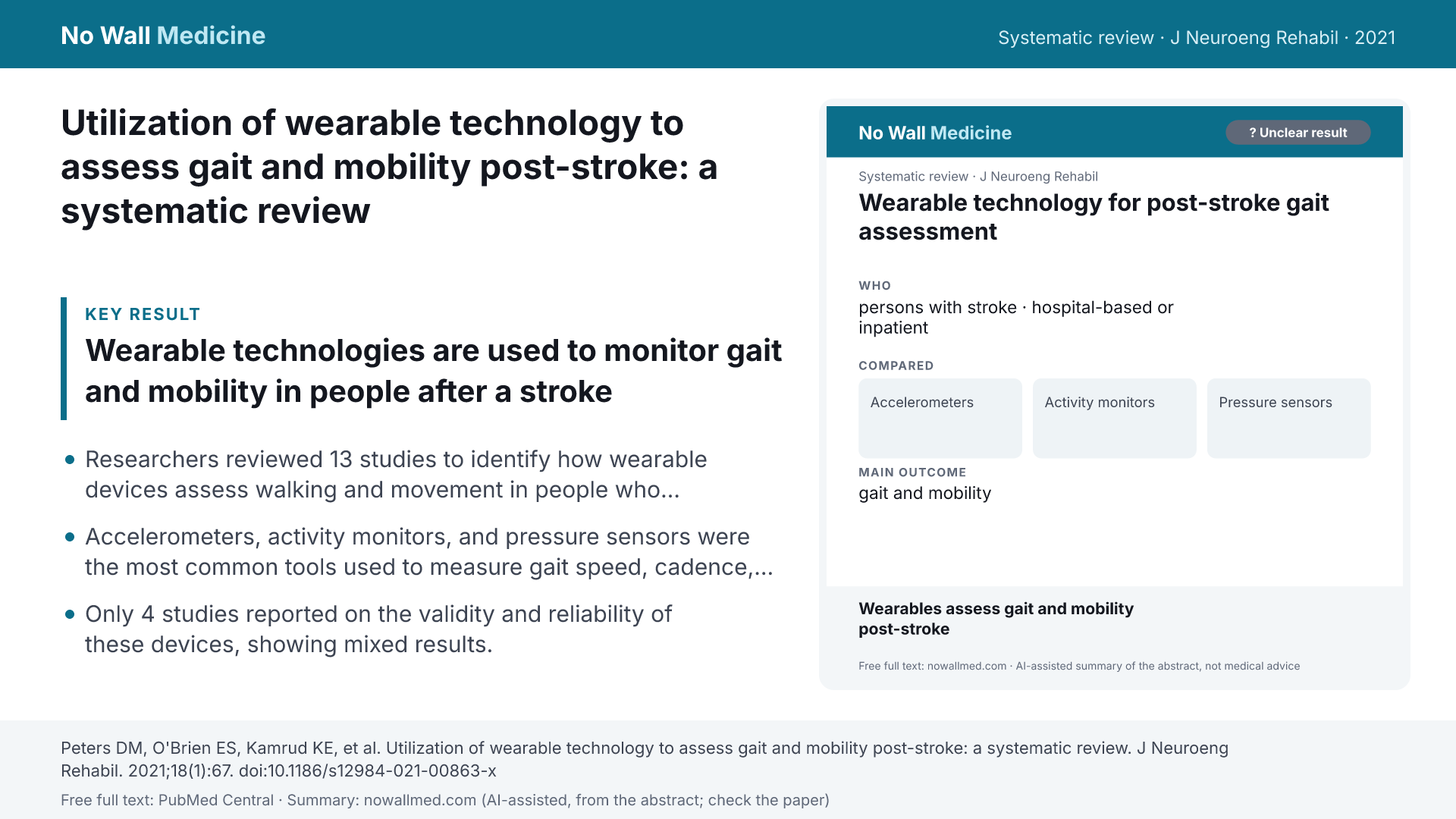
Key result: Wearable technologies are used to monitor gait and mobility in people after a stroke
Systematic reviewUnclear result
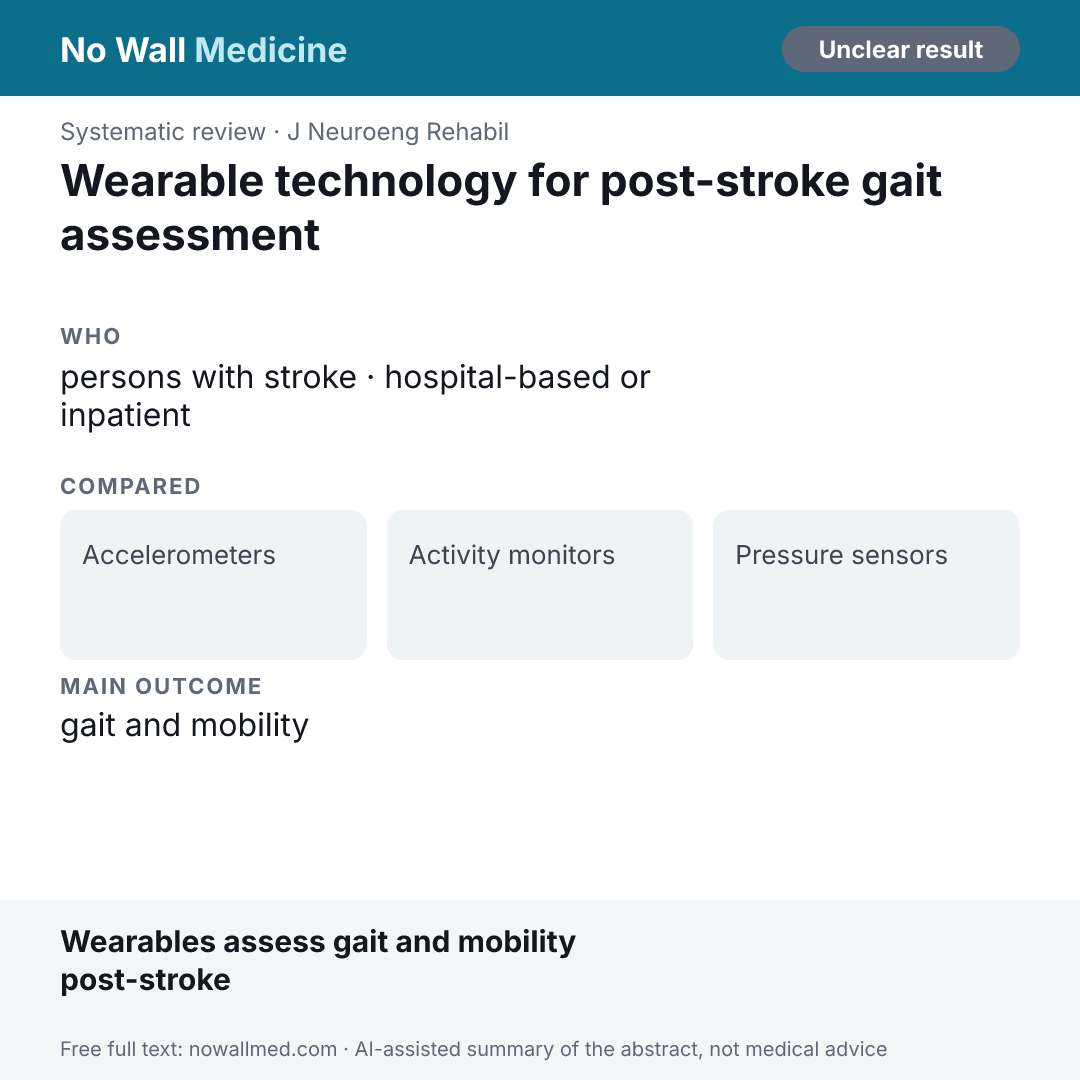
Wearable technology for post-stroke gait assessment
Who
persons with stroke · hospital-based or inpatient
Compared
Accelerometers
Activity monitors
Pressure sensors
Main outcome
gait and mobility
Bottom line: Wearables assess gait and mobility post-stroke
Limitation: limited validity and reliability data
J Neuroeng Rehabil · 2021-04-21 · Save PNG
Key points
- Researchers reviewed 13 studies to identify how wearable devices assess walking and movement in people who have experienced a stroke.
- Accelerometers, activity monitors, and pressure sensors were the most common tools used to measure gait speed, cadence, and step count.
- Only 4 studies reported on the validity and reliability of these devices, showing mixed results.
Discussion prompts
- Would these patients look like yours? Who was left out?
- Is the main outcome one that matters to patients?
- Is the difference large enough to change what you do?
Cite: Peters DM, O'Brien ES, Kamrud KE, et al. Utilization of wearable technology to assess gait and mobility post-stroke: a systematic review. J Neuroeng Rehabil. 2021;18(1):67. doi:10.1186/s12984-021-00863-x
Free full text: PubMed Central · Summary and visual abstract: nowallmed.com/a/utilization-of-wearable-technology-to-assess-gait-and-mobility-post-uqqo3h/ (AI-assisted from the abstract; check the paper before relying on it).