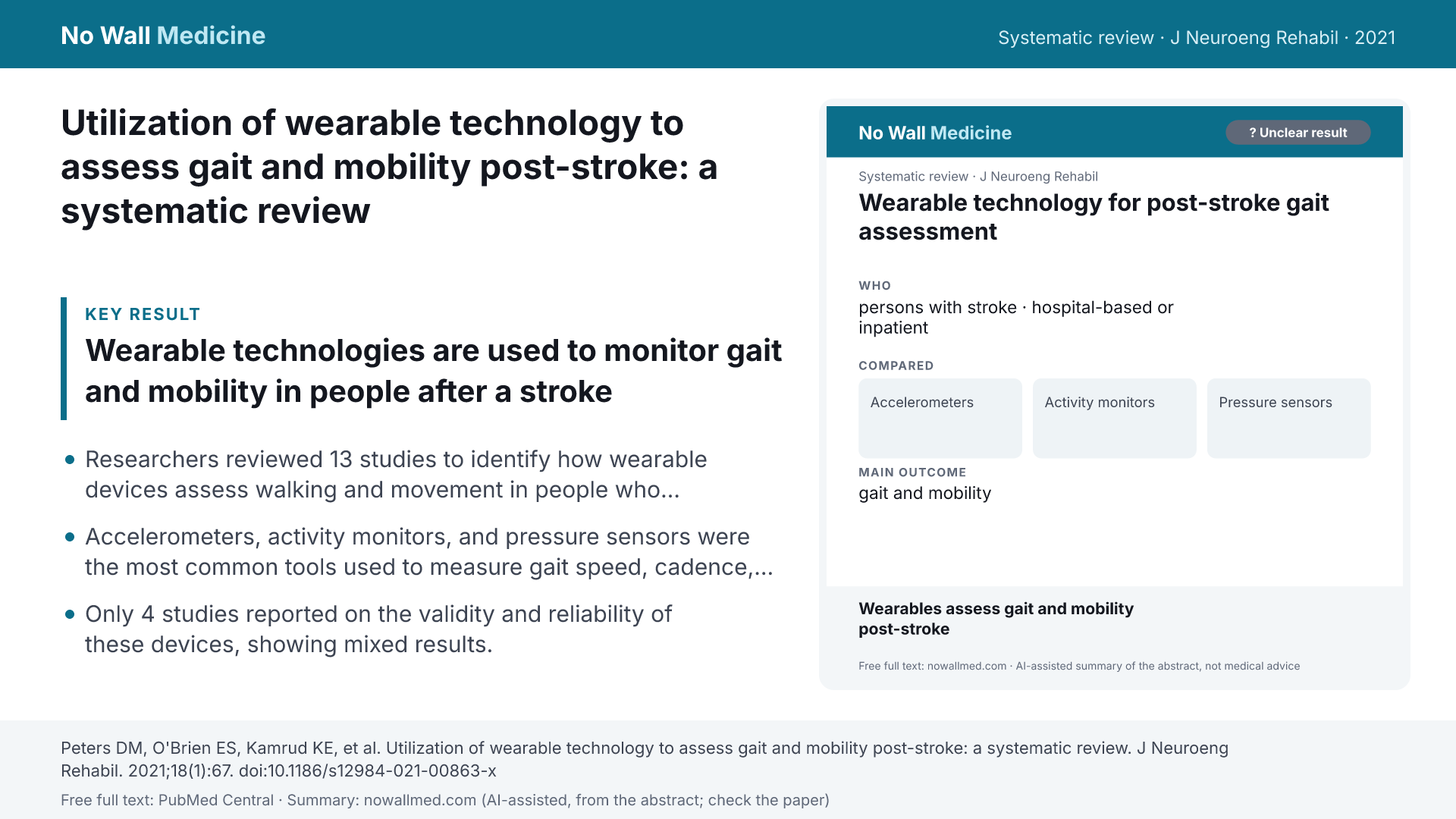
Wearable technologies are used to monitor gait and mobility in people after a stroke
Utilization of wearable technology to assess gait and mobility post-stroke: a systematic review
Systematic reviewUnclear result
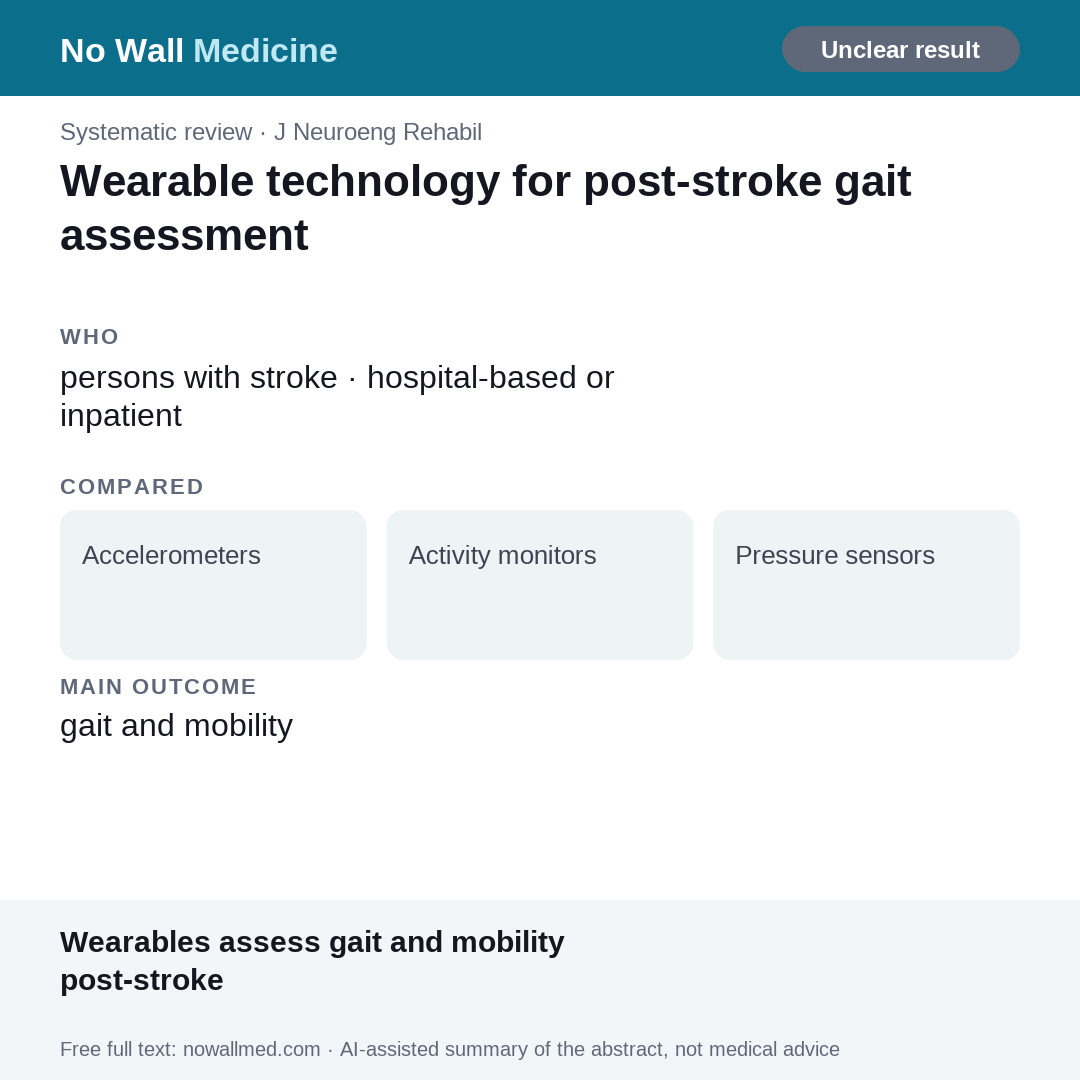
Wearable technology for post-stroke gait assessment
Who
persons with stroke · hospital-based or inpatient
Compared
Accelerometers
Activity monitors
Pressure sensors
Main outcome
gait and mobility
Bottom line: Wearables assess gait and mobility post-stroke
Limitation: limited validity and reliability data
J Neuroeng Rehabil · 2021-04-21Download image
Why it matters: It is unknown how wearable technologies are used to assess gait and mobility in people after a stroke and how accurate these devices are for this population.
Key points
- Researchers reviewed 13 studies to identify how wearable devices assess walking and movement in people who have experienced a stroke.
- Accelerometers, activity monitors, and pressure sensors were the most common tools used to measure gait speed, cadence, and step count.
- Only 4 studies reported on the validity and reliability of these devices, showing mixed results.
Headline and key points written with AI from the paper’s abstract, with every number checked against it. Read the paper before relying on them.
Was this summary helpful?
Subject terms
Cite this article
Peters DM, O'Brien ES, Kamrud KE, Roberts SM, Rooney TA, Thibodeau KP. Utilization of wearable technology to assess gait and mobility post-stroke: a systematic review. J Neuroeng Rehabil. 2021. doi:10.1186/s12984-021-00863-x
Spotted a mistake? Suggest a correction