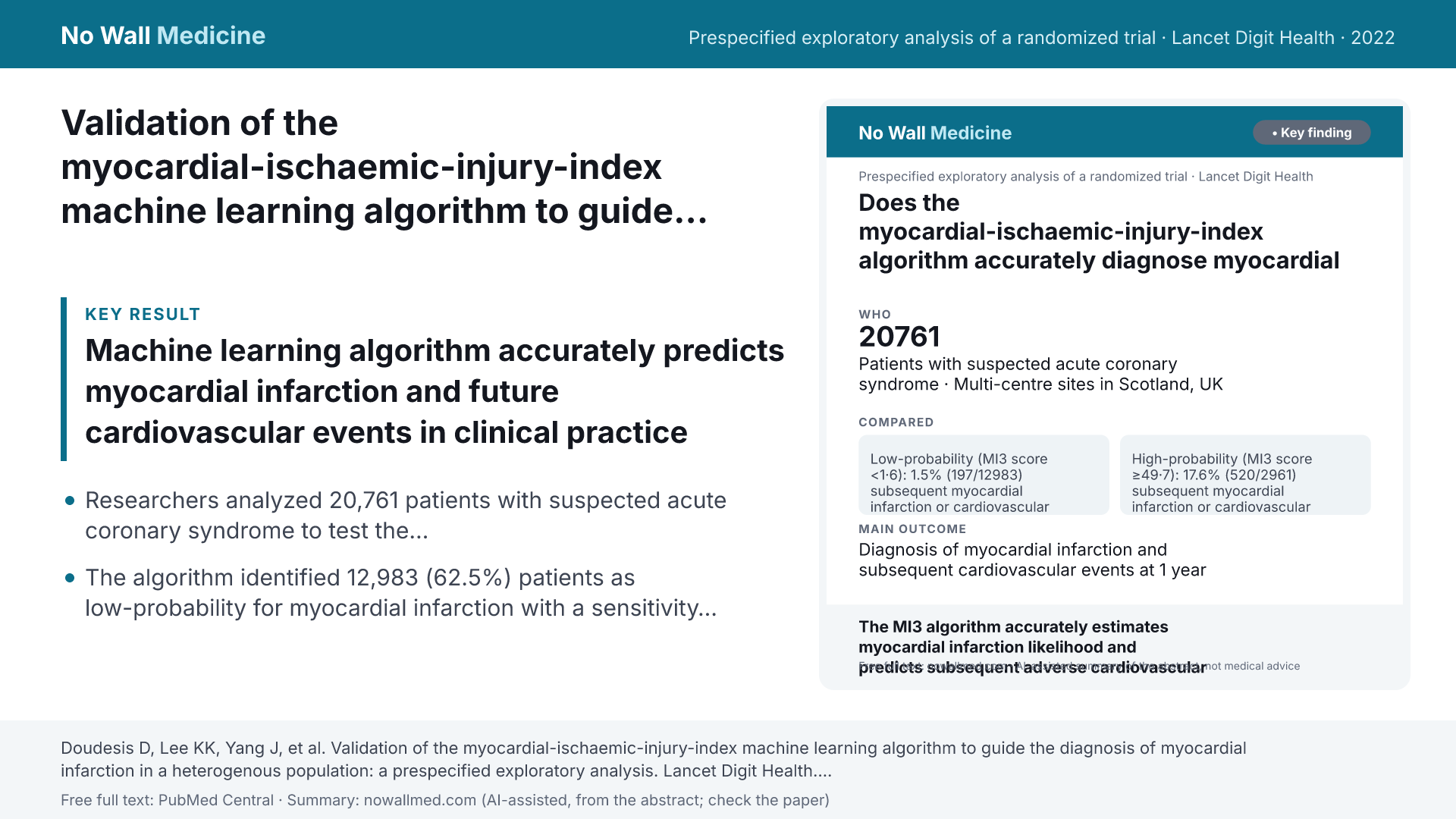
Machine learning algorithm accurately predicts myocardial infarction and future cardiovascular events in clinical practice
Validation of the myocardial-ischaemic-injury-index machine learning algorithm to guide the diagnosis of myocardial infarction in a heterogenous population: a prespecified exploratory analysis
Prespecified exploratory analysis of a randomized trialKey finding
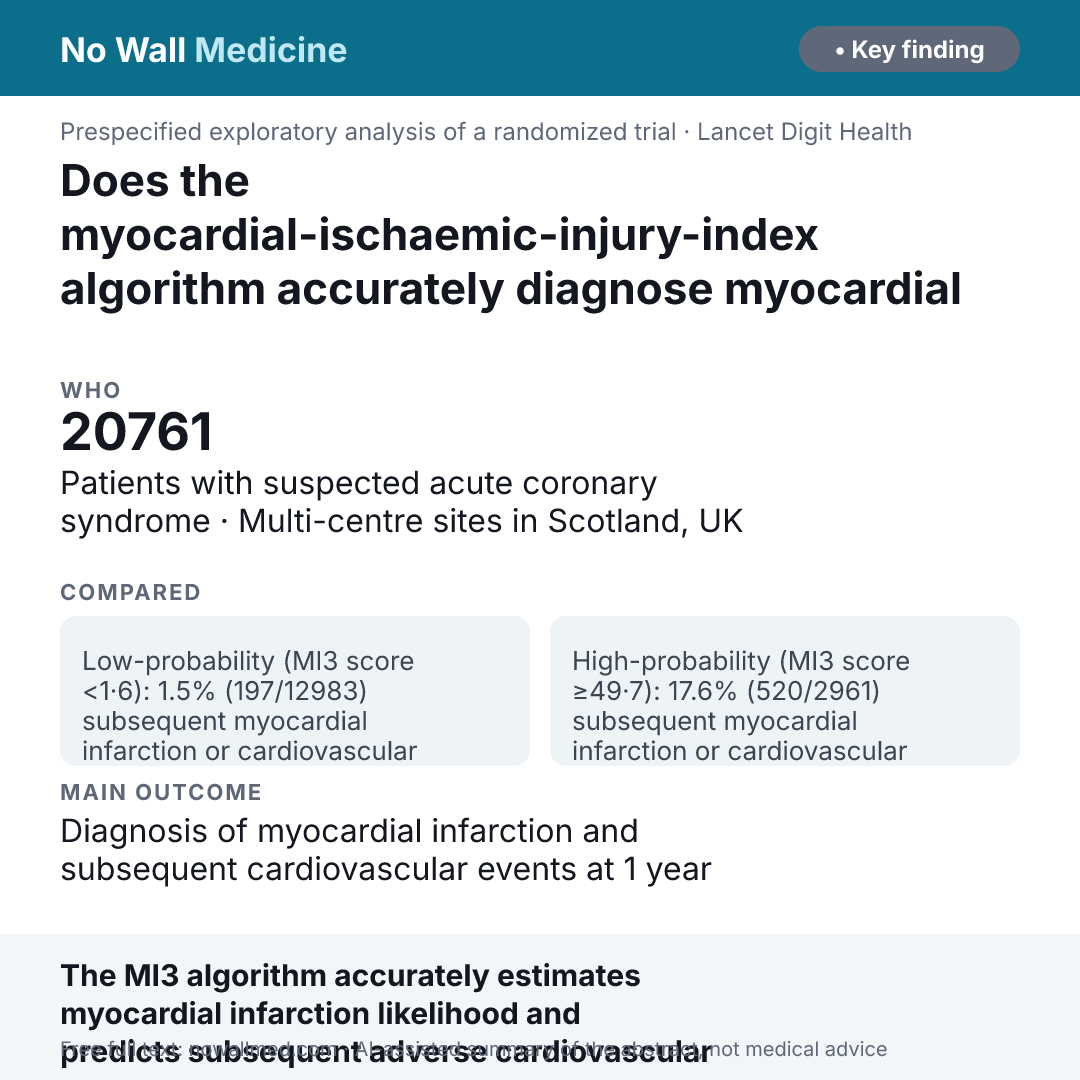
Does the myocardial-ischaemic-injury-index algorithm accurately diagnose myocardial infarction and predict subsequent events?
Who
20761
Patients with suspected acute coronary syndrome · Multi-centre sites in Scotland, UK
Compared
Low-probability (MI3 score <1·6): 1.5% (197/12983) subsequent myocardial infarction or cardiovascular death
High-probability (MI3 score ≥49·7): 17.6% (520/2961) subsequent myocardial infarction or cardiovascular death
Main outcome
Diagnosis of myocardial infarction and subsequent cardiovascular events at 1 year
Result: area under the receiver-operating-characteristic curve 0·949 (95% CI 0·946-0·952)
Bottom line: The MI3 algorithm accurately estimates myocardial infarction likelihood and predicts subsequent adverse cardiovascular events in suspected acute coronary syndrome.
Funded by: Medical Research Council, British Heart Foundation, NIHR, and NHSX
Lancet Digit Health · 2022-04-24 · Save PNG
Same trial (NCT01852123)
Papers we list that report this registered trial, oldest first. Read a secondary analysis alongside the main results.
- Secondary analysis Key finding
This paper Lancet Digit Health 2022-04 - Secondary analysis
Different causes of type 2 myocardial infarction are associated with different one-year death risks JAMA Netw Open 2022-07 - Main results Benefit found
High sensitivity cardiac troponin testing was associated with lower five year risk of death or heart attack BMJ 2023-11 - Related report
Exploring Sex-Specific High-Sensitivity Cardiac Troponin Thresholds for Rule-Out of Non-ST-Elevation Myocardial Infarction Clin Chem 2026-05
Why it matters: Fixed troponin thresholds used for diagnosing heart attacks do not account for variations in troponin levels based on age, sex, or time.
Headline and visual abstract written with AI from the paper’s abstract, with every number checked against it. Read the paper before relying on them.
Was this summary helpful?
Abstract
Background
Diagnostic pathways for myocardial infarction rely on fixed troponin thresholds, which do not recognise that troponin varies by age, sex, and time within individuals. To overcome this limitation, we recently introduced a machine learning algorithm that predicts the likelihood of myocardial infarction. Our aim was to evaluate whether this algorithm performs well in routine clinical practice and predicts subsequent events. Methods
The myocardial-ischaemic-injury-index (MI3) algorithm was validated in a prespecified exploratory analysis using data from a multi-centre randomised trial done in Scotland, UK that included consecutive patients with suspected acute coronary syndrome undergoing serial high-sensitivity cardiac troponin I measurement. Patients with ST-segment elevation myocardial infarction were excluded. MI3 incorporates age, sex, and two troponin measurements to compute a value (0-100) reflecting an individual's likelihood of myocardial infarction during the index visit and estimates diagnostic performance metrics (including area under the receiver-operating-characteristic curve, and the sensitivity, specificity, negative predictive value, and positive predictive value) at the computed score. Model performance for an index diagnosis of myocardial infarction (type 1 or type 4b), and for subsequent myocardial infarction or cardiovascular death at 1 year was determined using the previously defined low-probability threshold (1·6) and high-probability MI3 threshold (49·7). The trial is registered with ClinicalTrials.gov, NCT01852123. Findings
In total, 20 761 patients (64 years [SD 16], 9597 [46%] women) enrolled between June 10, 2013, and March 3, 2016, were included from the High-STEACS trial cohort, of whom 3272 (15·8%) had myocardial infarction. MI3 had an area under the receiver-operating-characteristic curve of 0·949 (95% CI 0·946-0·952) identifying 12 983 (62·5%) patients as low-probability for myocardial infarction at the pre-specified threshold (MI3 score <1·6; sensitivity 99·3% [95% CI 99·0-99·6], negative predictive value 99·8% [99·8-99·9]), and 2961 (14·3%) as high-probability at the pre-specified threshold (MI3 score ≥49·7; specificity 95·0% [94·6-95·3], positive predictive value 70·4% [68·7-72·0]). At 1 year, subsequent myocardial infarction or cardiovascular death occurred more often in high-probability patients than low-probability patients (520 [17·6%] of 2961 vs 197 [1·5%] of 12 983], p<0·0001). Interpretation
In consecutive patients undergoing serial cardiac troponin measurement for suspected acute coronary syndrome, the MI3 algorithm accurately estimated the likelihood of myocardial infarction and predicted subsequent adverse cardiovascular events. By providing individual probabilities the MI3 algorithm could improve the diagnosis and assessment of risk in patients with suspected acute coronary syndrome. Funding
Medical Research Council, British Heart Foundation, National Institute for Health Research, and NHSX.
Abstract reproduced under the article’s CC BY licence.
Subject terms
Headline, design, result, bottom line, caveat and citation as plain text.
Cite this article
Doudesis D, Lee KK, Yang J, et al. Validation of the myocardial-ischaemic-injury-index machine learning algorithm to guide the diagnosis of myocardial infarction in a heterogenous population: a prespecified exploratory analysis. Lancet Digit Health. 2022;4(5):e300-e308. doi:10.1016/S2589-7500(22)00025-5
Spotted a mistake? Suggest a correction