Genetic risk scores for certain lung receptors are associated with airway responses to allergens and pollution
Variants in transient receptor potential channels and toll-like receptors modify airway responses to allergen and air pollution: a randomized controlled response human exposure study
Randomized, double-blinded, four-arm, crossover studyMixed results
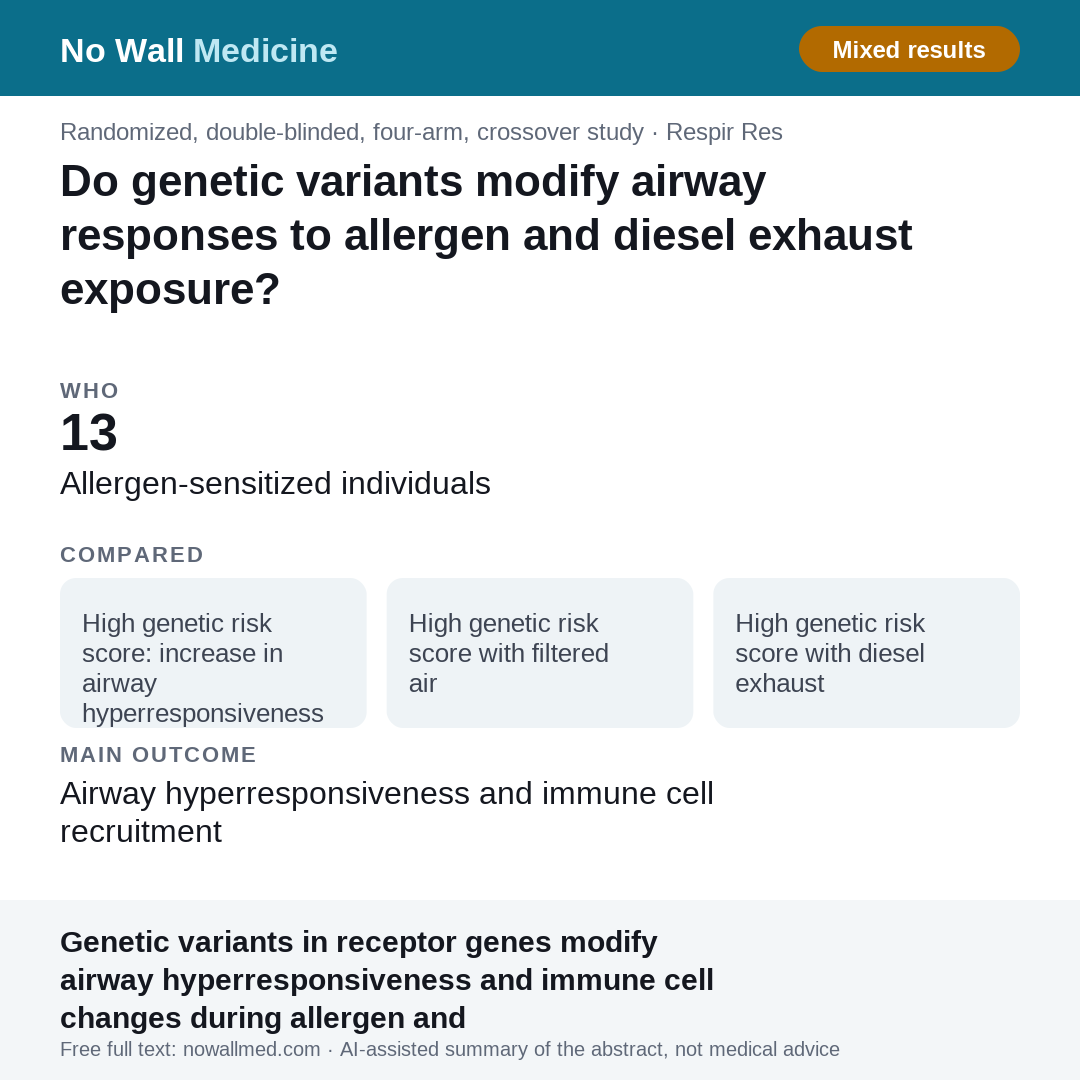
Do genetic variants modify airway responses to allergen and diesel exhaust exposure?
Who
13
Allergen-sensitized individuals
Compared
High genetic risk score: increase in airway hyperresponsiveness when co-exposed to particle-depleted diesel exhaust
High genetic risk score with filtered air
High genetic risk score with diesel exhaust
Main outcome
Airway hyperresponsiveness and immune cell recruitment
Bottom line: Genetic variants in receptor genes modify airway hyperresponsiveness and immune cell changes during allergen and particle-depleted diesel exhaust exposure.
Respir Res · 2023-09-07Download image
Clinical question: Do genetic variants modify airway responses to allergen and diesel exhaust exposure?
Why it matters: It is unknown if specific genetic variations in lung cell surface receptors modify how individuals respond to combined exposure to allergens and air pollution.
Key points
- Researchers studied 13 allergen-sensitized participants in a randomized, double-blinded, crossover study involving exposures to diesel exhaust, particle-depleted diesel exhaust, or filtered air.
- In participants with a high genetic risk score, allergen exposure was associated with an increase in airway hyperresponsiveness when co-exposed to particle-depleted diesel exhaust (p = 0.03).
- Filtered air and particle-depleted diesel exhaust were also associated with a relative increase in macrophages and a decrease in lymphocytes in bronchoalveolar lavage.
Headline and key points written with AI from the paper’s abstract, with every number checked against it. Read the paper before relying on them.
Was this summary helpful?
Subject terms
Cite this article
Robinson A, Huff RD, Ryu MH, Carlsten C. Variants in transient receptor potential channels and toll-like receptors modify airway responses to allergen and air pollution: a randomized controlled response human exposure study. Respir Res. 2023. doi:10.1186/s12931-023-02518-y
Spotted a mistake? Suggest a correction
Top studies every Monday
The week’s key trials and guidelines in your specialties, plus any topics you follow. By email, free.
Get the weekly digest