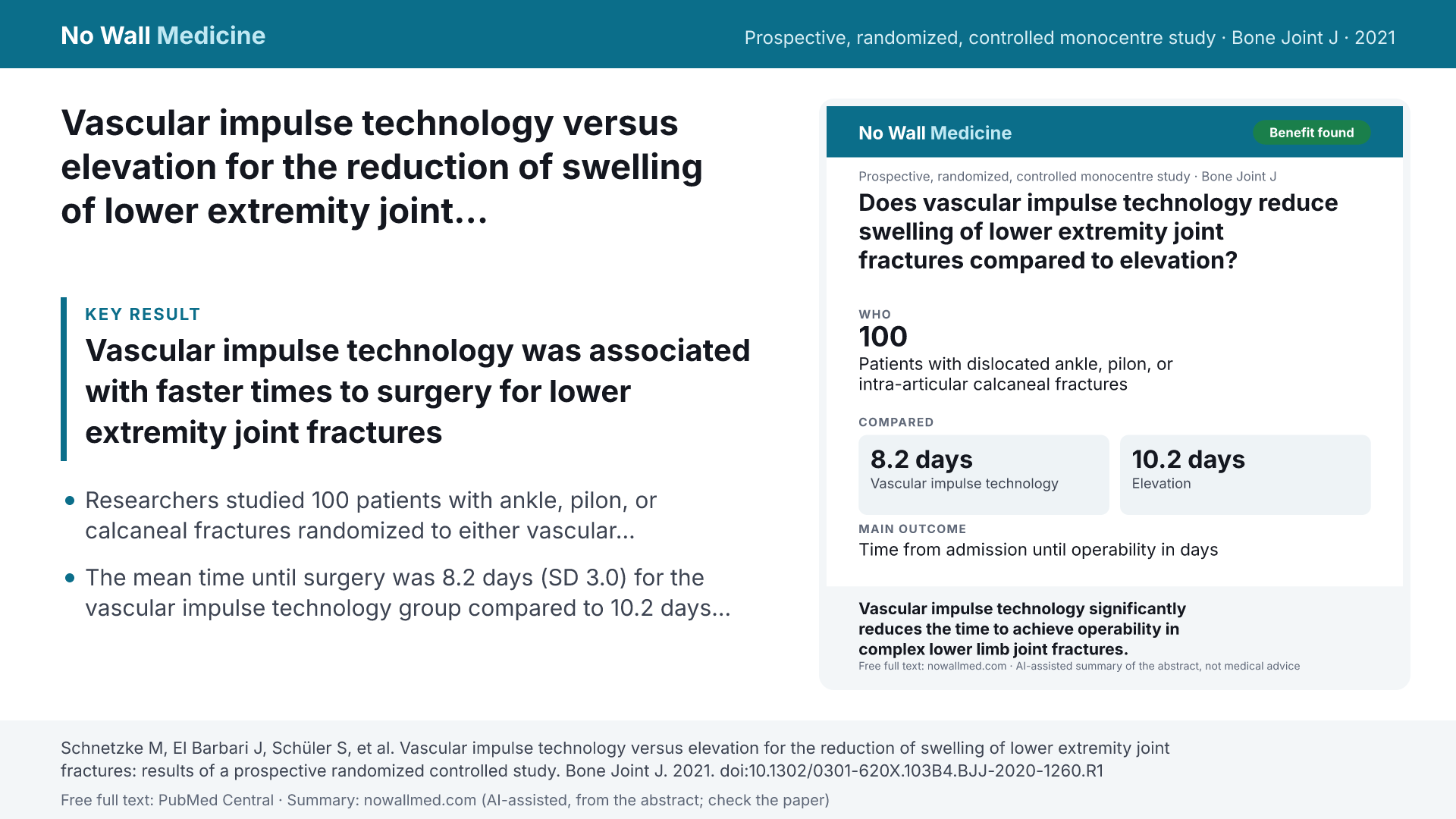
Vascular impulse technology was associated with faster times to surgery for lower extremity joint fractures
Vascular impulse technology versus elevation for the reduction of swelling of lower extremity joint fractures: results of a prospective randomized controlled study
Prospective, randomized, controlled monocentre studyBenefit found
Does vascular impulse technology reduce swelling of lower extremity joint fractures compared to elevation?
Who
100
Patients with dislocated ankle, pilon, or intra-articular calcaneal fractures
Compared
8.2 daysVascular impulse technology (SD 3.0)
10.2 daysElevation (SD 3.7)
Main outcome
Time from admission until operability in days
Bottom line: Vascular impulse technology significantly reduces the time to achieve operability in complex lower limb joint fractures.
Bone Joint J · 2021-04-01Download image
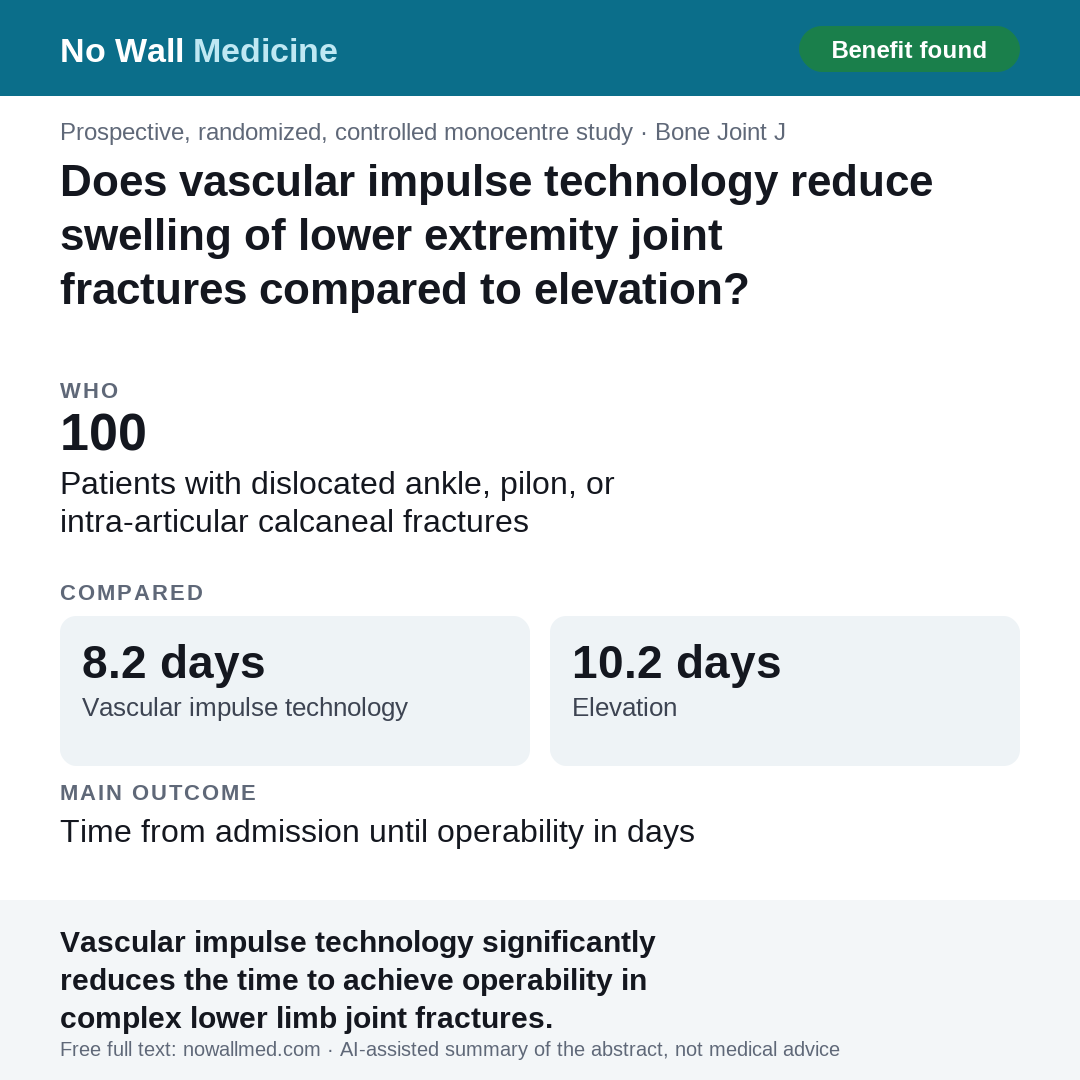
Clinical question: Does vascular impulse technology reduce swelling of lower extremity joint fractures compared to elevation?
Why it matters: Soft-tissue swelling in complex lower extremity joint fractures is associated with prolonged hospitalization and soft-tissue complications.
Key points
- Researchers studied 100 patients with ankle, pilon, or calcaneal fractures randomized to either vascular impulse technology or conventional elevation.
- The mean time until surgery was 8.2 days (SD 3.0) for the vascular impulse technology group compared to 10.2 days (SD 3.7) for the elevation group.
- Vascular impulse technology was associated with a lower length of stay, increased reduction in swelling, and a lower revision rate.
Headline and key points written with AI from the paper’s abstract, with every number checked against it. Read the paper before relying on them.
Was this summary helpful?
Subject terms
Cite this article
Schnetzke M, El Barbari J, Schüler S, et al. Vascular impulse technology versus elevation for the reduction of swelling of lower extremity joint fractures: results of a prospective randomized controlled study. Bone Joint J. 2021. doi:10.1302/0301-620X.103B4.BJJ-2020-1260.R1
Spotted a mistake? Suggest a correction