Vector-Induced Humoral Responses After rVSVΔG-ZEBOV-GP Immunization Identify Vaccinated Individuals and Correlate With Ebola Virus Glycoprotein Antibodies
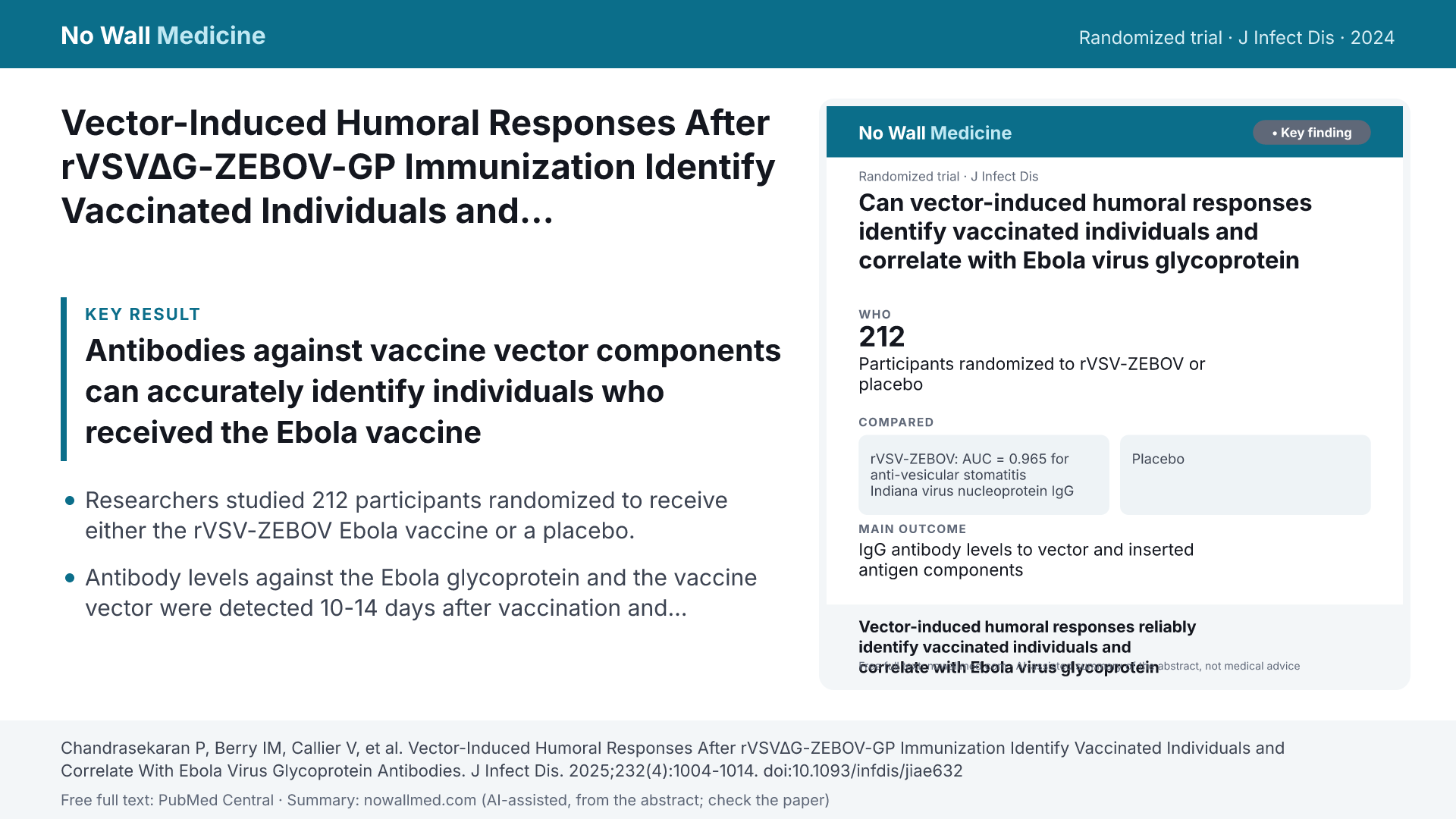
Key result: Antibodies against vaccine vector components can accurately identify individuals who received the Ebola vaccine
Randomized trialKey finding
Can vector-induced humoral responses identify vaccinated individuals and correlate with Ebola virus glycoprotein antibodies?
Who
212
Participants randomized to rVSV-ZEBOV or placebo
Compared
rVSV-ZEBOV: AUC = 0.965 for anti-vesicular stomatitis Indiana virus nucleoprotein IgG
Placebo
Main outcome
IgG antibody levels to vector and inserted antigen components
Result: AUC = 0.965 for anti-vesicular stomatitis Indiana virus nucleoprotein IgG; AUC = 0.945 for anti-Ebola virus glycoprotein IgG
Bottom line: Vector-induced humoral responses reliably identify vaccinated individuals and correlate with Ebola virus glycoprotein antibodies.
J Infect Dis · 2024-12-24
Key points
- Researchers studied 212 participants randomized to receive either the rVSV-ZEBOV Ebola vaccine or a placebo.
- Antibody levels against the Ebola glycoprotein and the vaccine vector were detected 10-14 days after vaccination and remained stable through 360 days.
- At 28 days, measuring antibodies against the vaccine vector (AUC = 0.965) and the Ebola glycoprotein (AUC = 0.945) accurately distinguished vaccinated people from those who received a placebo.
Discussion prompts
- Would these patients look like yours? Who was left out?
- Is the main outcome one that matters to patients?
- Is the difference large enough to change what you do?
Cite: Chandrasekaran P, Berry IM, Callier V, et al. Vector-Induced Humoral Responses After rVSVΔG-ZEBOV-GP Immunization Identify Vaccinated Individuals and Correlate With Ebola Virus Glycoprotein Antibodies. J Infect Dis. 2025;232(4):1004-1014. doi:10.1093/infdis/jiae632
Free full text: PubMed Central · Summary and visual abstract: nowallmed.com/a/vector-induced-humoral-responses-after-rvsv-g-zebov-gp-immunization-1eznuzk/ (AI-assisted from the abstract; check the paper before relying on it).