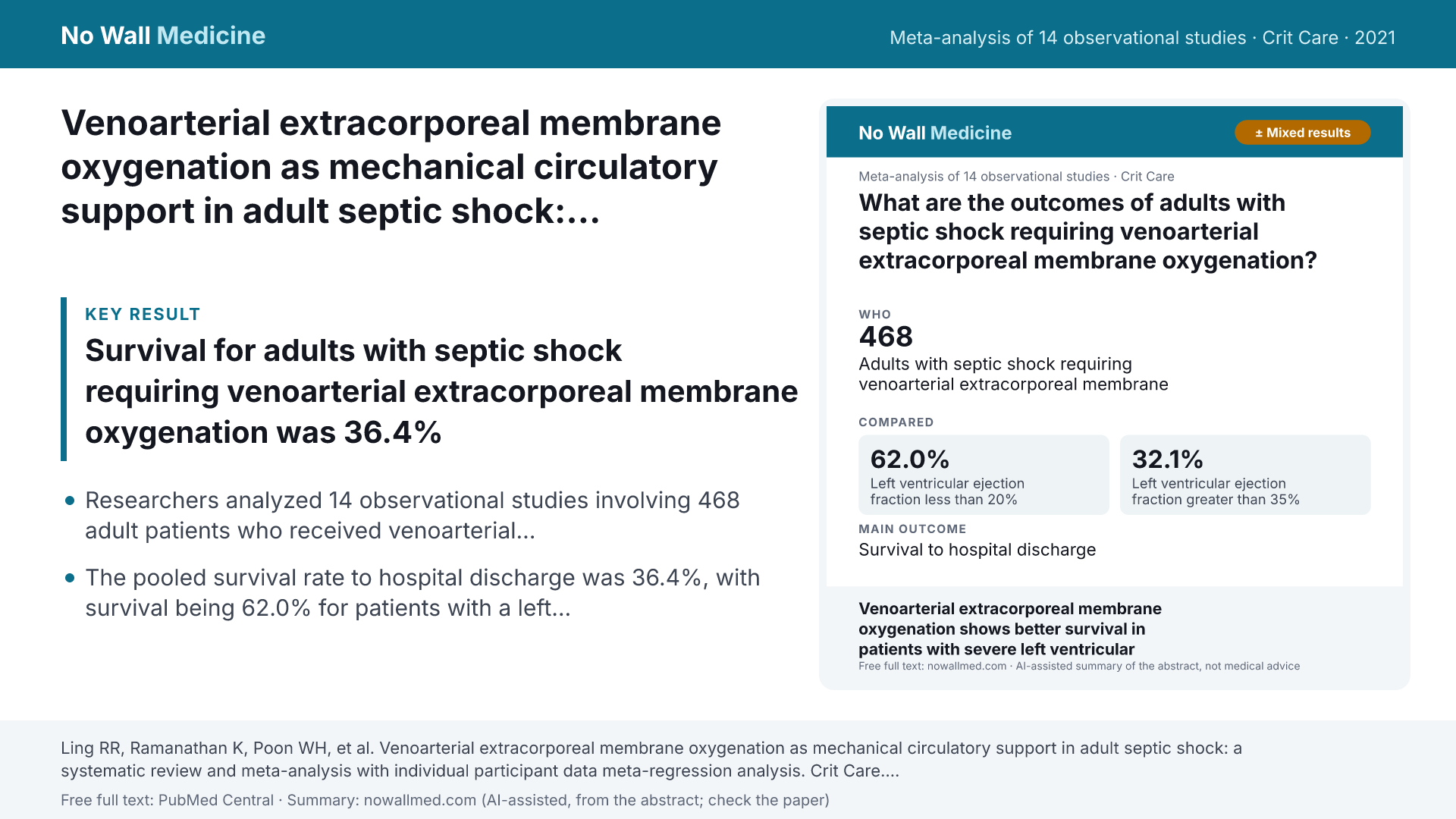
Survival for adults with septic shock requiring venoarterial extracorporeal membrane oxygenation was 36.4%
Venoarterial extracorporeal membrane oxygenation as mechanical circulatory support in adult septic shock: a systematic review and meta-analysis with individual participant data meta-regression analysis
Meta-analysis of 14 observational studiesMixed results
What are the outcomes of adults with septic shock requiring venoarterial extracorporeal membrane oxygenation?
Who
468
Adults with septic shock requiring venoarterial extracorporeal membrane oxygenation · Asia, Europe, and North America
Compared
62.0%Left ventricular ejection fraction less than 20% (95%-CI: 51.6%-72.0%)
32.1%Left ventricular ejection fraction greater than 35% (95%-CI: 8.69%-60.7%)
Main outcome
Survival to hospital discharge
Result: 36.4% (95% confidence interval [CI]: 23.6%-50.1%)
Bottom line: Venoarterial extracorporeal membrane oxygenation shows better survival in patients with severe left ventricular depression during septic shock.
Limitation: The meta-analysis included observational studies rather than randomized controlled trials.
Crit Care · 2021-07-14Download image
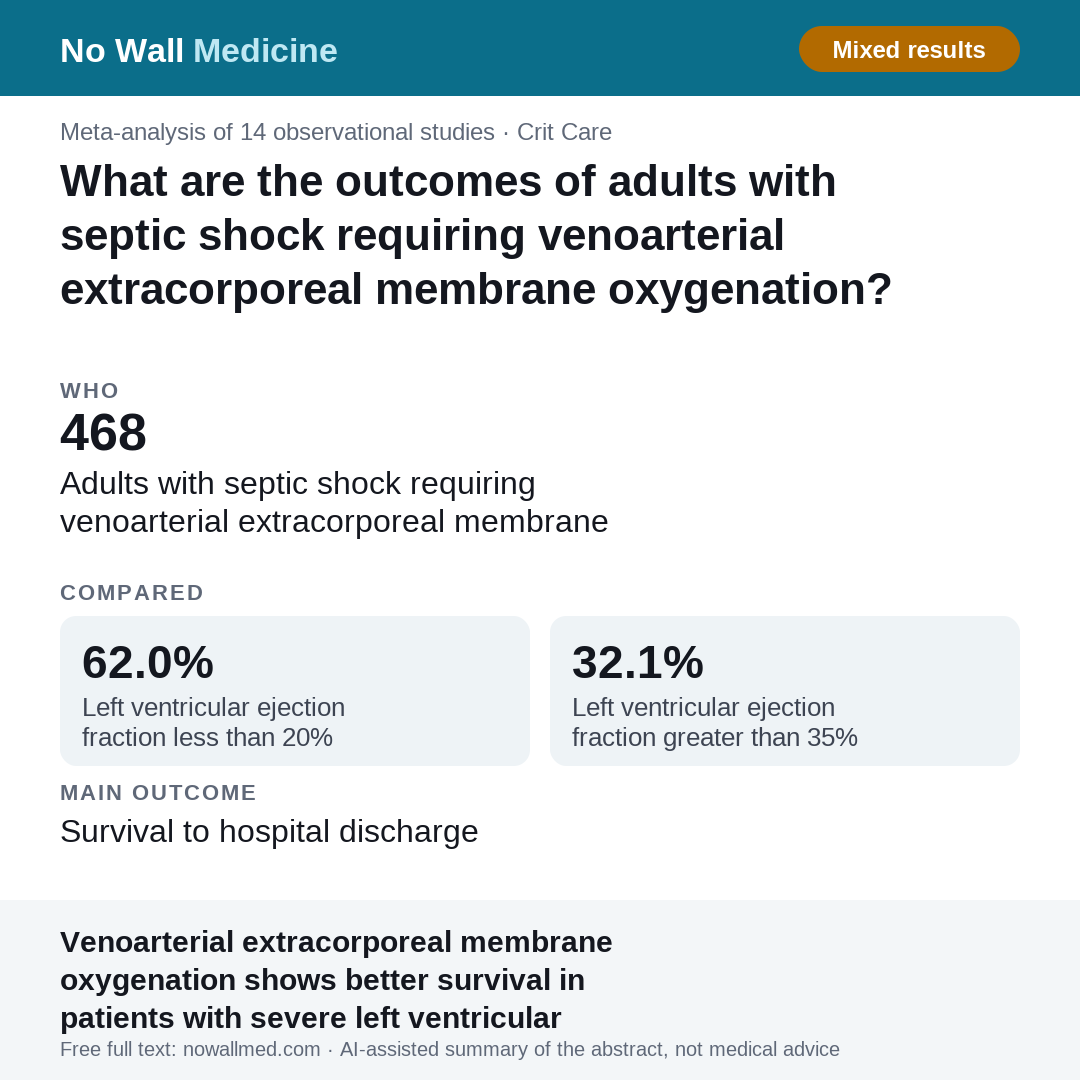
Clinical question: What are the outcomes of adults with septic shock requiring venoarterial extracorporeal membrane oxygenation?
Why it matters: The use of venoarterial extracorporeal membrane oxygenation for adult septic shock is controversial despite being recommended for children.
Key points
- Researchers analyzed 14 observational studies involving 468 adult patients who received venoarterial extracorporeal membrane oxygenation, a machine that provides heart and lung support, for septic shock.
- The pooled survival rate to hospital discharge was 36.4%, with survival being 62.0% for patients with a left ventricular ejection fraction—a measure of heart pumping strength—under 20%.
- Survival was 32.1% for patients with a left ventricular ejection fraction greater than 35%, and survival rates in Asian studies were 19.5% compared to 61.0% in European studies.
Headline and key points written with AI from the paper’s abstract, with every number checked against it. Read the paper before relying on them.
Was this summary helpful?
Abstract
Background
While recommended by international societal guidelines in the paediatric population, the use of venoarterial extracorporeal membrane oxygenation (VA ECMO) as mechanical circulatory support for refractory septic shock in adults is controversial. We aimed to characterise the outcomes of adults with septic shock requiring VA ECMO, and identify factors associated with survival. Methods
We searched Pubmed, Embase, Scopus and Cochrane databases from inception until 1st June 2021, and included all relevant publications reporting on > 5 adult patients requiring VA ECMO for septic shock. Study quality and certainty in evidence were assessed using the appropriate Joanna Briggs Institute checklist, and the Grading of Recommendations, Assessment, Development and Evaluations (GRADE) approach, respectively. The primary outcome was survival to hospital discharge, and secondary outcomes included intensive care unit length of stay, duration of ECMO support, complications while on ECMO, and sources of sepsis. Random-effects meta-analysis (DerSimonian and Laird) were conducted. Data synthesis
We included 14 observational studies with 468 patients in the meta-analysis. Pooled survival was 36.4% (95% confidence interval [CI]: 23.6%-50.1%). Survival among patients with left ventricular ejection fraction (LVEF) < 20% (62.0%, 95%-CI: 51.6%-72.0%) was significantly higher than those with LVEF > 35% (32.1%, 95%-CI: 8.69%-60.7%, p = 0.05). Survival reported in studies from Asia (19.5%, 95%-CI: 13.0%-26.8%) was notably lower than those from Europe (61.0%, 95%-CI: 48.4%-73.0%) and North America (45.5%, 95%-CI: 16.7%-75.8%). GRADE assessment indicated high certainty of evidence for pooled survival. Conclusions
When treated with VA ECMO, the majority of patients with septic shock and severe sepsis-induced myocardial depression survive. However, VA ECMO has poor outcomes in adults with septic shock without severe left ventricular depression. VA ECMO may be a viable treatment option in carefully selected adult patients with refractory septic shock.
Abstract reproduced under the article’s CC BY licence.
Subject terms
Cite this article
Ling RR, Ramanathan K, Poon WH, et al. Venoarterial extracorporeal membrane oxygenation as mechanical circulatory support in adult septic shock: a systematic review and meta-analysis with individual participant data meta-regression analysis. Crit Care. 2021. doi:10.1186/s13054-021-03668-5
Spotted a mistake? Suggest a correction