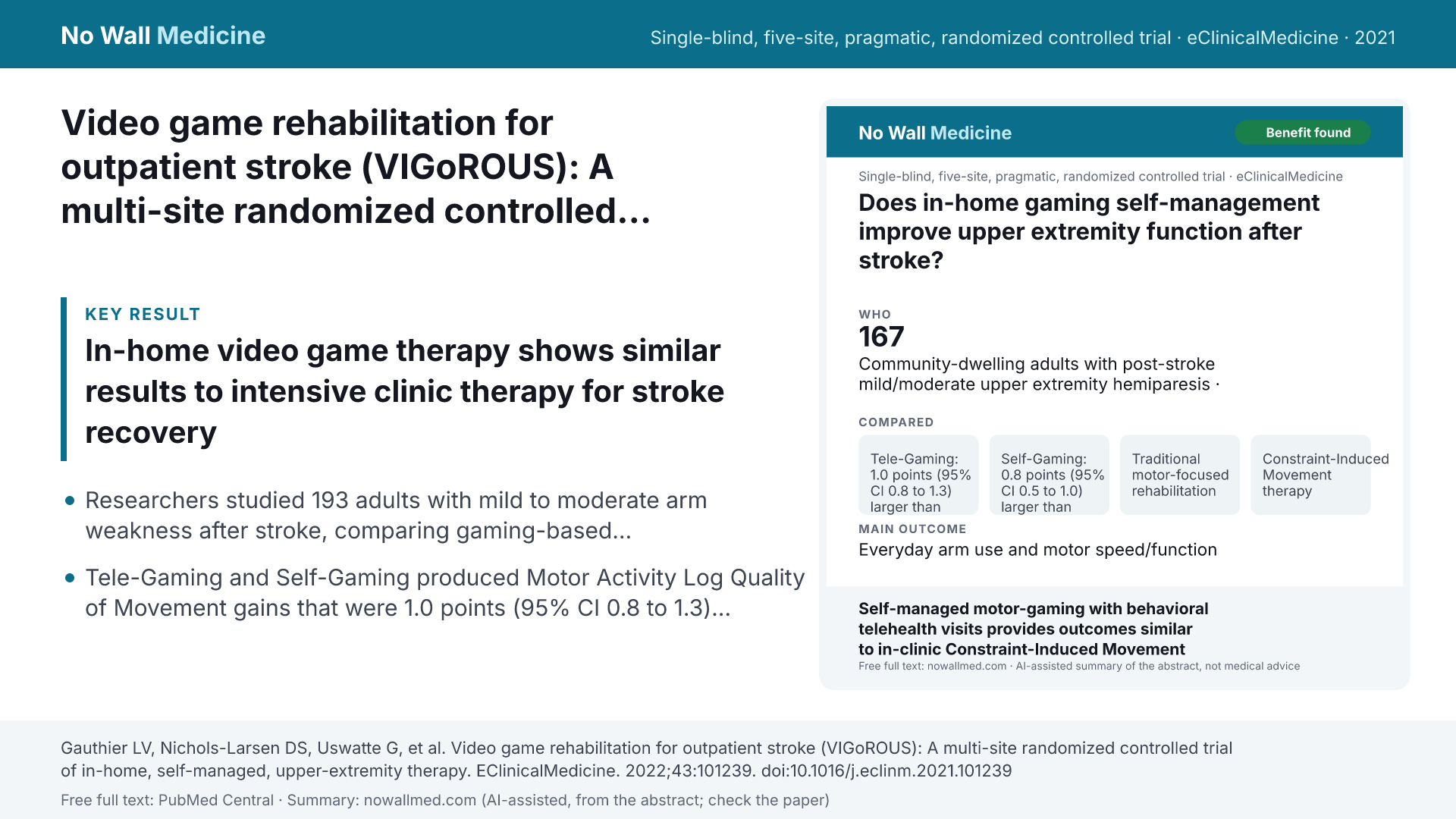
In-home video game therapy shows similar results to intensive clinic therapy for stroke recovery
Video game rehabilitation for outpatient stroke (VIGoROUS): A multi-site randomized controlled trial of in-home, self-managed, upper-extremity therapy
Single-blind, five-site, pragmatic, randomized controlled trialBenefit found
Does in-home gaming self-management improve upper extremity function after stroke?
Who
167
Community-dwelling adults with post-stroke mild/moderate upper extremity hemiparesis · Five sites
Compared
Tele-Gaming: 1.0 points (95% CI 0.8 to 1.3) larger than Traditional care
Self-Gaming: 0.8 points (95% CI 0.5 to 1.0) larger than Traditional care
Traditional motor-focused rehabilitation
Constraint-Induced Movement therapy
Main outcome
Everyday arm use and motor speed/function
Result: Tele-Gaming vs CI therapy: -0.2 points (95% CI -0.4 to 0.1)
Bottom line: Self-managed motor-gaming with behavioral telehealth visits provides outcomes similar to in-clinic Constraint-Induced Movement therapy.
Funded by: PCORI, NIH
eClinicalMedicine · 2021-12-17Download image
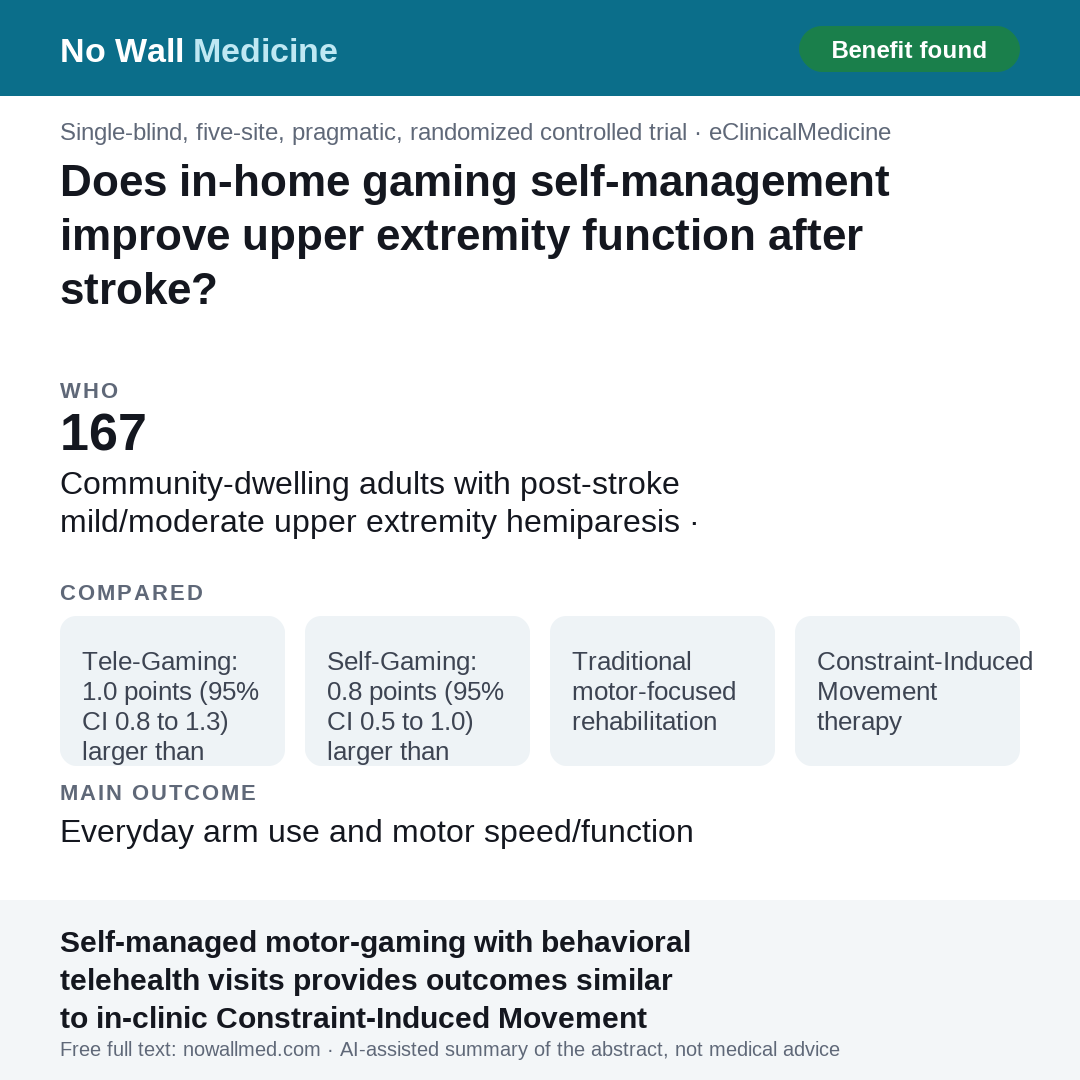
Clinical question: Does in-home gaming self-management improve upper extremity function after stroke?
Why it matters: It is unknown if self-managed motor practice using video games can effectively redirect therapist time toward behavioral interventions to improve arm use in daily life.
Key points
- Researchers studied 193 adults with mild to moderate arm weakness after stroke, comparing gaming-based self-management and telehealth to traditional rehabilitation and intensive Constraint-Induced Movement therapy.
- Tele-Gaming and Self-Gaming produced Motor Activity Log Quality of Movement gains that were 1.0 points (95% CI 0.8 to 1.3) and 0.8 points (95% CI 0.5 to 1.0) larger than Traditional care.
- Tele-Gaming was not less effective than Constraint-Induced Movement therapy, while Self-Gaming was less effective by -0.4 points (95% CI -0.6 to -0.2).
Headline and key points written with AI from the paper’s abstract, with every number checked against it. Read the paper before relying on them.
Was this summary helpful?
Cite this article
Gauthier LV, Nichols-Larsen DS, Uswatte G, et al. Video game rehabilitation for outpatient stroke (VIGoROUS): A multi-site randomized controlled trial of in-home, self-managed, upper-extremity therapy. eClinicalMedicine. 2021. doi:10.1016/j.eclinm.2021.101239
Spotted a mistake? Suggest a correction