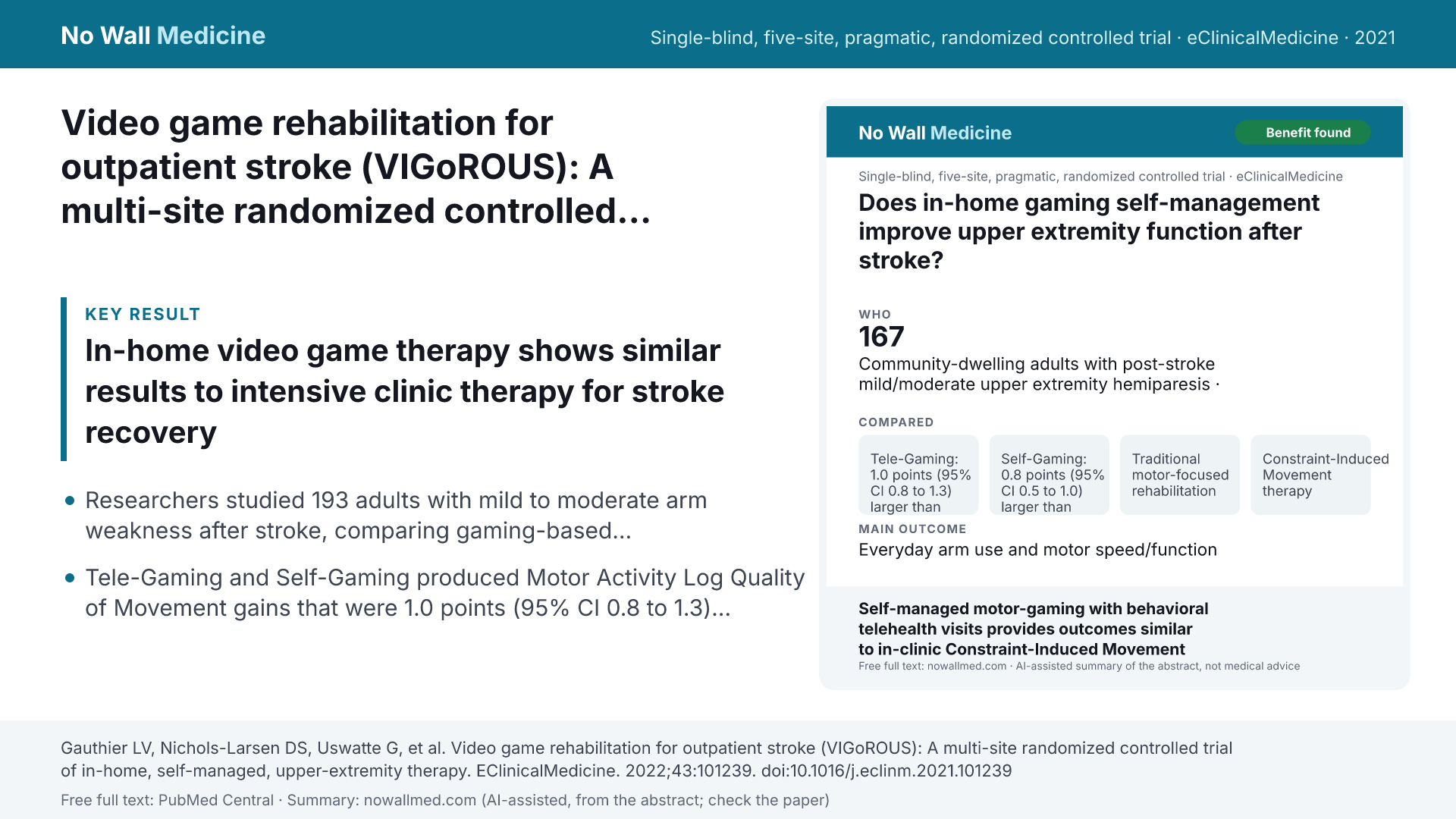
Video game rehabilitation for outpatient stroke (VIGoROUS): A multi-site randomized controlled trial of in-home, self-managed, upper-extremity therapy
Key result: In-home video game therapy shows similar results to intensive clinic therapy for stroke recovery
Single-blind, five-site, pragmatic, randomized controlled trialBenefit found
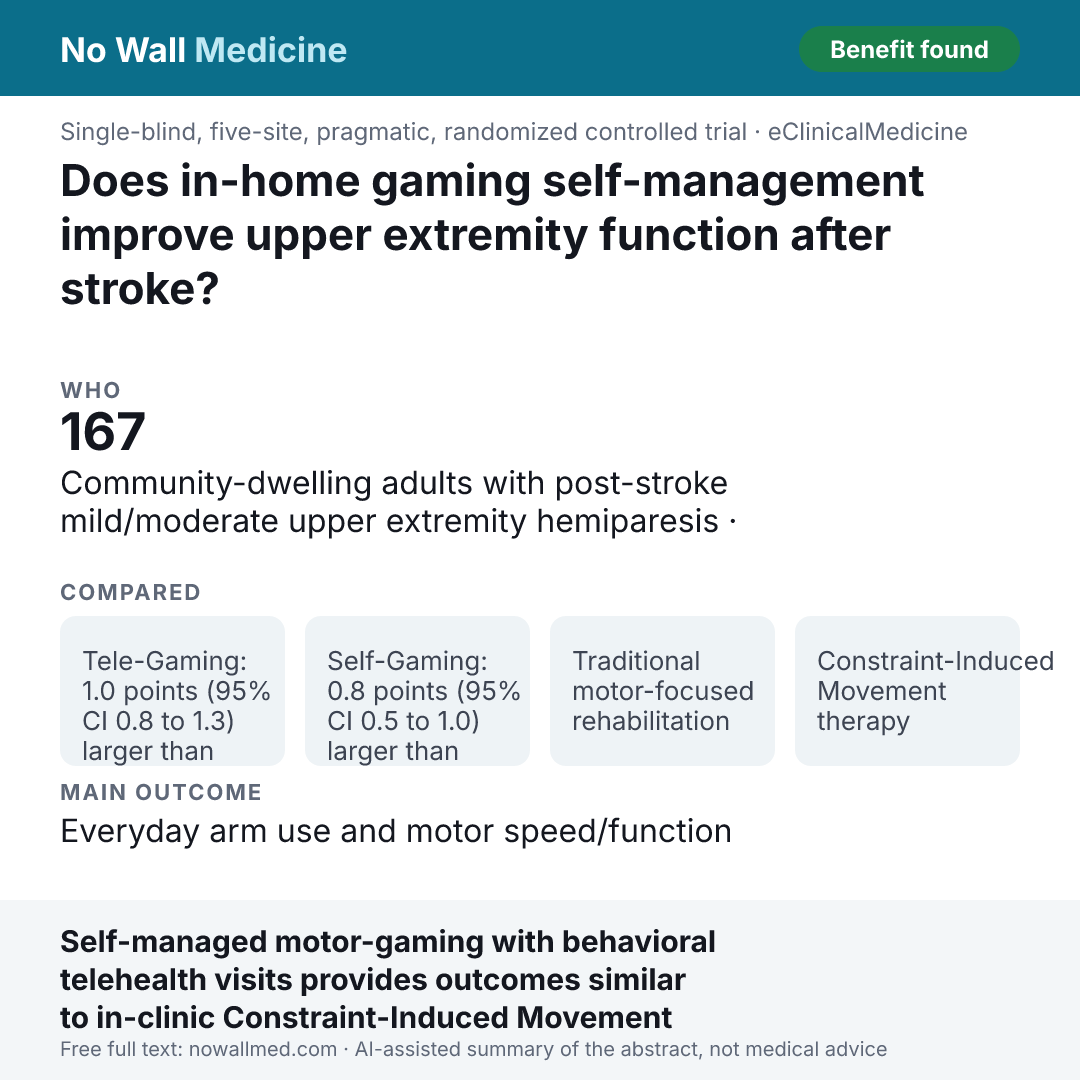
Does in-home gaming self-management improve upper extremity function after stroke?
Who
167
Community-dwelling adults with post-stroke mild/moderate upper extremity hemiparesis · Five sites
Compared
Tele-Gaming: 1.0 points (95% CI 0.8 to 1.3) larger than Traditional care
Self-Gaming: 0.8 points (95% CI 0.5 to 1.0) larger than Traditional care
Traditional motor-focused rehabilitation
Constraint-Induced Movement therapy
Main outcome
Everyday arm use and motor speed/function
Result: Tele-Gaming vs CI therapy: -0.2 points (95% CI -0.4 to 0.1)
Bottom line: Self-managed motor-gaming with behavioral telehealth visits provides outcomes similar to in-clinic Constraint-Induced Movement therapy.
Funded by: PCORI, NIH
eClinicalMedicine · 2021-12-17 · Save PNG
Key points
- Researchers studied 193 adults with mild to moderate arm weakness after stroke, comparing gaming-based self-management and telehealth to traditional rehabilitation and intensive Constraint-Induced Movement therapy.
- Tele-Gaming and Self-Gaming produced Motor Activity Log Quality of Movement gains that were 1.0 points (95% CI 0.8 to 1.3) and 0.8 points (95% CI 0.5 to 1.0) larger than Traditional care.
- Tele-Gaming was not less effective than Constraint-Induced Movement therapy, while Self-Gaming was less effective by -0.4 points (95% CI -0.6 to -0.2).
Discussion prompts
- Would these patients look like yours? Who was left out?
- Is the main outcome one that matters to patients?
- Is the difference large enough to change what you do?
Cite: Gauthier LV, Nichols-Larsen DS, Uswatte G, et al. Video game rehabilitation for outpatient stroke (VIGoROUS): A multi-site randomized controlled trial of in-home, self-managed, upper-extremity therapy. EClinicalMedicine. 2022;43:101239. doi:10.1016/j.eclinm.2021.101239
Free full text: PubMed Central · Summary and visual abstract: nowallmed.com/a/video-game-rehabilitation-for-outpatient-stroke-vigorous-a-multi-site-bf6mbc/ (AI-assisted from the abstract; check the paper before relying on it).