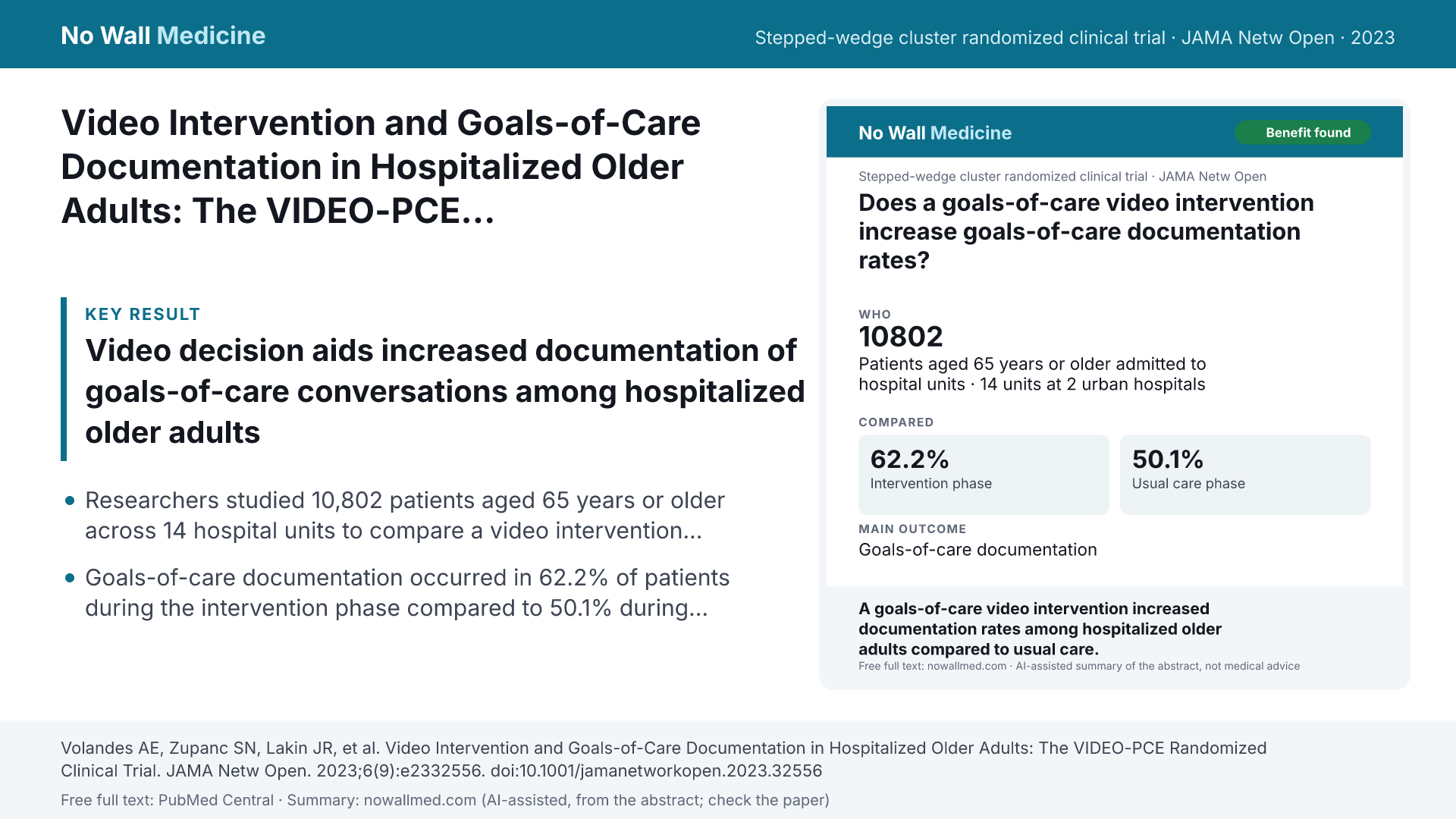
Video decision aids increased documentation of goals-of-care conversations among hospitalized older adults
Video Intervention and Goals-of-Care Documentation in Hospitalized Older Adults: The VIDEO-PCE Randomized Clinical Trial
Stepped-wedge cluster randomized clinical trialBenefit found
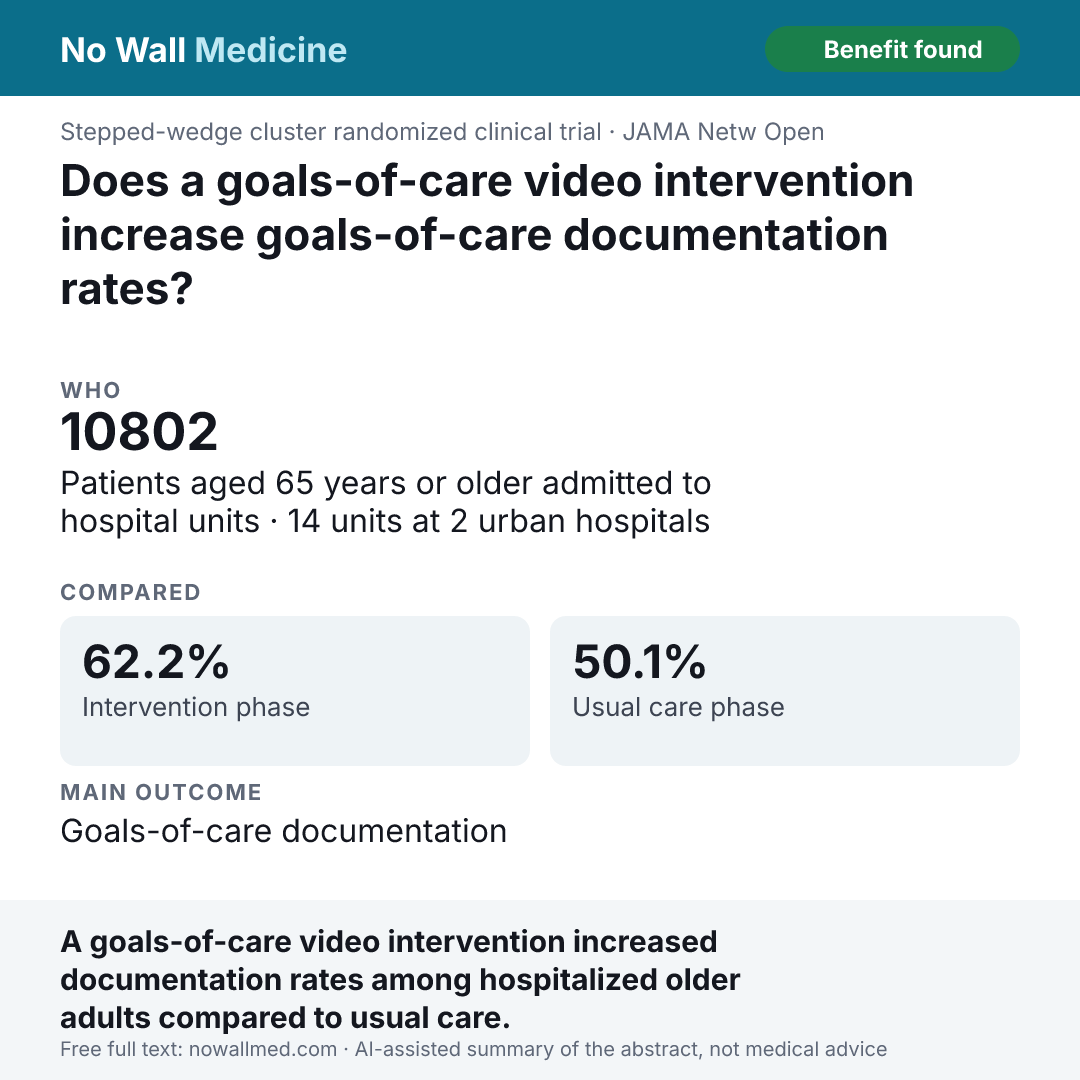
Does a goals-of-care video intervention increase goals-of-care documentation rates?
Who
10802
Patients aged 65 years or older admitted to hospital units · 14 units at 2 urban hospitals in New York and Boston
Compared
62.2%Intervention phase (3744/6023)
50.1%Usual care phase (2396/4779)
Main outcome
Goals-of-care documentation
Bottom line: A goals-of-care video intervention increased documentation rates among hospitalized older adults compared to usual care.
JAMA Netw Open · 2023-09-05 · Save PNG
Clinical question: Does a goals-of-care video intervention increase goals-of-care documentation rates?
Why it matters: Many hospitalized individuals never communicate their goals or preferences regarding medical treatment to their clinicians.
In absolute numbers
Intervention phase: 62.2% · Usual care phase: 50.1% → a difference of 12.1 percentage points, so about 9 people would need the treatment for 1 more to benefit (number needed to treat) over the trial’s follow-up.
Worked out by us from the two group results above, not reported by the authors. Check the paper for the exact outcome and timing.
Key points
- Researchers studied 10,802 patients aged 65 years or older across 14 hospital units to compare a video intervention with usual care.
- Goals-of-care documentation occurred in 62.2% of patients during the intervention phase compared to 50.1% during the usual care phase.
- The intervention also showed higher documentation rates for Black or African American, Hispanic or Latino, non-English speaking, and dementia patients.
Headline and key points written with AI from the paper’s abstract, with every number checked against it. Read the paper before relying on them.
Was this summary helpful?
Subject terms
Headline, design, result, key points, caveat and citation as plain text.
Cite this article
Volandes AE, Zupanc SN, Lakin JR, et al. Video Intervention and Goals-of-Care Documentation in Hospitalized Older Adults: The VIDEO-PCE Randomized Clinical Trial. JAMA Netw Open. 2023;6(9):e2332556. doi:10.1001/jamanetworkopen.2023.32556
Spotted a mistake? Suggest a correction