Video Streaming or Telephone Communication During Emergency Medical Services Dispatch Calls: A Cluster Randomized Clinical Trial
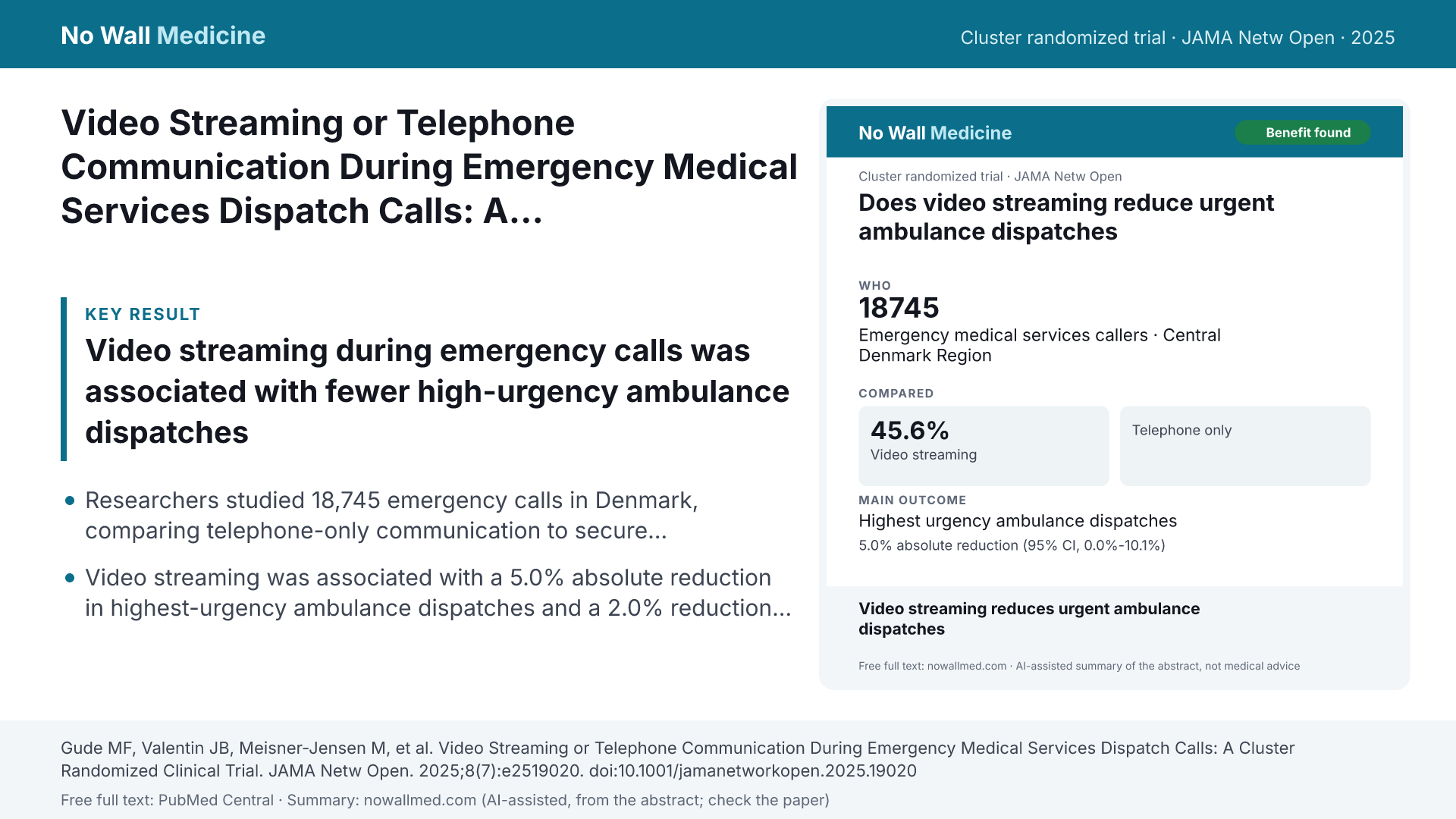
Key result: Video streaming during emergency calls was associated with fewer high-urgency ambulance dispatches
Cluster randomized trialBenefit found
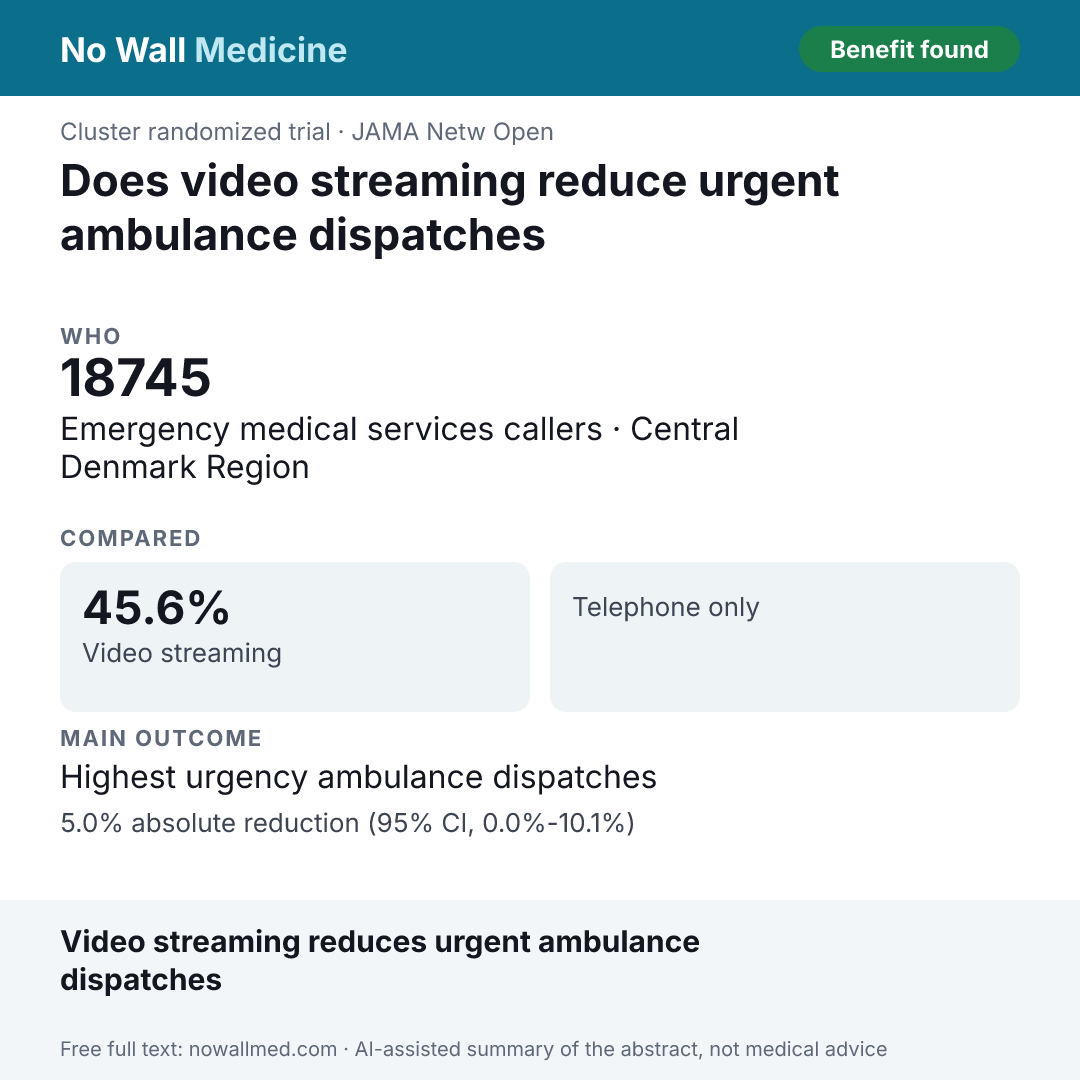
Does video streaming reduce urgent ambulance dispatches
Who
18745
Emergency medical services callers · Central Denmark Region
Compared
45.6%Video streaming (3706/8124)
Telephone only
Main outcome
Highest urgency ambulance dispatches
Result: 5.0% absolute reduction (95% CI, 0.0%-10.1%)
Bottom line: Video streaming reduces urgent ambulance dispatches
Limitation: Single center study
JAMA Netw Open · 2025-07-01 · Save PNG
Key points
- Researchers studied 18,745 emergency calls in Denmark, comparing telephone-only communication to secure one-way smartphone video streaming.
- Video streaming was associated with a 5.0% absolute reduction in highest-urgency ambulance dispatches and a 2.0% reduction in 24-hour hospital admissions for patients not initially transported.
- The video streaming group had a mean dispatch time of 3.7 minutes compared to 3.2 minutes for the telephone-only group.
Discussion prompts
- Would these patients look like yours? Who was left out?
- Is the main outcome one that matters to patients?
- Is the difference large enough to change what you do?
Cite: Gude MF, Valentin JB, Meisner-Jensen M, et al. Video Streaming or Telephone Communication During Emergency Medical Services Dispatch Calls: A Cluster Randomized Clinical Trial. JAMA Netw Open. 2025;8(7):e2519020. doi:10.1001/jamanetworkopen.2025.19020
Free full text: PubMed Central · Summary and visual abstract: nowallmed.com/a/video-streaming-or-telephone-communication-during-emergency-medical-1vrwrv3/ (AI-assisted from the abstract; check the paper before relying on it).