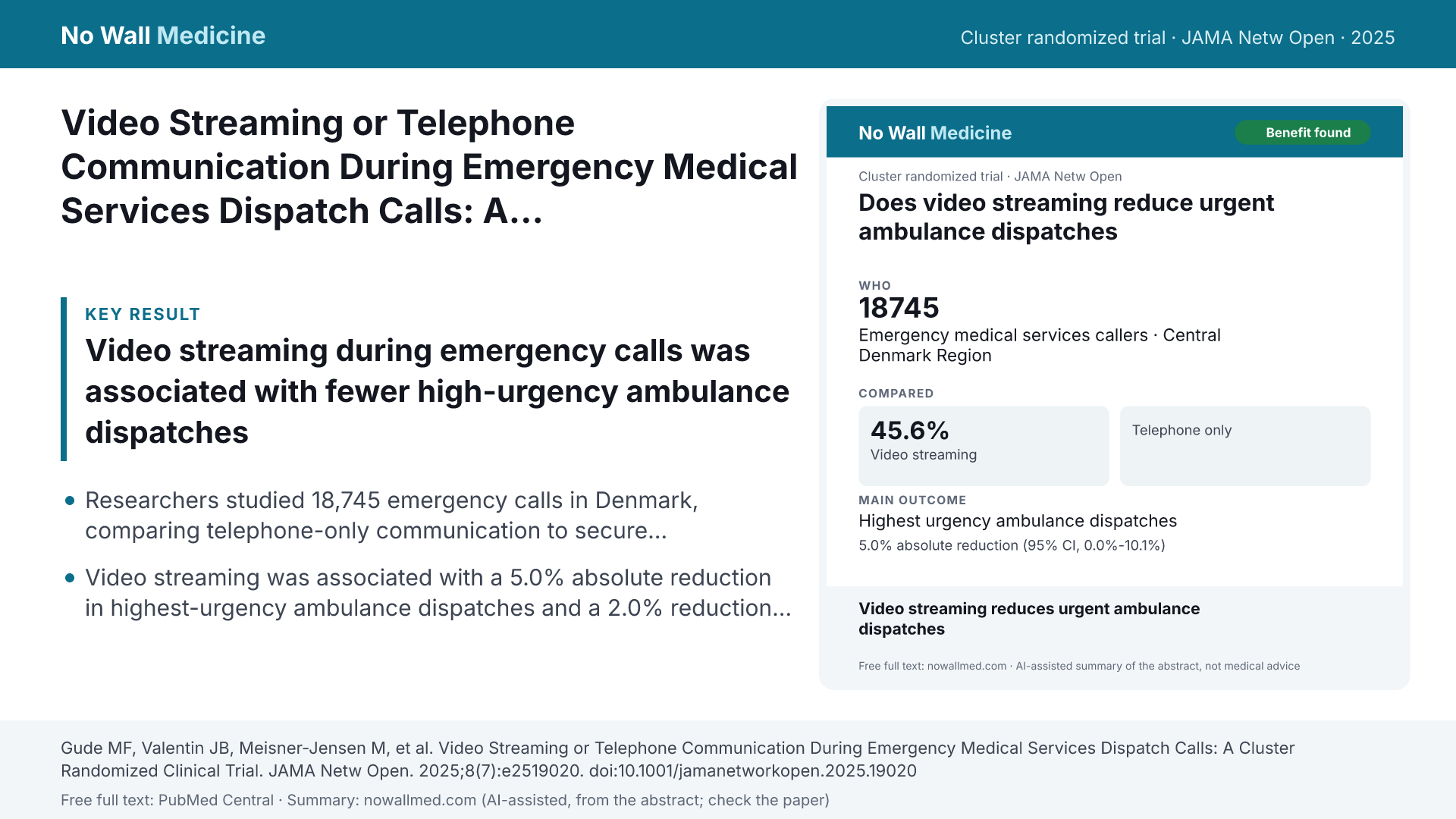
Video streaming during emergency calls was associated with fewer high-urgency ambulance dispatches
Video Streaming or Telephone Communication During Emergency Medical Services Dispatch Calls: A Cluster Randomized Clinical Trial
Cluster randomized trialBenefit found
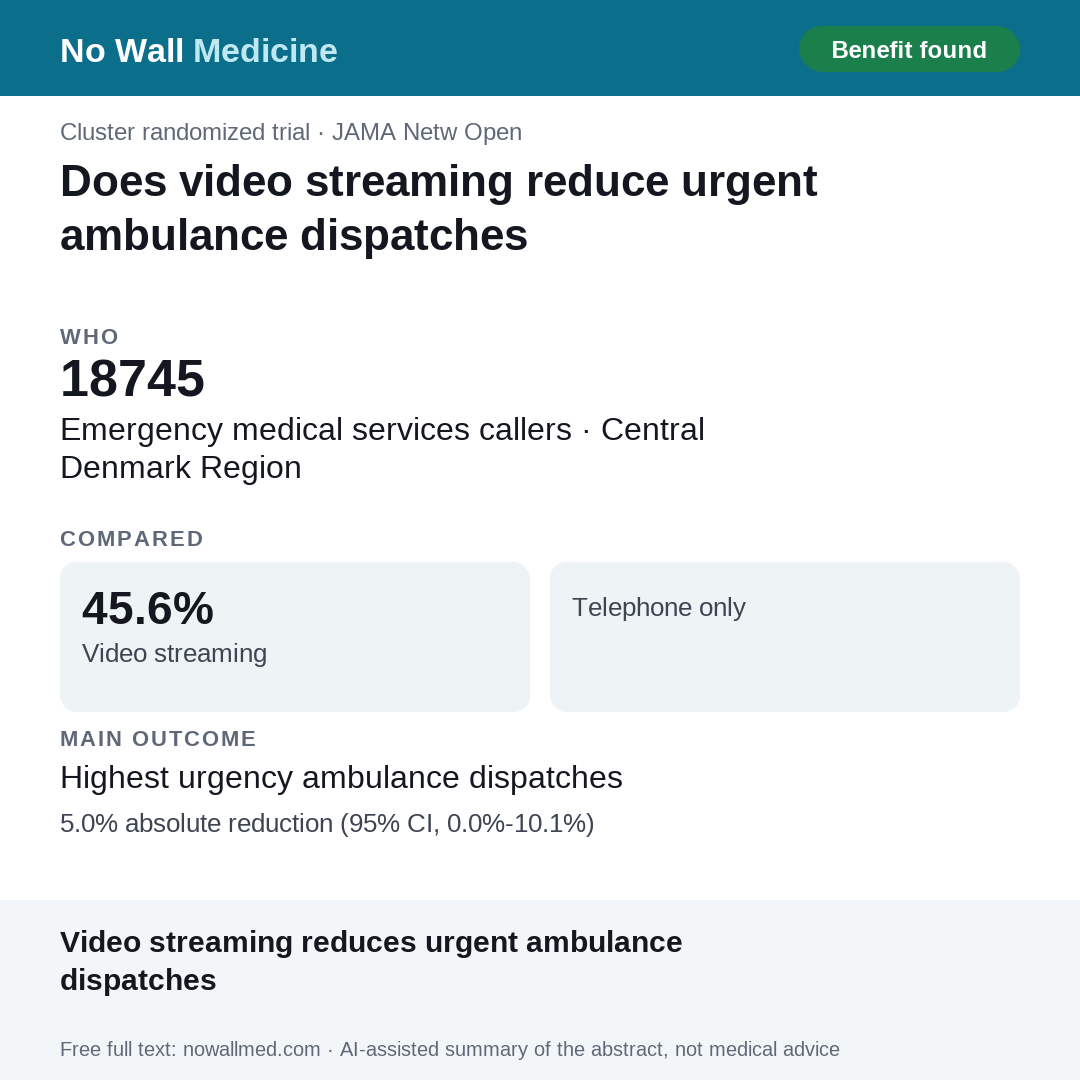
Does video streaming reduce urgent ambulance dispatches
Who
18745
Emergency medical services callers · Central Denmark Region
Compared
45.6%Video streaming (3706/8124)
Telephone only
Main outcome
Highest urgency ambulance dispatches
Result: 5.0% absolute reduction (95% CI, 0.0%-10.1%)
Bottom line: Video streaming reduces urgent ambulance dispatches
Limitation: Single center study
JAMA Netw Open · 2025-07-01Download image
Why it matters: It is unknown if video streaming during emergency calls can improve triage precision and resource allocation without compromising clinical safety.
Key points
- Researchers studied 18,745 emergency calls in Denmark, comparing telephone-only communication to secure one-way smartphone video streaming.
- Video streaming was associated with a 5.0% absolute reduction in highest-urgency ambulance dispatches and a 2.0% reduction in 24-hour hospital admissions for patients not initially transported.
- The video streaming group had a mean dispatch time of 3.7 minutes compared to 3.2 minutes for the telephone-only group.
Headline and key points written with AI from the paper’s abstract, with every number checked against it. Read the paper before relying on them.
Was this summary helpful?
Subject terms
Cite this article
Gude MF, Valentin JB, Meisner-Jensen M, et al. Video Streaming or Telephone Communication During Emergency Medical Services Dispatch Calls: A Cluster Randomized Clinical Trial. JAMA Netw Open. 2025. doi:10.1001/jamanetworkopen.2025.19020
Spotted a mistake? Suggest a correction