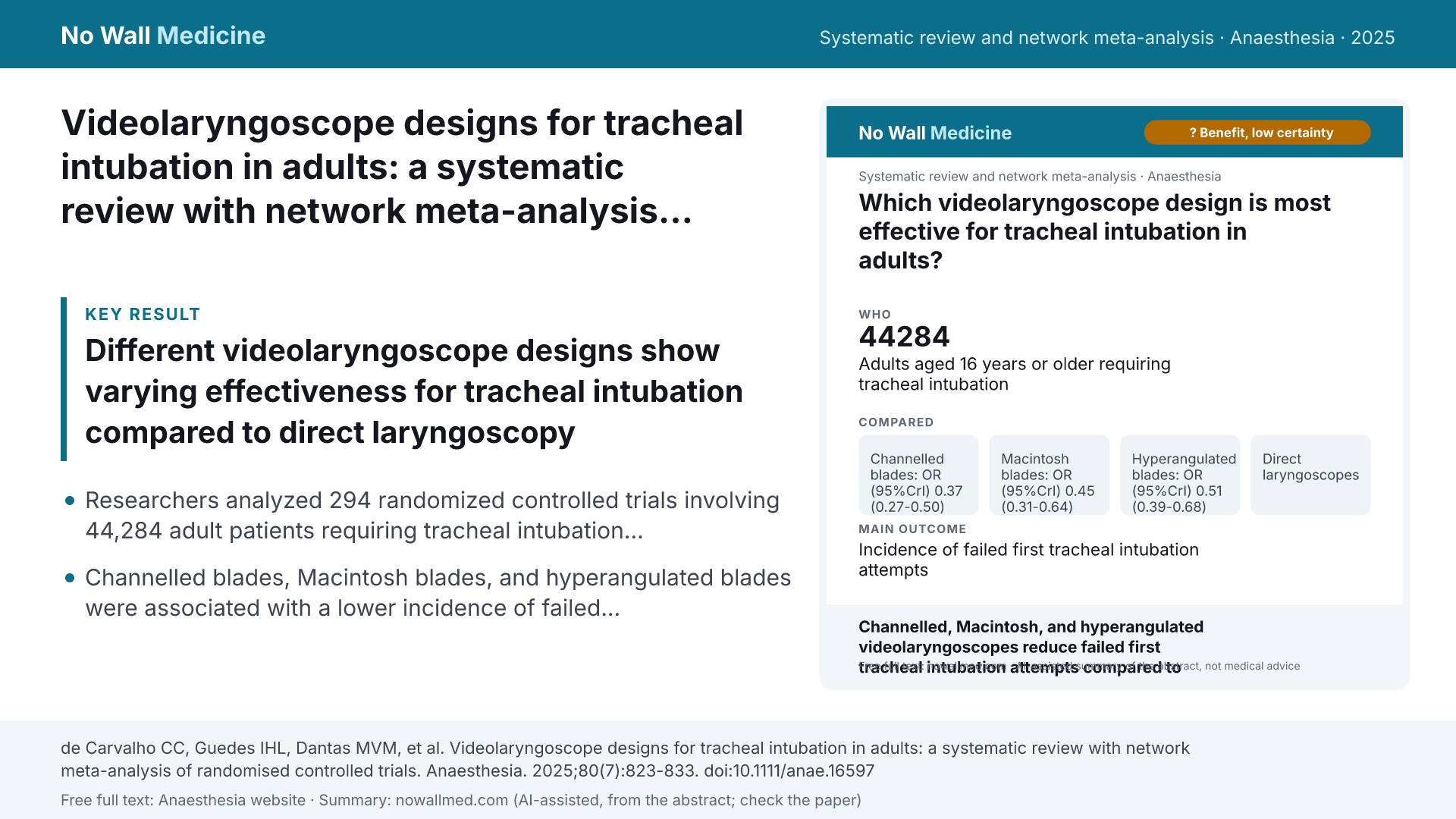
Different videolaryngoscope designs show varying effectiveness for tracheal intubation compared to direct laryngoscopy
Videolaryngoscope designs for tracheal intubation in adults: a systematic review with network meta-analysis of randomised controlled trials
Systematic review and network meta-analysisBenefit, low certainty
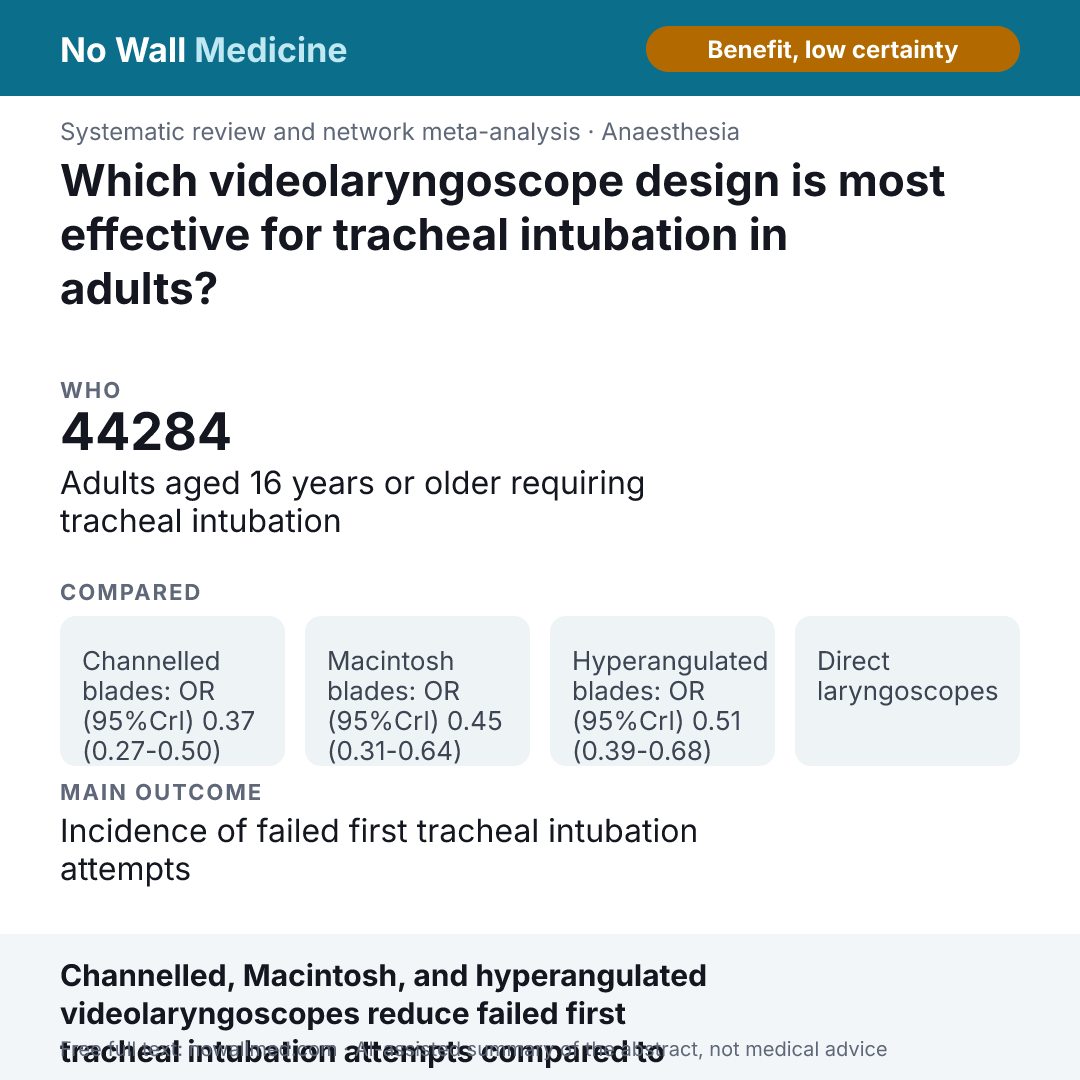
Which videolaryngoscope design is most effective for tracheal intubation in adults?
Who
44284
Adults aged 16 years or older requiring tracheal intubation
Compared
Channelled blades: OR (95%CrI) 0.37 (0.27-0.50)
Macintosh blades: OR (95%CrI) 0.45 (0.31-0.64)
Hyperangulated blades: OR (95%CrI) 0.51 (0.39-0.68)
Direct laryngoscopes
Main outcome
Incidence of failed first tracheal intubation attempts
Result: OR (95%CrI) 0.37 (0.27-0.50) for channelled blades
Bottom line: Channelled, Macintosh, and hyperangulated videolaryngoscopes reduce failed first tracheal intubation attempts compared to direct laryngoscopy.
Limitation: No definitive conclusions can be drawn regarding comparative performance across different video-assisted devices and designs.
Anaesthesia · 2025-03-11 · Save PNG
Clinical question: Which videolaryngoscope design is most effective for tracheal intubation in adults?
Why it matters: The wide variety of available videolaryngoscope designs makes it difficult to identify which specific device is most effective for tracheal intubation.
Key points
- Researchers analyzed 294 randomized controlled trials involving 44,284 adult patients requiring tracheal intubation under general anesthesia.
- Channelled blades, Macintosh blades, and hyperangulated blades were associated with a lower incidence of failed first intubation attempts compared to direct laryngoscopy.
- Channelled-blade devices ranked highest for reducing failed first attempts, while no significant difference was found between video stylets and direct laryngoscopes.
Headline and key points written with AI from the paper’s abstract, with every number checked against it. Read the paper before relying on them.
Was this summary helpful?
Subject terms
Headline, design, result, key points, caveat and citation as plain text.
Cite this article
de Carvalho CC, Guedes IHL, Dantas MVM, et al. Videolaryngoscope designs for tracheal intubation in adults: a systematic review with network meta-analysis of randomised controlled trials. Anaesthesia. 2025;80(7):823-833. doi:10.1111/anae.16597
Spotted a mistake? Suggest a correction