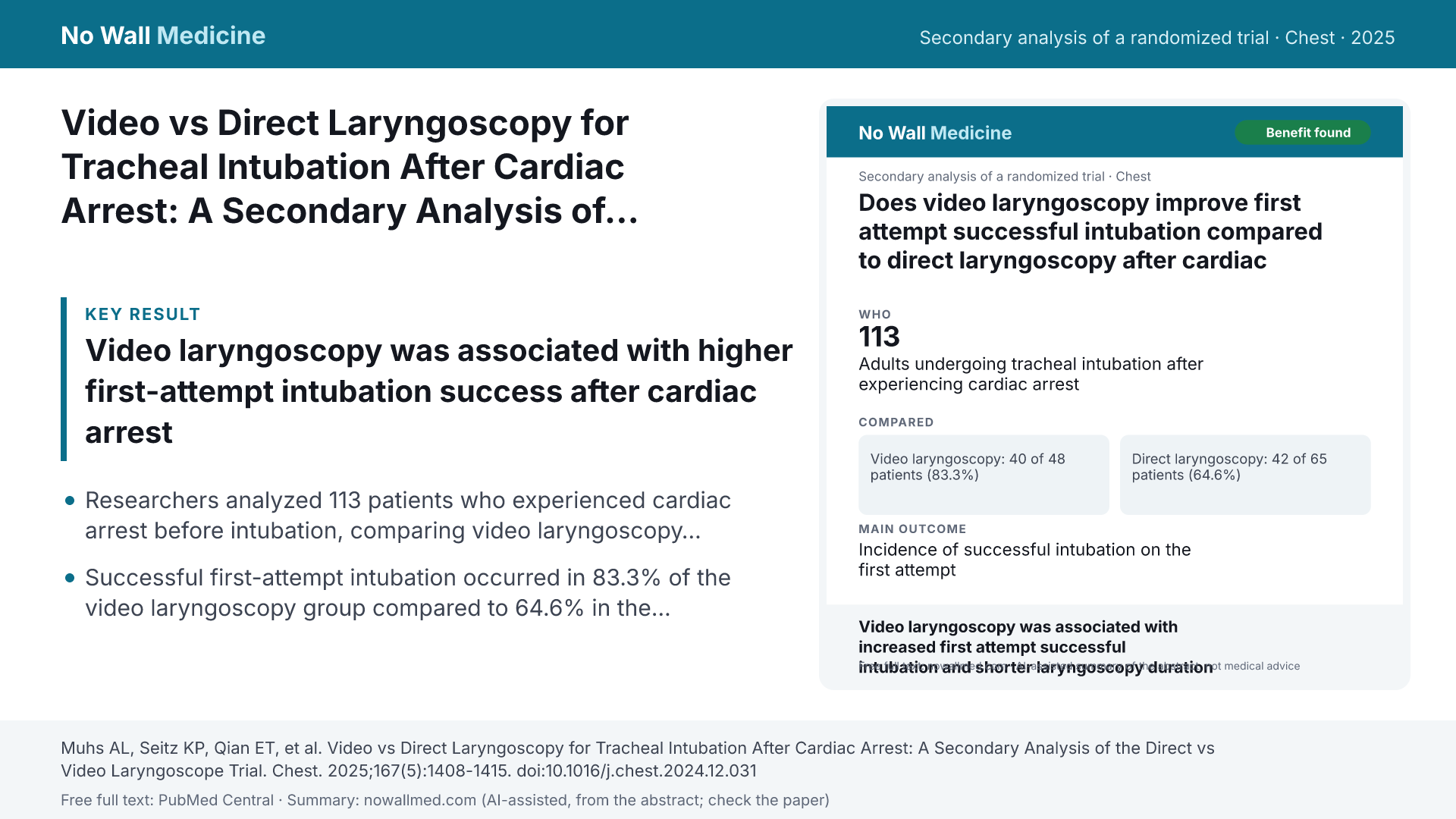
Video laryngoscopy was associated with higher first-attempt intubation success after cardiac arrest
Video vs Direct Laryngoscopy for Tracheal Intubation After Cardiac Arrest: A Secondary Analysis of the Direct vs Video Laryngoscope Trial
Secondary analysis of a randomized trialBenefit found
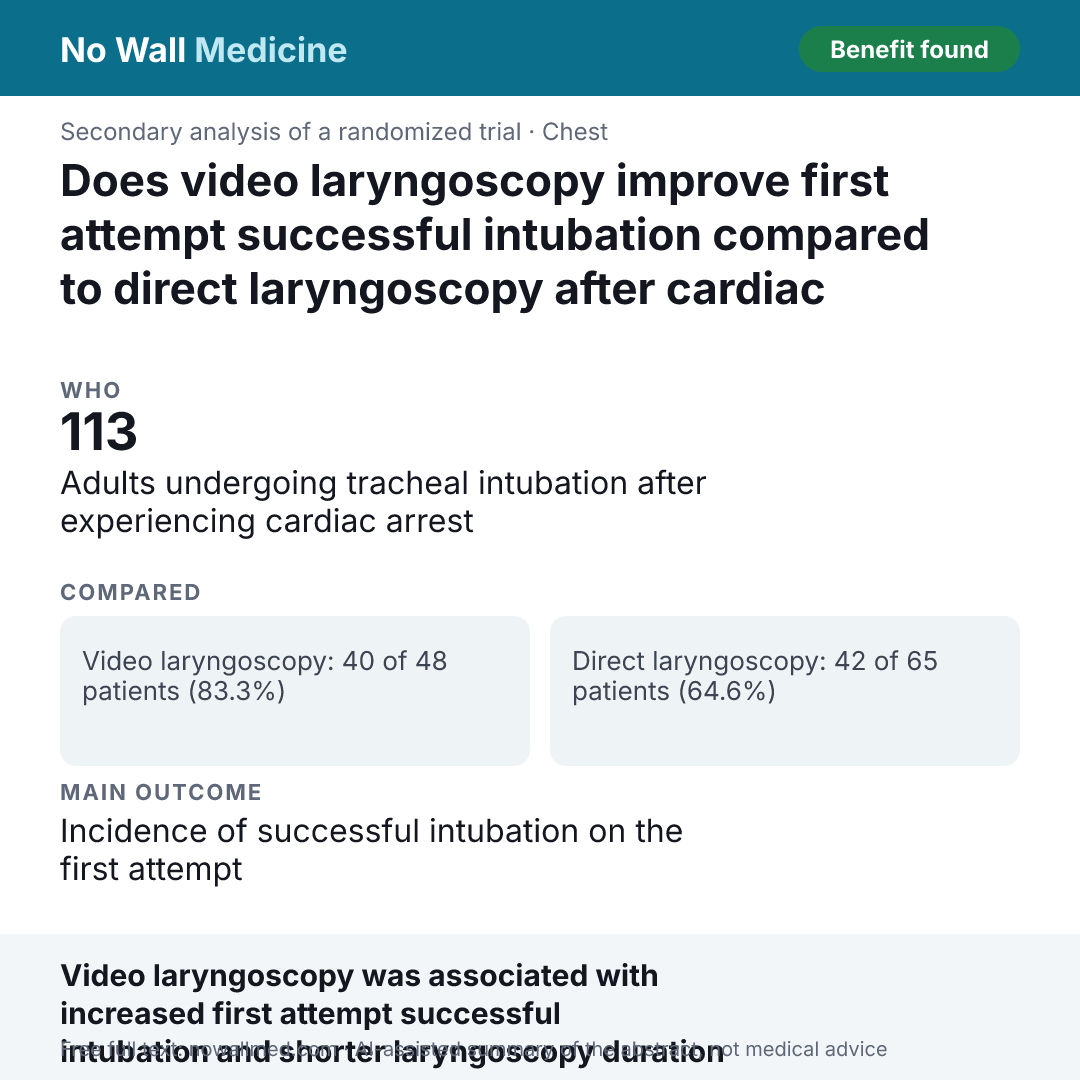
Does video laryngoscopy improve first attempt successful intubation compared to direct laryngoscopy after cardiac arrest?
Who
113
Adults undergoing tracheal intubation after experiencing cardiac arrest
Compared
Video laryngoscopy: 40 of 48 patients (83.3%)
Direct laryngoscopy: 42 of 65 patients (64.6%)
Main outcome
Incidence of successful intubation on the first attempt
Result: absolute risk difference, 18.7 percentage points; 95% CI, 1.2-36.2 percentage points
Bottom line: Video laryngoscopy was associated with increased first attempt successful intubation and shorter laryngoscopy duration after cardiac arrest.
Chest · 2025-01-11 · Save PNG
Clinical question: Does video laryngoscopy improve first attempt successful intubation compared to direct laryngoscopy after cardiac arrest?
Why it matters: Current American Heart Association guidelines recommend endotracheal tube placement after cardiac arrest but do not provide guidance on which laryngoscope method to use.
Key points
- Researchers analyzed 113 patients who experienced cardiac arrest before intubation, comparing video laryngoscopy to direct laryngoscopy using a traditional blade.
- Successful first-attempt intubation occurred in 83.3% of the video laryngoscopy group compared to 64.6% in the direct laryngoscopy group.
- The mean duration of laryngoscopy, the procedure used to view the vocal cords, was 48.0 seconds for video versus 98.0 seconds for direct laryngoscopy.
Headline and key points written with AI from the paper’s abstract, with every number checked against it. Read the paper before relying on them.
Was this summary helpful?
Subject terms
Headline, design, result, key points, caveat and citation as plain text.
Cite this article
Muhs AL, Seitz KP, Qian ET, et al. Video vs Direct Laryngoscopy for Tracheal Intubation After Cardiac Arrest: A Secondary Analysis of the Direct vs Video Laryngoscope Trial. Chest. 2025;167(5):1408-1415. doi:10.1016/j.chest.2024.12.031
Spotted a mistake? Suggest a correction