Videolaryngoscopy vs. direct laryngoscopy in class 2 and 3 obesity: a systematic review, meta-analysis and trial sequential analysis of randomised controlled trials
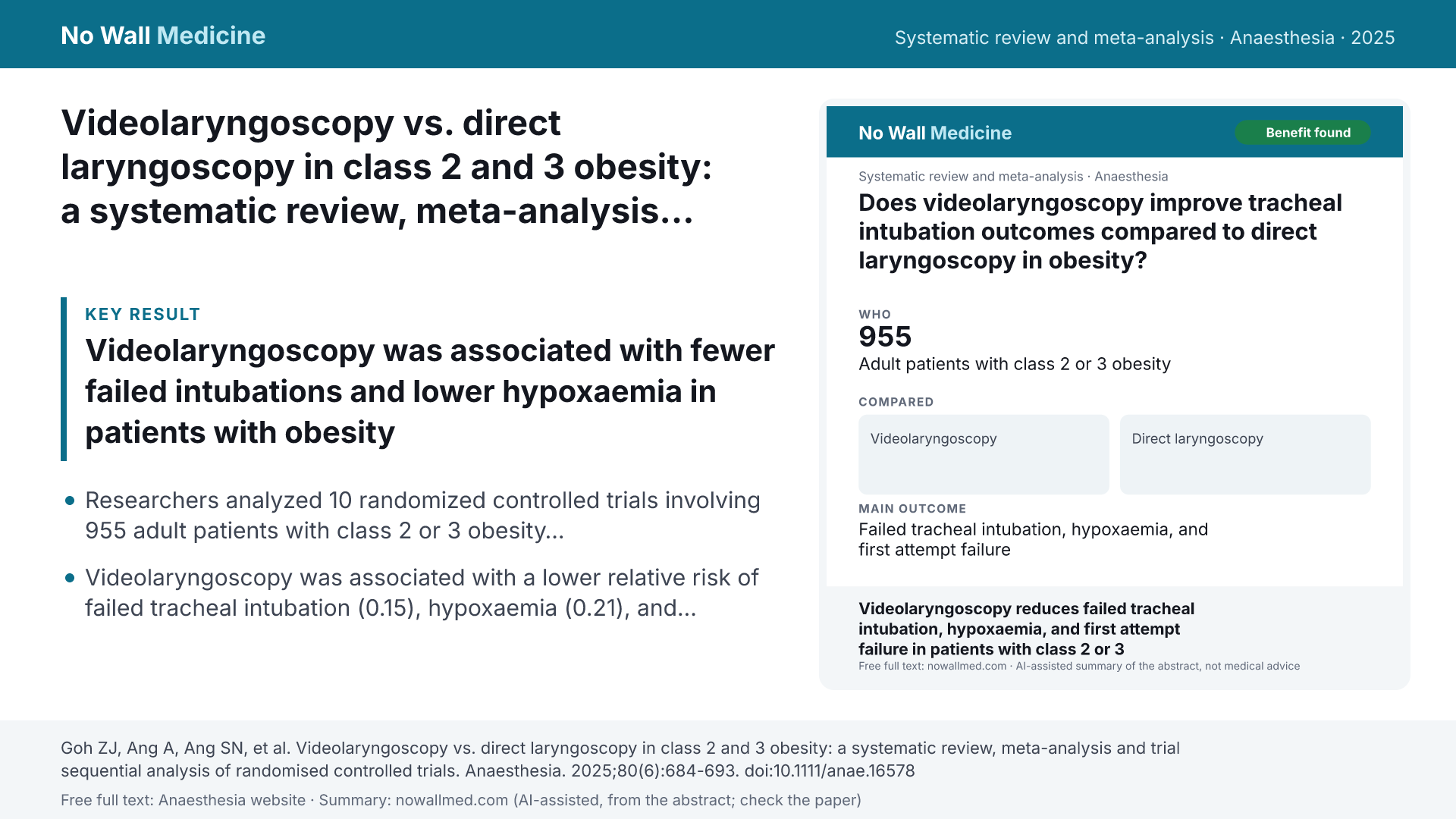
Key result: Videolaryngoscopy was associated with fewer failed intubations and lower hypoxaemia in patients with obesity
Key points
- Researchers analyzed 10 randomized controlled trials involving 955 adult patients with class 2 or 3 obesity undergoing elective general surgery.
- Videolaryngoscopy was associated with a lower relative risk of failed tracheal intubation (0.15), hypoxaemia (0.21), and first attempt failure (0.44).
- There was no significant difference between the two methods regarding time to tracheal intubation, incidence of sore throat, or intubation difficulty scale.
Why it matters: Airway and respiratory complications are over-represented in patients living with class 2 or 3 obesity, necessitating evaluation of videolaryngoscopy versus direct laryngoscopy.
Discussion prompts
- Would these patients look like yours? Who was left out?
- Is the main outcome one that matters to patients?
- Is the difference large enough to change what you do?
Cite: Goh ZJ, Ang A, Ang SN, et al. Videolaryngoscopy vs. direct laryngoscopy in class 2 and 3 obesity: a systematic review, meta-analysis and trial sequential analysis of randomised controlled trials. Anaesthesia. 2025;80(6):684-693. doi:10.1111/anae.16578
Free full text: Anaesthesia website · Summary and visual abstract: nowallmed.com/a/videolaryngoscopy-vs-direct-laryngoscopy-in-class-2-and-3-obesity-a-k6uv7l/ (AI-assisted from the abstract; check the paper before relying on it).