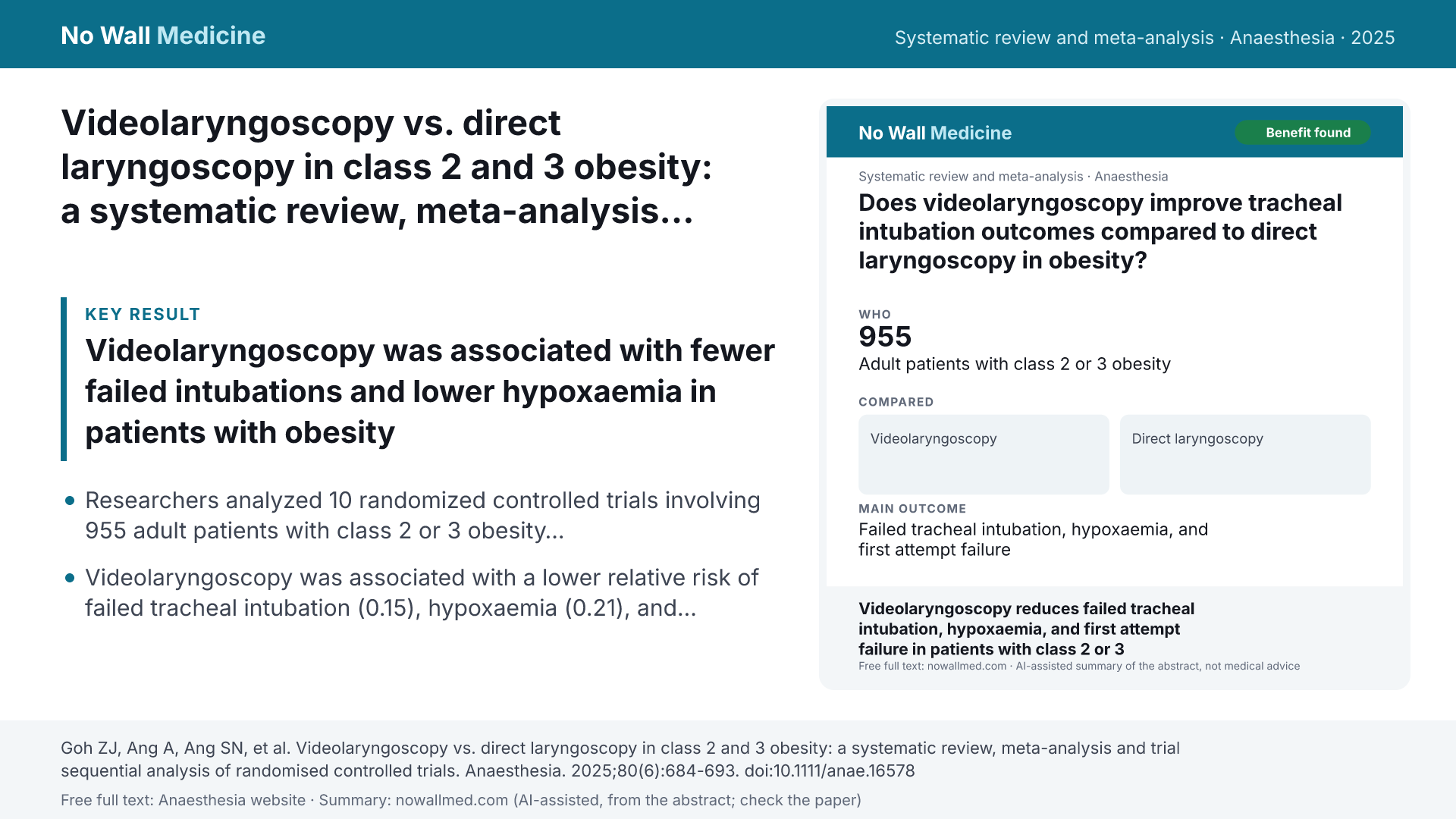
Videolaryngoscopy was associated with fewer failed intubations and lower hypoxaemia in patients with obesity
Videolaryngoscopy vs. direct laryngoscopy in class 2 and 3 obesity: a systematic review, meta-analysis and trial sequential analysis of randomised controlled trials
Systematic review and meta-analysisBenefit found
Does videolaryngoscopy improve tracheal intubation outcomes compared to direct laryngoscopy in obesity?
Who
955
Adult patients with class 2 or 3 obesity
Compared
Videolaryngoscopy
Direct laryngoscopy
Main outcome
Failed tracheal intubation, hypoxaemia, and first attempt failure
Result: failed tracheal intubation relative risk 0.15 (95%CI 0.05-0.35)
Bottom line: Videolaryngoscopy reduces failed tracheal intubation, hypoxaemia, and first attempt failure in patients with class 2 or 3 obesity.
Anaesthesia · 2025-04-08Download image

Clinical question: Does videolaryngoscopy improve tracheal intubation outcomes compared to direct laryngoscopy in obesity?
Why it matters: Airway and respiratory complications are over-represented in patients living with class 2 or 3 obesity, necessitating evaluation of videolaryngoscopy versus direct laryngoscopy.
Key points
- Researchers analyzed 10 randomized controlled trials involving 955 adult patients with class 2 or 3 obesity undergoing elective general surgery.
- Videolaryngoscopy was associated with a lower relative risk of failed tracheal intubation (0.15), hypoxaemia (0.21), and first attempt failure (0.44).
- There was no significant difference between the two methods regarding time to tracheal intubation, incidence of sore throat, or intubation difficulty scale.
Headline and key points written with AI from the paper’s abstract, with every number checked against it. Read the paper before relying on them.
Was this summary helpful?
Subject terms
Cite this article
Goh ZJ, Ang A, Ang SN, et al. Videolaryngoscopy vs. direct laryngoscopy in class 2 and 3 obesity: a systematic review, meta-analysis and trial sequential analysis of randomised controlled trials. Anaesthesia. 2025. doi:10.1111/anae.16578
Spotted a mistake? Suggest a correction