Videolaryngoscopy and direct laryngoscopy show similar first-attempt success rates for paediatric tracheal intubation
Videolaryngoscopy versus direct laryngoscopy for paediatric tracheal intubation: a systematic review with meta-analysis and trial sequential analysis
Systematic review and meta-analysisNo clear difference
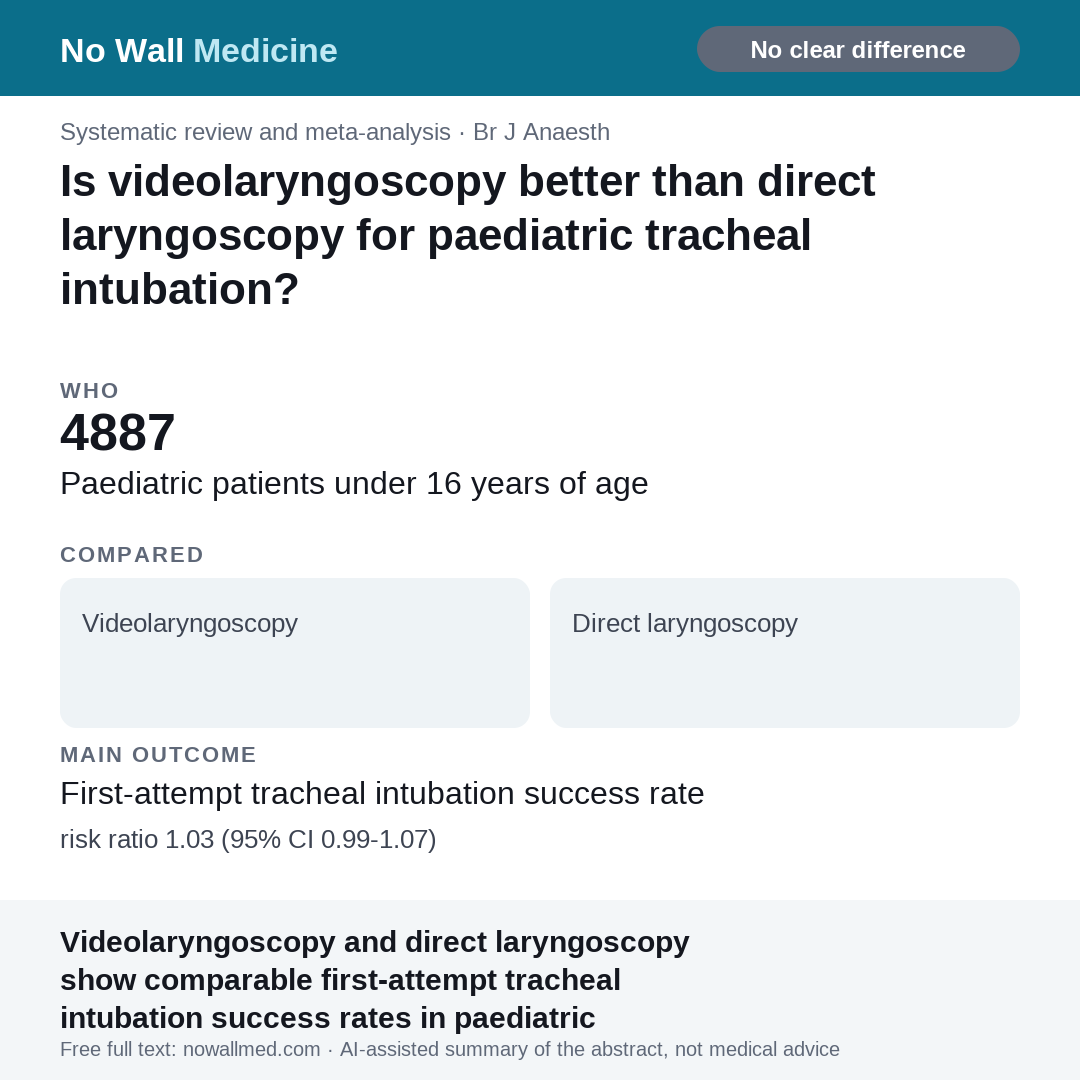
Is videolaryngoscopy better than direct laryngoscopy for paediatric tracheal intubation?
Who
4887
Paediatric patients under 16 years of age
Compared
Videolaryngoscopy
Direct laryngoscopy
Main outcome
First-attempt tracheal intubation success rate
Result: risk ratio 1.03 (95% CI 0.99-1.07)
Bottom line: Videolaryngoscopy and direct laryngoscopy show comparable first-attempt tracheal intubation success rates in paediatric patients.
Br J Anaesth · 2025-10-03Download image
Clinical question: Is videolaryngoscopy better than direct laryngoscopy for paediatric tracheal intubation?
Why it matters: The comparative efficacy, safety, and clinical impact of videolaryngoscopy versus direct laryngoscopy for paediatric tracheal intubation remain under investigation.
Key points
- Researchers analyzed 53 randomized controlled trials involving 4887 paediatric patients under 16 years of age to compare videolaryngoscopy and direct laryngoscopy.
- First-attempt success rates were comparable between the two methods with a risk ratio of 1.03 (95% CI: 0.99-1.07, P=0.18).
- Videolaryngoscopy was associated with improved glottic visualisation by a mean difference of 9.8% (95% CI: 3.2-16.4, P<0.01) and lower oesophageal intubation in children under 1 yr of age.
Headline and key points written with AI from the paper’s abstract, with every number checked against it. Read the paper before relying on them.
Topics
Cite this article
Koepp-Medina G, Lusardi AC, Di Fonzo B, Huber M, Afshari A, Bonfiglio R. Videolaryngoscopy versus direct laryngoscopy for paediatric tracheal intubation: a systematic review with meta-analysis and trial sequential analysis. Br J Anaesth. 2025. doi:10.1016/j.bja.2025.07.094
Spotted a mistake? Suggest a correction