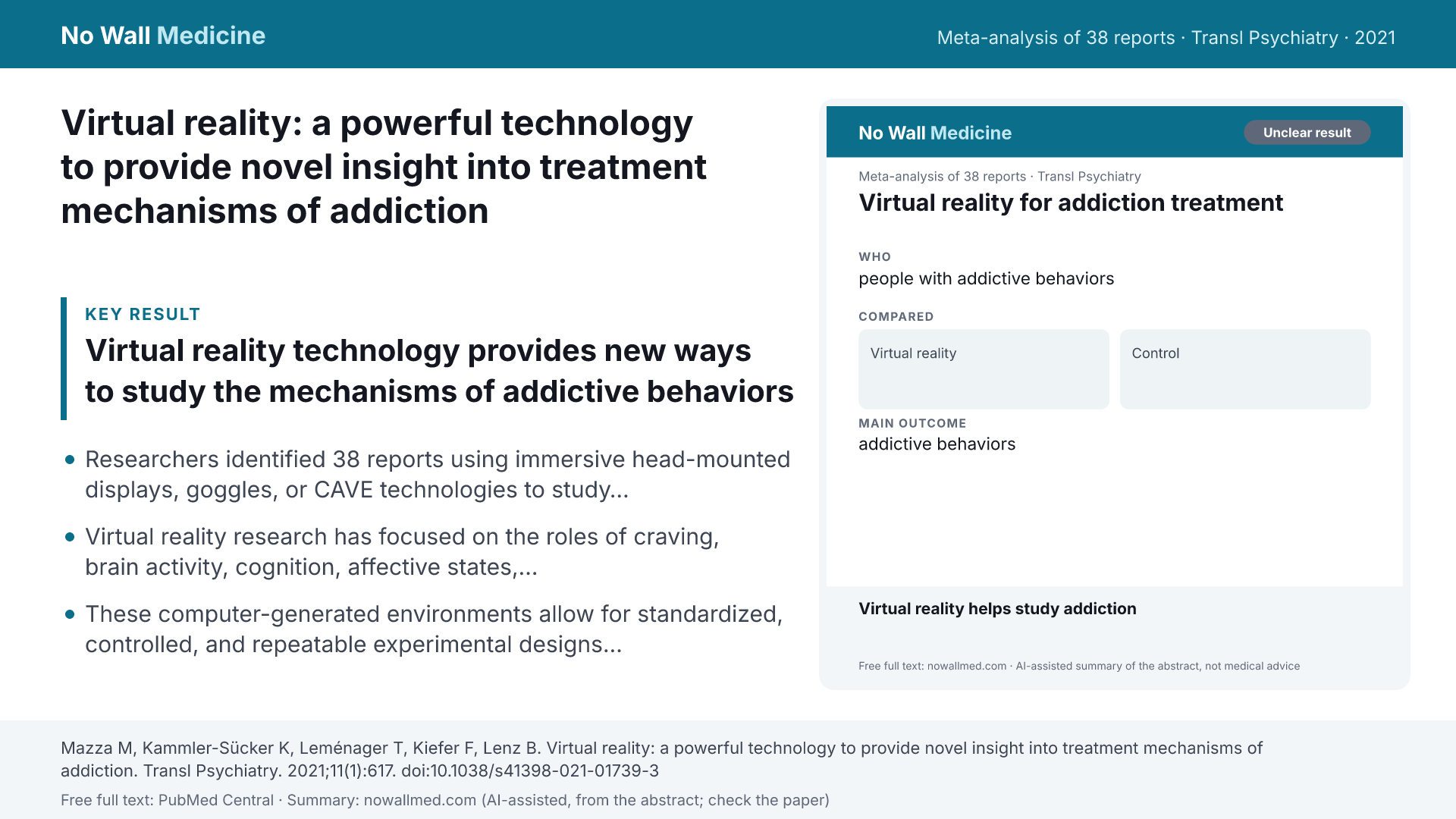
Virtual reality: a powerful technology to provide novel insight into treatment mechanisms of addiction
Key result: Virtual reality technology provides new ways to study the mechanisms of addictive behaviors
Meta-analysis of 38 reportsUnclear result
Virtual reality for addiction treatment
Who
people with addictive behaviors
Compared
Virtual reality
Control
Main outcome
addictive behaviors
Bottom line: Virtual reality helps study addiction
Transl Psychiatry · 2021-12-06Download image

Key points
- Researchers identified 38 reports using immersive head-mounted displays, goggles, or CAVE technologies to study addiction treatment mechanisms.
- Virtual reality research has focused on the roles of craving, brain activity, cognition, affective states, and psychophysiology in addiction.
- These computer-generated environments allow for standardized, controlled, and repeatable experimental designs using multi-sensorial cues.
Discussion prompts
- Would these patients look like yours? Who was left out?
- Is the main outcome one that matters to patients?
- Is the difference large enough to change what you do?
Cite: Mazza M, Kammler-Sücker K, Leménager T, Kiefer F, Lenz B. Virtual reality: a powerful technology to provide novel insight into treatment mechanisms of addiction. Transl Psychiatry. 2021. doi:10.1038/s41398-021-01739-3
Free full text: PubMed Central · Summary and visual abstract: nowallmed.com/a/virtual-reality-a-powerful-technology-to-provide-novel-insight-into-12n3vti/ (AI-assisted from the abstract; check the paper before relying on it).