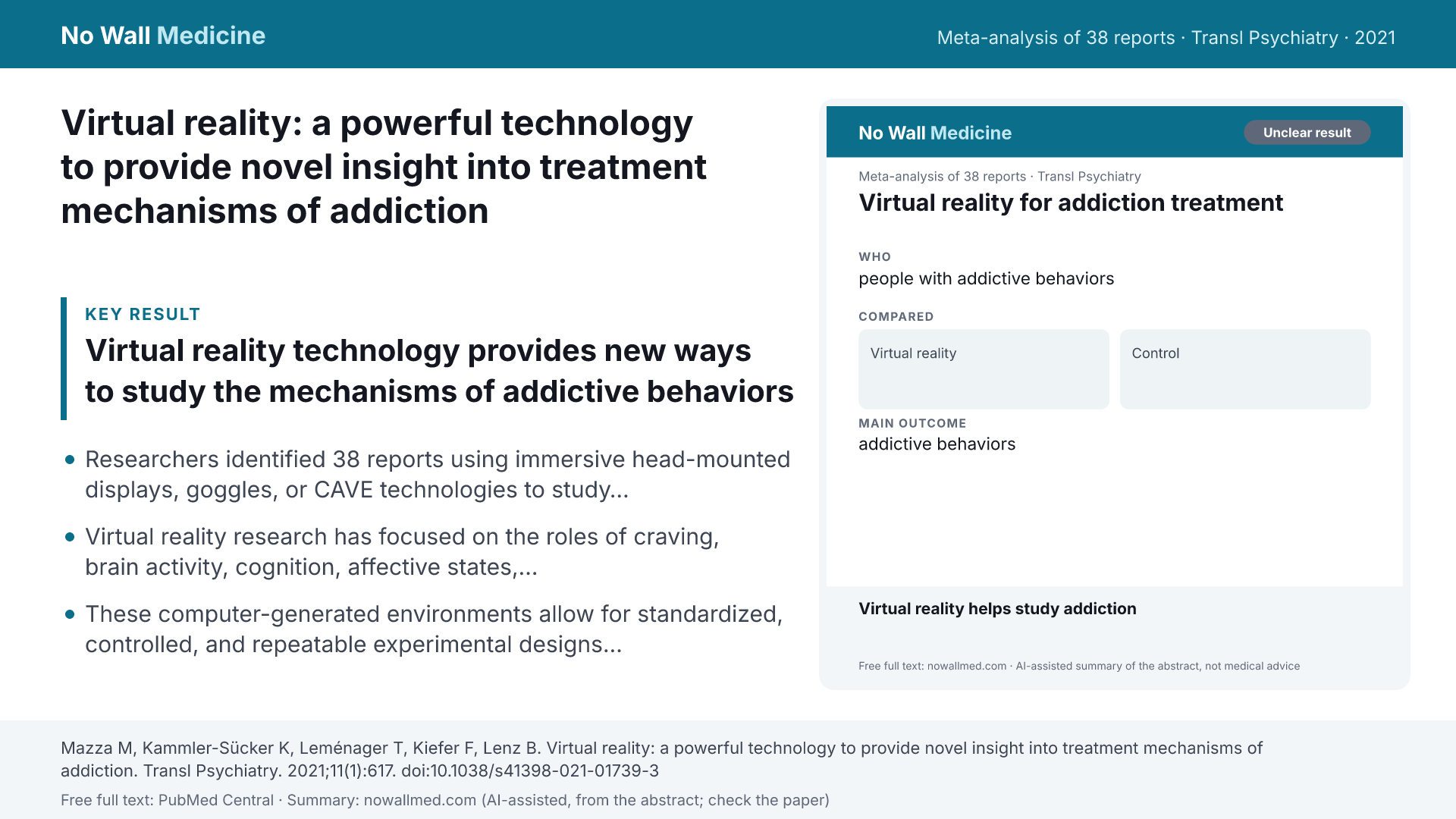
Virtual reality technology provides new ways to study the mechanisms of addictive behaviors
Virtual reality: a powerful technology to provide novel insight into treatment mechanisms of addiction
Meta-analysis of 38 reportsUnclear result
Virtual reality for addiction treatment
Who
people with addictive behaviors
Compared
Virtual reality
Control
Main outcome
addictive behaviors
Bottom line: Virtual reality helps study addiction
Transl Psychiatry · 2021-12-06Download image

Key points
- Researchers identified 38 reports using immersive head-mounted displays, goggles, or CAVE technologies to study addiction treatment mechanisms.
- Virtual reality research has focused on the roles of craving, brain activity, cognition, affective states, and psychophysiology in addiction.
- These computer-generated environments allow for standardized, controlled, and repeatable experimental designs using multi-sensorial cues.
Headline and key points written with AI from the paper’s abstract, with every number checked against it. Read the paper before relying on them.
Was this summary helpful?
Subject terms
Cite this article
Mazza M, Kammler-Sücker K, Leménager T, Kiefer F, Lenz B. Virtual reality: a powerful technology to provide novel insight into treatment mechanisms of addiction. Transl Psychiatry. 2021. doi:10.1038/s41398-021-01739-3
Spotted a mistake? Suggest a correction