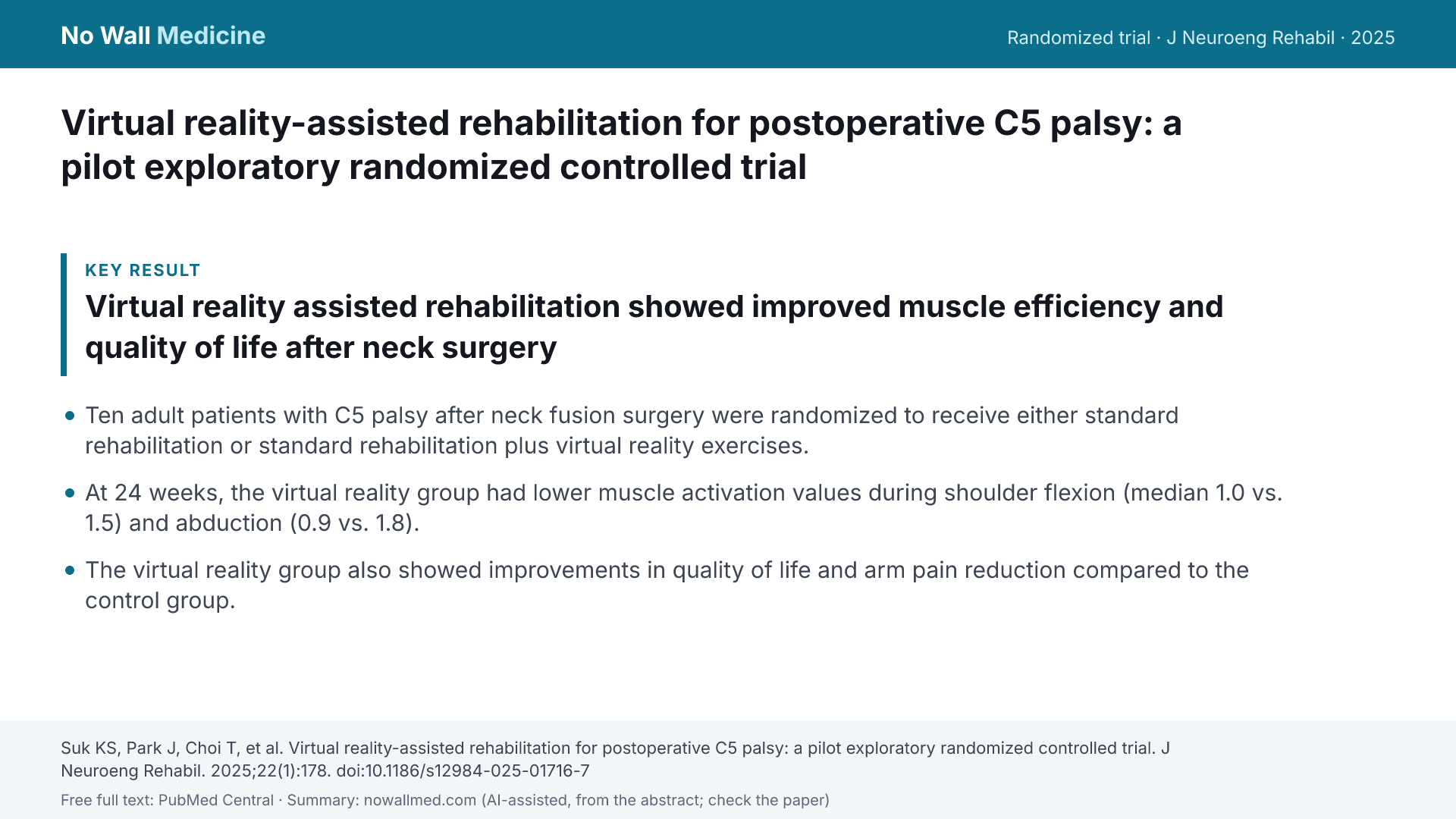
Virtual reality assisted rehabilitation showed improved muscle efficiency and quality of life after neck surgery
Virtual reality-assisted rehabilitation for postoperative C5 palsy: a pilot exploratory randomized controlled trial
Why it matters: The application of virtual reality for neurorehabilitation in patients experiencing C5 palsy after posterior cervical decompression or fusion surgery remains underexplored.
Key points
- Ten adult patients with C5 palsy after neck fusion surgery were randomized to receive either standard rehabilitation or standard rehabilitation plus virtual reality exercises.
- At 24 weeks, the virtual reality group had lower muscle activation values during shoulder flexion (median 1.0 vs. 1.5) and abduction (0.9 vs. 1.8).
- The virtual reality group also showed improvements in quality of life and arm pain reduction compared to the control group.
Headline and key points written with AI from the paper’s abstract, with every number checked against it. Read the paper before relying on them.
Was this summary helpful?
Subject terms
Cite this article
Suk KS, Park J, Choi T, et al. Virtual reality-assisted rehabilitation for postoperative C5 palsy: a pilot exploratory randomized controlled trial. J Neuroeng Rehabil. 2025. doi:10.1186/s12984-025-01716-7
Spotted a mistake? Suggest a correction