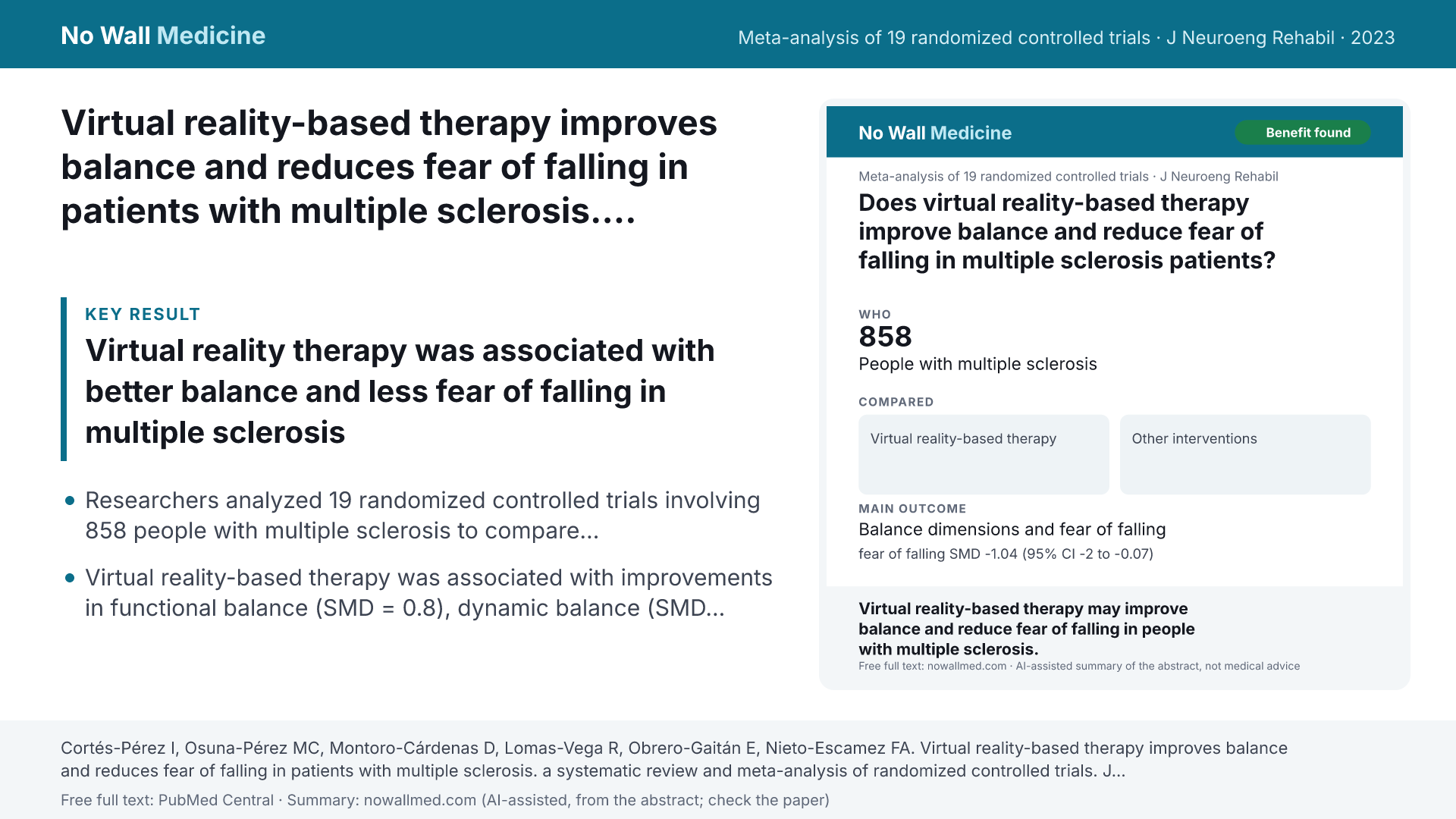
Virtual reality therapy was associated with better balance and less fear of falling in multiple sclerosis
Virtual reality-based therapy improves balance and reduces fear of falling in patients with multiple sclerosis. a systematic review and meta-analysis of randomized controlled trials
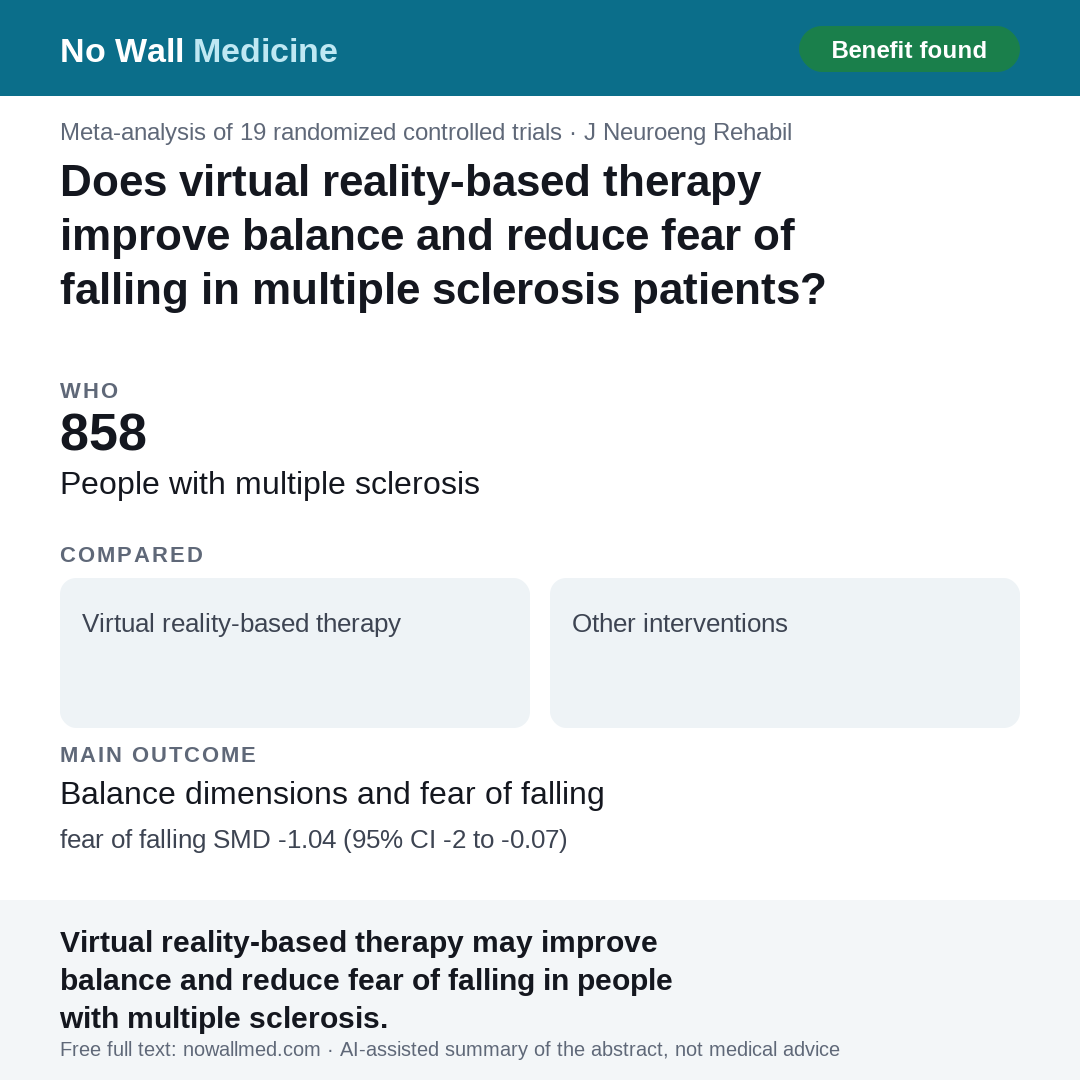
Meta-analysis of 19 randomized controlled trialsBenefit found
Does virtual reality-based therapy improve balance and reduce fear of falling in multiple sclerosis patients?
Who
858
People with multiple sclerosis
Compared
Virtual reality-based therapy
Other interventions
Main outcome
Balance dimensions and fear of falling
Result: fear of falling SMD -1.04 (95% CI -2 to -0.07)
Bottom line: Virtual reality-based therapy may improve balance and reduce fear of falling in people with multiple sclerosis.
J Neuroeng Rehabil · 2023-04-11Download image
Clinical question: Does virtual reality-based therapy improve balance and reduce fear of falling in multiple sclerosis patients?
Why it matters: It was unknown how virtual reality-based therapy affects balance dimensions and fear of falling in people with multiple sclerosis.
Key points
- Researchers analyzed 19 randomized controlled trials involving 858 people with multiple sclerosis to compare virtual reality-based therapy against other interventions.
- Virtual reality-based therapy was associated with improvements in functional balance (SMD = 0.8), dynamic balance (SMD = -0.3), postural control (SMD = -0.54), and confidence of balance (SMD = 0.43).
- The therapy was associated with a reduction in fear of falling (SMD = -1.04), but no significant effect was found for gait speed (SMD = -0.11).
Headline and key points written with AI from the paper’s abstract, with every number checked against it. Read the paper before relying on them.
Was this summary helpful?
Subject terms
Cite this article
Cortés-Pérez I, Osuna-Pérez MC, Montoro-Cárdenas D, Lomas-Vega R, Obrero-Gaitán E, Nieto-Escamez FA. Virtual reality-based therapy improves balance and reduces fear of falling in patients with multiple sclerosis. a systematic review and meta-analysis of randomized controlled trials. J Neuroeng Rehabil. 2023. doi:10.1186/s12984-023-01174-z
Spotted a mistake? Suggest a correction