Walking and balance training improved standing balance control in people with spinal cord injury
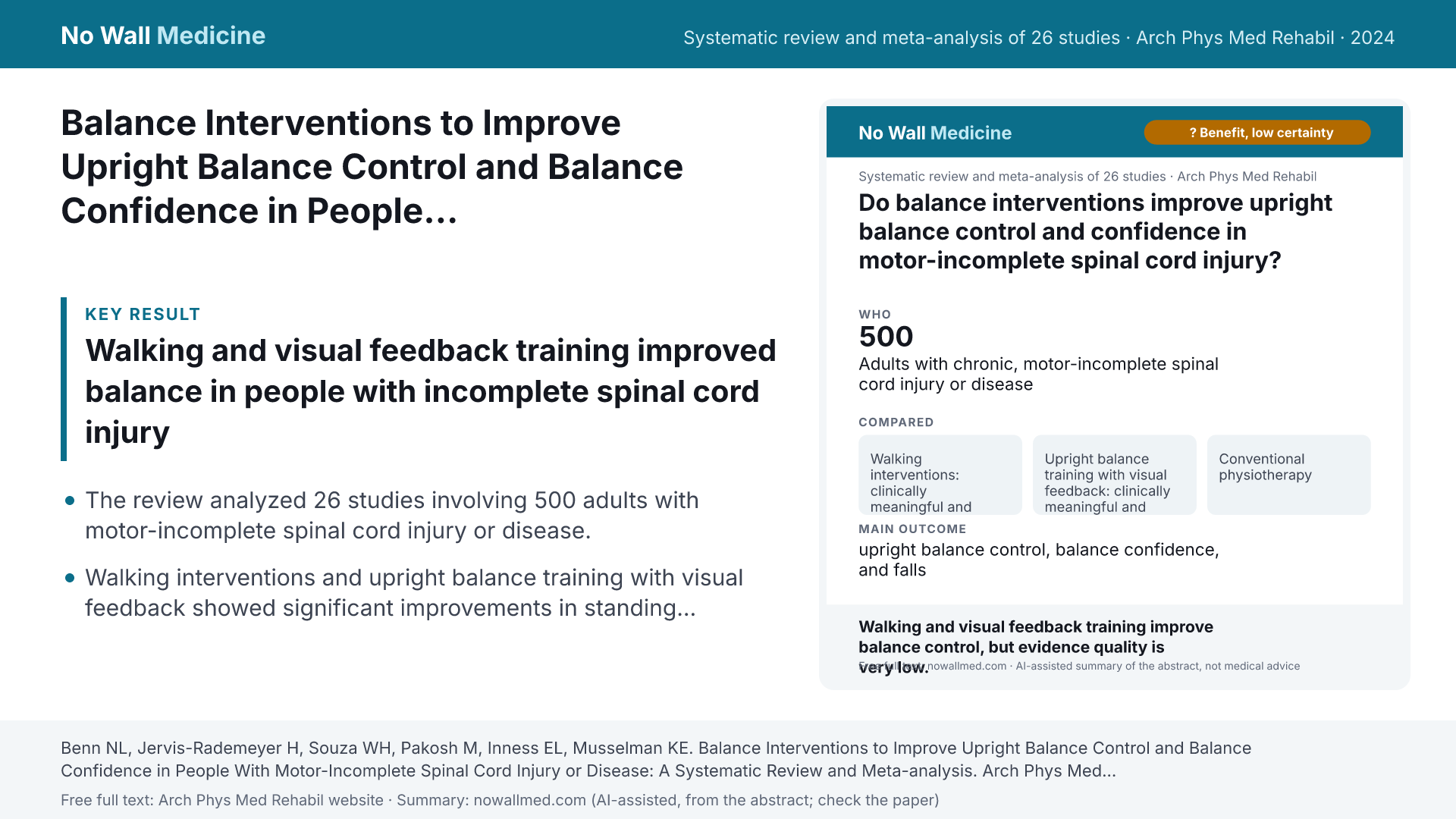
Balance Interventions to Improve Upright Balance Control and Balance Confidence in People With Motor-Incomplete Spinal Cord Injury or Disease: A Systematic Review and Meta-analysis
Systematic review and meta-analysis of 26 studiesBenefit found
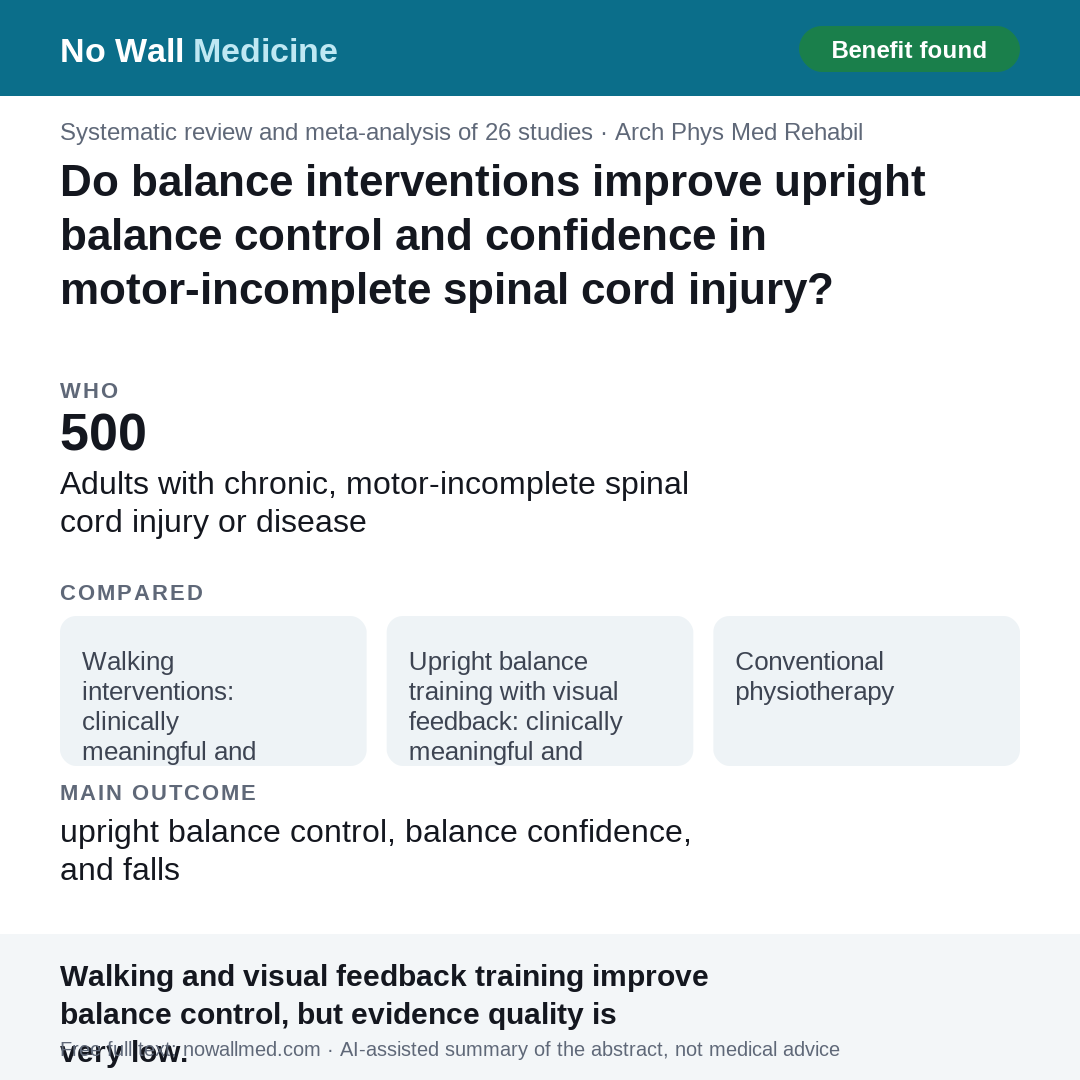
Do balance interventions improve upright balance control and confidence in motor-incomplete spinal cord injury?
Who
500
Adults with chronic, motor-incomplete spinal cord injury or disease
Compared
Walking interventions: clinically meaningful and significant pooled effects
Upright balance training with visual feedback: clinically meaningful and significant pooled effects
Conventional physiotherapy
Main outcome
upright balance control, balance confidence, and falls
Bottom line: Walking and visual feedback training improve balance control, but evidence quality is very low.
Limitation: the quality of the evidence was very low
Arch Phys Med Rehabil · 2024-08-05Download image
Clinical question: Do balance interventions improve upright balance control and confidence in motor-incomplete spinal cord injury?
Why it matters: Evidence was needed on effective interventions for upright balance control in people with spinal cord injury
Key points
- 500 people with spinal cord injury, aged 18-74, were studied in 26 trials.
- Walking and upright balance training improved standing balance control and balance confidence.
- Minor adverse events, such as muscle soreness, were reported in 8 studies.
Headline and key points written with AI from the paper’s abstract, with every number checked against it. Read the paper before relying on them.
Was this summary helpful?
Subject terms
Cite this article
Benn NL, Jervis-Rademeyer H, Souza WH, Pakosh M, Inness EL, Musselman KE. Balance Interventions to Improve Upright Balance Control and Balance Confidence in People With Motor-Incomplete Spinal Cord Injury or Disease: A Systematic Review and Meta-analysis. Arch Phys Med Rehabil. 2024. doi:10.1016/j.apmr.2024.07.013
Spotted a mistake? Suggest a correction
Top studies every Monday
The week’s key trials and guidelines in your specialties, plus any topics you follow. By email, free.
Get the weekly digest