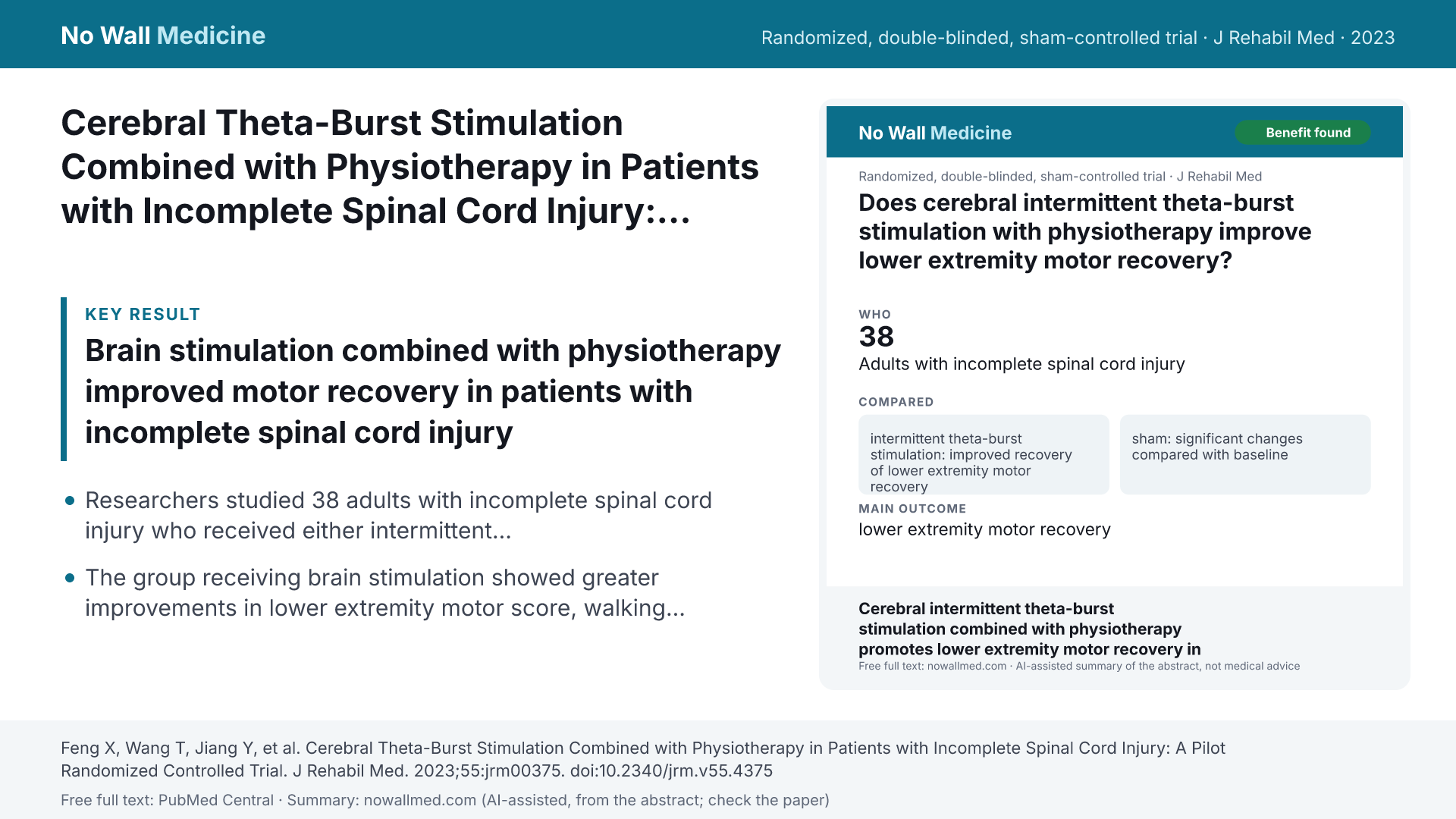
Brain stimulation combined with physiotherapy improved motor recovery in patients with incomplete spinal cord injury
Cerebral Theta-Burst Stimulation Combined with Physiotherapy in Patients with Incomplete Spinal Cord Injury: A Pilot Randomized Controlled Trial
Randomized, double-blinded, sham-controlled trialBenefit found
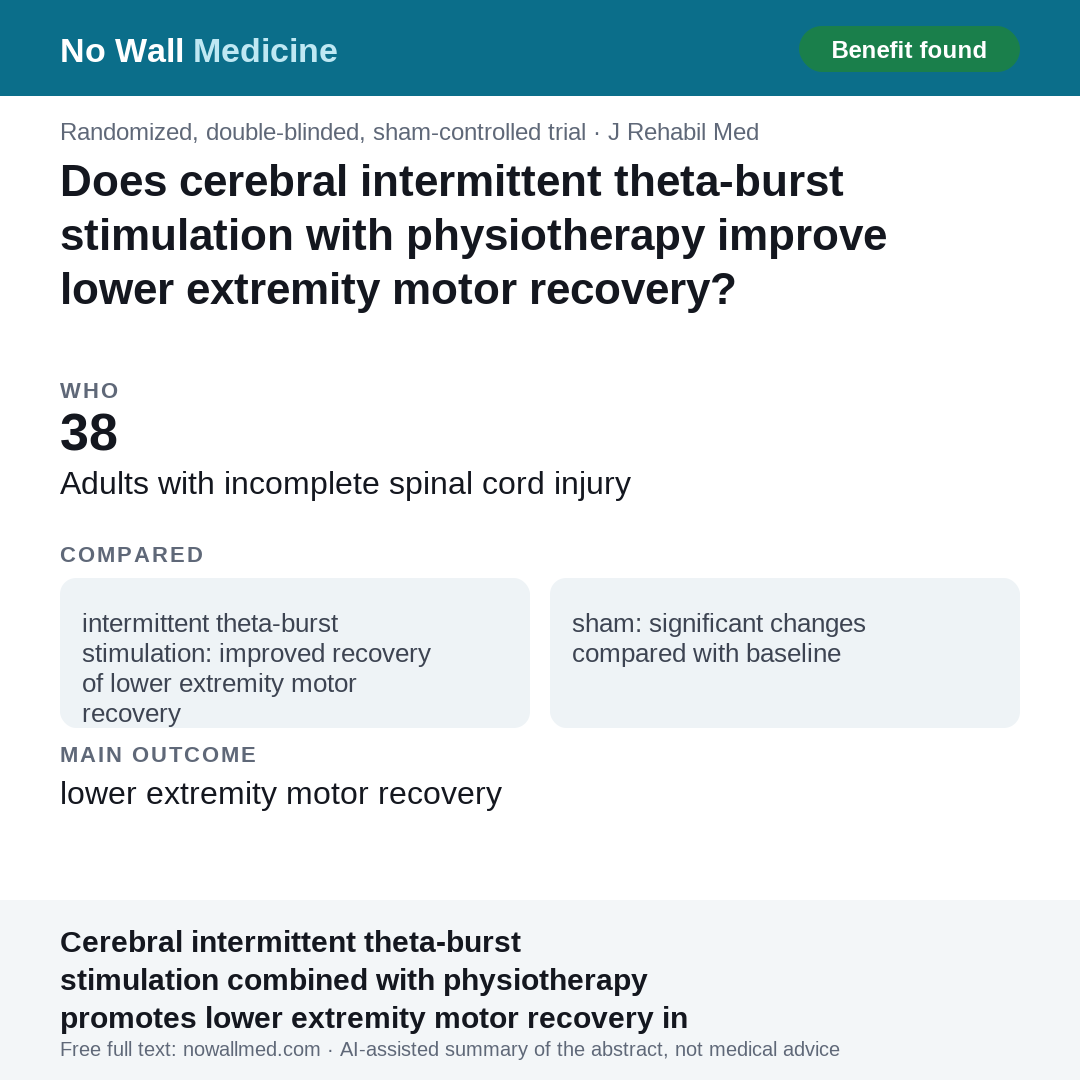
Does cerebral intermittent theta-burst stimulation with physiotherapy improve lower extremity motor recovery?
Who
38
Adults with incomplete spinal cord injury
Compared
intermittent theta-burst stimulation: improved recovery of lower extremity motor recovery
sham: significant changes compared with baseline
Main outcome
lower extremity motor recovery
Bottom line: Cerebral intermittent theta-burst stimulation combined with physiotherapy promotes lower extremity motor recovery in incomplete spinal cord injury patients.
Limitation: small sample size and lacked comparison of multiple stimulation modes
J Rehabil Med · 2023-02-13Download image
Clinical question: Does cerebral intermittent theta-burst stimulation with physiotherapy improve lower extremity motor recovery?
Why it matters: It was unknown if combining intermittent theta-burst stimulation with physiotherapy would enhance lower extremity motor recovery in individuals with incomplete spinal cord injury.
Key points
- Researchers studied 38 adults with incomplete spinal cord injury who received either intermittent theta-burst stimulation, a type of brain stimulation, or a sham treatment alongside physiotherapy.
- The group receiving brain stimulation showed greater improvements in lower extremity motor score, walking speed, stride length, muscle activity, and walking and daily living scales than the sham group.
- Both groups showed significant changes from baseline in walking speed, stride length, muscle activity, and motor scores after the 9 week intervention.
Limitation the authors note: The study included a small sample size and did not compare the effects of different stimulation modes.
Headline and key points written with AI from the paper’s abstract, with every number checked against it. Read the paper before relying on them.
Was this summary helpful?
Subject terms
Cite this article
Feng X, Wang T, Jiang Y, Liu Y, Yang H, Duan Z. Cerebral Theta-Burst Stimulation Combined with Physiotherapy in Patients with Incomplete Spinal Cord Injury: A Pilot Randomized Controlled Trial. J Rehabil Med. 2023. doi:10.2340/jrm.v55.4375
Spotted a mistake? Suggest a correction